
If you're settling for a 2% conversion rate, you aren't just underperforming; you're actively subsidizing your competitors' expansion. In May 2026, the median law firm website conversion rate has climbed to 6.3%, yet most owners are still left wondering what is a good conversion rate for a law firm website while their $150,000 annual SEO budget evaporates into thin air. You likely feel the daily pressure of rising lead costs and the irritation of "tire-kicker" inquiries that never turn into signed cases. It's a predictable outcome in a landscape where 48% of firms remain essentially unreachable by phone and 27% never respond to online leads at all.
We are here to stop the bleeding. You'll discover why "average" is a death sentence in this aggressive market and how to re-engineer your digital presence into an elite engine that commands conversion rates of 8% to 15%. This article delivers the definitive 2026 benchmarks for every practice area and a battle-tested tactical plan to secure total market dominance without increasing your advertising spend by a single dollar. It's time to stop participating in the market and start owning it.
Key Takeaways
- Learn exactly what is a good conversion rate for a law firm website in 2026 and why the industry standard of 2% is a signal of a failing strategy.
- Identify specific performance benchmarks for your practice area to determine if you are leading the market or losing high-value cases to more aggressive competitors.
- Stop wasting capital on PPC traffic that doesn't convert by identifying and eliminating the hidden "friction points" that drive leads to your rivals.
- Master the elite engineering tactics, including the Authority Stack and aggressive CTA placement, that transform your website into a high-impact lead generation engine.
- Unlock the strategic advantage that allows you to outspend rivals and achieve total dominance in your niche through superior ROI and scalability.
What is a Good Conversion Rate for a Law Firm Website? Breaking the 2% Ceiling
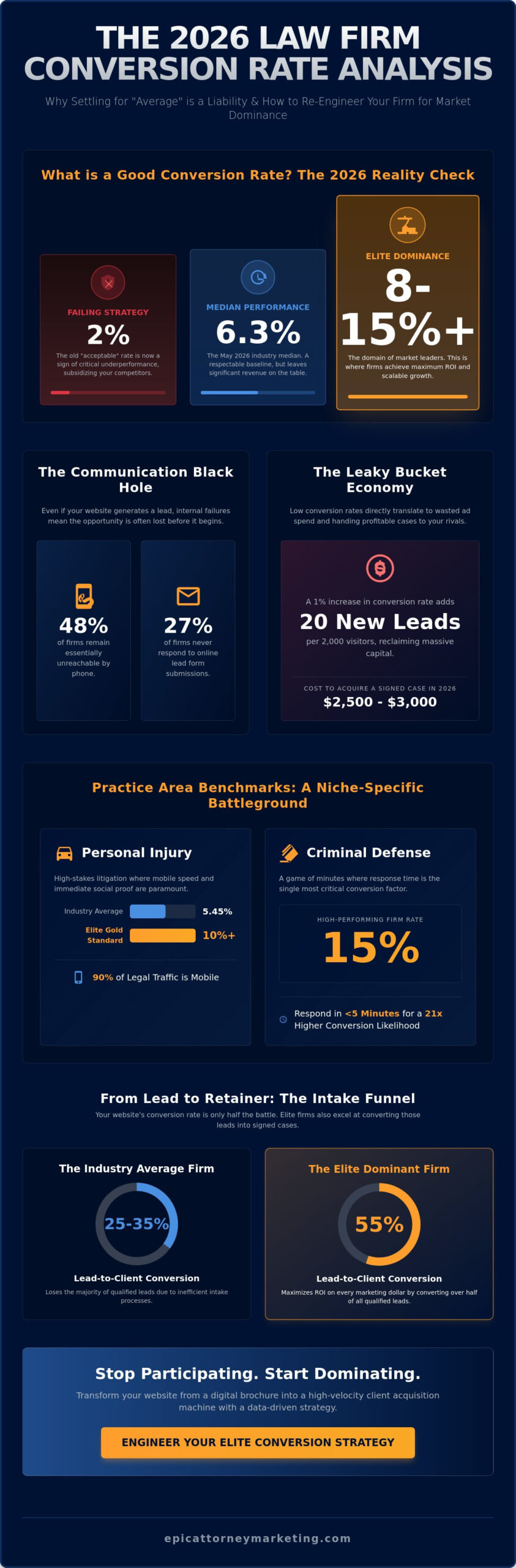
Most legal marketing agencies will tell you that a 2% conversion rate is acceptable. They are lying to cover their own mediocrity. In May 2026, settling for a 2% rate doesn't just mean you're average; it means you're failing. According to data published in April 2026, the median law firm website conversion rate has hit 6.3%. If your site is hovering at 2%, you are losing two-thirds of your potential cases before they even pick up the phone. You are paying for traffic that your competitors are ultimately monetizing.
When asking what is a good conversion rate for a law firm website, you must first define what a conversion actually is. At Epic Attorney Marketing, we don't count vanity metrics. A conversion is a trackable, high-intent action: a completed contact form, a direct phone call, or a live chat initiation. We distinguish this "Marketing Conversion" from your "Client Conversion" rate, which is your intake team's ability to turn those leads into signed retainers. While the industry average for lead-to-client conversion sits between 25% and 35%, elite firms are pushing 55%. Your website is the frontline of this battle. It's the engine that determines the quality and volume of every opportunity your firm receives.
The Math of Legal Conversion
Calculating your performance is clinical. Take your total number of unique leads and divide it by your unique website visitors. If you had 1,000 visitors and 20 leads, you're at 2%. This is the "Average Trap." Most firms focus on micro-conversions like newsletter signups or eBook downloads. These are distractions. In a high-stakes legal environment, the only metric that matters is intake volume. A mere 1% increase in your conversion rate can be transformative. For a firm with 2,000 monthly visitors, moving from 2% to 3% adds 20 leads to the pipeline. Given that the cost to acquire a single signed case in 2026 ranges from $2,500 to $3,000, that 1% shift represents massive reclaimed capital.
Median vs. Elite Performance
To dominate your market, you must stop "hosting a website" and start operating a high-velocity conversion engine. This requires a process known as Conversion rate optimization, which uses data-driven adjustments to force more visitors into your intake system. While the median sits at 6.3%, high-performing firms in 2026 are achieving 8% to 12%, with some highly optimized niche sites exceeding 15%. The Epic conversion benchmark for 2026 is a minimum of 5% for top-tier firms. If you aren't hitting this floor, your digital presence is a liability that is actively bleeding revenue and handing your market share to aggressive competitors who understand the math of dominance.
Practice Area Benchmarks: What Dominant Firms Achieve in 2026
Generic data is the enemy of strategy. To understand what is a good conversion rate for a law firm website, you must first acknowledge that search intent varies wildly across different legal silos. A visitor looking for an emergency bail bondsman has a fundamentally different psychological profile than a business owner researching succession planning. According to the latest conversion rate benchmarks, the median performance across all legal landing pages is 6.3%, but elite firms don't settle for the middle of the pack. They exploit the high-intent nature of their specific niche to drive double-digit returns.
Personal Injury and High-Stakes Litigation
In the personal injury space, the industry average is a stagnant 5.45%. This is unacceptable. Dominant firms in 2026 treat 10% as the absolute gold standard for their landing pages. Because nearly 90% of legal traffic now originates from mobile devices, PI conversion is won or lost on mobile speed and immediate social proof. If your site doesn't lead with battle-tested results and clickable settlement data, you're losing the "emergency" visitor to a competitor who does. Local PI campaigns should out-convert broad mass tort leads because the intent is localized and the trust barrier is lower.
Criminal Defense and Urgent Intake
Criminal defense is a game of minutes. If you don't respond to a lead within 5 minutes, you're 21 times less likely to convert them. High-performing defense firms achieve 15% conversion rates by utilizing aggressive, high-urgency landing page designs that prioritize click-to-call functionality above all else. For these firms, a phone call is the only conversion action that matters. If your intake system isn't operational 24/7, you're essentially handing your most valuable leads to the firm down the street that never sleeps.
Family Law and Estate Planning
Family law and estate planning require an "Education-First" tactical approach. These visitors aren't always in a state of panic; they're in a state of research. While the average family law conversion rate sits at 6.3%, elite practitioners target 3% to 5% while focusing heavily on lead quality. In these high-trust niches, multi-step forms often outperform short, generic contact fields because they qualify the lead and establish authority before the first consultation. If you're ready to stop guessing and start scaling, our lead generation strategies are designed for total niche takeover.
Dominance isn't about being better than everyone; it's about being better than the "average" version of yourself. Whether you're in bankruptcy, where elite rates hit 13%, or immigration at 5.6%, your goal is to out-engineer the friction that stops a visitor from becoming a client. Anything less is just expensive digital window dressing.
The Leaky Bucket Syndrome: Why Most Legal Websites Fail to Convert
Pouring more money into Pay-Per-Click (PPC) or aggressive SEO campaigns to fix a low-converting website is like trying to fill a bucket riddled with holes by turning up the faucet. It's a strategic failure. Many law firm owners fall victim to the "Traffic Fallacy," believing that more eyeballs will eventually solve their revenue stagnation. In reality, you're just subsidizing your competitors by paying for visitors who will ultimately leave your site to hire the firm that actually answers their questions. When you ask what is a good conversion rate for a law firm website, you're really asking how much of your $150,000 annual marketing budget you're willing to set on fire.
Friction is the silent killer of legal ROI. Every millisecond of delay and every unnecessary click acts as a barrier between a high-intent lead and your intake team. You might believe your brand is so prestigious that potential clients will wait for a slow page or a delayed callback. They won't. Data from March 2026 shows that firms responding within 5 minutes are 21 times more likely to convert the lead. If your website is a "leaky bucket," you aren't just losing a lead; you're handing a signed case to the firm down the street that understands the value of speed.
Technical Friction and User Fatigue
In 2026, Core Web Vitals aren't just technical suggestions; they're the gatekeepers of your intake system. Nearly 90% of your legal traffic originates from mobile devices. If your site is "over-designed" with heavy animations or complex navigation that obscures the primary call to action, you're creating user fatigue. High-achieving attorneys often prioritize aesthetic vanity over a frictionless UI. If a potential client has to hunt for a phone number or navigate a clunky menu, they'll bounce. They don't care about your high-resolution office tour; they care about their legal crisis. Dominant firms strip away the fluff to ensure the path from landing to intake is a straight line.
The 'Leaky Bucket' of Unoptimized SEO
Ranking #1 on Google is a hollow victory if your landing page fails to command immediate action. We see firms dominate the SERPs for high-volume keywords yet fail to sign cases because their content lacks psychological triggers. This is the danger of "vanity traffic"—visitors who click but never intend to hire. To see how we pair elite visibility with high-impact conversion, examine our tactical guide on law firm seo. Without a conversion-first mindset, your SEO efforts are just digital dead weight. A high-performing firm doesn't just want to be seen; it wants to be hired. If your current strategy ignores the 27% of firms that never even respond to online leads, you're leaving the door wide open for an aggressive competitor to take your market share.
Engineering an Elite Conversion Machine: 5 Non-Negotiable Elements
Stop treating your website like a digital business card. It's a high-performance tactical asset. If you want to know what is a good conversion rate for a law firm website, look at the elite firms hitting 15% or higher. They don't achieve these numbers by accident. They engineer them through five non-negotiable elements that force visitors into the intake pipeline. Aggressive CTA placement is the first step. Don't hide your contact information on a single "Contact Us" page. It must be omnipresent, strategically placed to capture intent the moment it peaks.
Pair these CTAs with an "Authority Stack." This is a calculated display of reviews, awards, and case results that act as psychological triggers. While some competitors claim that optimized CTAs increase conversion by 121%, they fail to explain that the phrasing must be high-impact and results-oriented to actually move the needle. You aren't just asking for a click; you're offering a solution to a crisis. Your mobile site is your actual website. With 90% of legal traffic originating from mobile devices in 2026, a desktop-first mentality is a recipe for failure. Speed is your greatest weapon. A sub-1-second load time isn't a luxury. It's the technical blueprint for market dominance.
Finally, connect your website directly to your CRM. Instant response is the only response that matters. If your intake isn't integrated, you're losing leads in the manual gap between form submission and callback. If you're ready to stop losing cases to faster rivals, request an elite marketing audit to identify your firm's technical vulnerabilities.
Zero-Friction Lead Capture
In the 2026 legal landscape, live chat is the gold standard for immediate engagement. While AI chat adoption has surged to 79%, it often lacks the human nuance required for high-stakes litigation inquiries. Reduce your form fields to the "Rule of 3"—Name, Phone, and Email. Every additional field you add is a friction point that lowers your ROI. Use sticky headers to keep your call button visible at all times. This ensures the solution to the client's problem is always exactly one tap away, regardless of how far they scroll.
Psychological Trust Signals
Social proof follows a strict hierarchy. Video testimonials now outperform text-based reviews by a massive margin because they humanize your success and build immediate rapport. Your law firm website design must be built as a high-performance engine, not a creative exercise. Every element should serve the conversion. Battle-Tested branding creates an immediate strategic advantage by positioning your firm as the only logical choice before a prospect even speaks to your intake team.
Scaling Your ROI: Positioning Your Firm for Total Market Dominance
Dominance in the 2026 legal market is a matter of mathematical leverage. Most law firm owners view marketing as an expense to be managed rather than a tactical operation to be won. When you finally stop asking what is a good conversion rate for a law firm website and start demanding an elite 10% to 15% return, you unlock the ability to outspend every competitor in your niche. High conversion rates are the only metrics that allow you to bid aggressively on high-intent PPC keywords while maintaining a superior ROI. If your website converts at 12% and your rival's site stagnates at the 6.3% industry median, you can effectively pay twice as much for traffic and still secure a lower cost-per-case.
The transition from generating "leads" to securing "cases" requires a full-funnel approach that most vendors ignore. At Epic Attorney Marketing, we don't just optimize for clicks; we engineer for market takeover. While high-performing firms see a return on marketing investment of 7-10:1, average firms are stuck at a 3:1 ratio, barely covering their overhead. Winning in 2026 belongs to the firms that out-convert their rivals. It's no longer enough to just out-rank them on a search results page. You must command the visitor's attention and force a decision the moment they land on your page.
The Aggressive Blueprint for Growth
Scaling your firm requires a clinical focus on lowering your Client Acquisition Cost (CAC). Elite conversion rates act as a force multiplier for every dollar you spend on SEO and paid search. If you're waiting for the market to stabilize before you optimize your intake engine, you're effectively handing your most valuable cases to your biggest rival. For a comprehensive look at how we build these high-velocity systems, examine our digital marketing for attorneys blueprint. This is the strategic foundation for firms that refuse to settle for mediocrity.
The Epic Attorney Marketing Guarantee
Our methodology is data-driven, results-oriented, and unapologetically bold. We don't "manage" your marketing. We achieve scalability and dominance through battle-tested tactics that have been refined in the highest-stakes legal markets. We understand that your goal isn't just to participate in the market; it's to own it. If you're tired of hearing about "brand awareness" while your intake numbers flatline, it's time for a disruptor. Stop settling for average and start dominating your market today.
Secure Your Strategic Advantage in 2026
The data is undeniable. Settling for the 6.3% industry median means you're leaving over half of your potential market share on the table for more aggressive rivals. You've seen how elite engineering and friction-free intake systems transform a website from a passive liability into a high-velocity conversion engine. By mastering your mobile performance and psychological trust signals, you gain the mathematical leverage to outspend and out-scale every competitor in your niche. Understanding what is a good conversion rate for a law firm website is only the first step; the second is executing a battle-tested plan that demands results.
At Epic Attorney Marketing, we've spent over a decade perfecting the methodology of turning average websites into elite marketing engines. Our approach isn't based on creative guesswork; it's built on results-oriented strategies designed for national market dominance. Don't let your firm be part of the 27% that fails to respond to leads or the 48% that remains unreachable by phone. Ready to turn your website into a high-performance lead engine? Let’s talk dominance. Success in 2026 belongs to the firms that refuse to be average and choose to be elite.
Frequently Asked Questions
What is a good conversion rate for a personal injury law firm?
A good conversion rate for a personal injury firm is 10% or higher for dedicated landing pages. While the broad industry median for PI is 5.45% as of April 2026, elite firms achieve double-digit returns by focusing on high-intent search terms. If you aren't hitting the 10% mark, you're likely losing high-value motor vehicle accident cases to more aggressive competitors with faster mobile sites.
How do I find the current conversion rate of my law firm's website?
You calculate your conversion rate by dividing total trackable leads by unique website visitors over a specific period. Use Google Analytics 4 (GA4) to track form submissions and integrate call-tracking software to capture every phone inquiry. Without precise data from these sources, you're just guessing at your ROI. True dominance requires knowing exactly which pages turn visitors into signed cases.
Does a higher conversion rate always mean more money for my firm?
Not necessarily; lead quality is the decisive factor in your actual revenue growth. A high conversion rate consisting of "tire-kickers" only wastes your intake team's time and resources. You need to focus on what is a good conversion rate for a law firm website that specifically targets qualified, high-value cases rather than just chasing high volume for the sake of vanity metrics.
Can SEO improve my website's conversion rate, or is it just for traffic?
SEO is a primary driver of conversion when it targets high-intent keywords that signal a readiness to hire. Ranking for general legal definitions brings traffic, but ranking for "trial lawyer in [City]" brings clients. Elite SEO strategies align search intent with aggressive calls to action. This ensures your visibility translates directly into intake calls and signed retainers rather than just empty clicks.
What are the biggest 'conversion killers' on a lawyer's website?
The biggest conversion killers are generic stock photos, hidden phone numbers, and a total lack of immediate social proof. Potential clients decide to hire or bounce within seconds of landing on your page. If they don't see a "Battle-Tested" result or a clear way to contact you immediately, they'll leave for a firm that projects more authority and urgency.
Is it better to have a long contact form or a short one for legal leads?
Short forms typically generate a higher volume of leads, but multi-step forms often produce higher-quality clients through better qualification. While a simple 3-field form is best for urgent matters like criminal defense, using conditional logic can filter out unqualified inquiries for complex litigation. This balance ensures your intake team spends their time on cases that actually move the needle for your firm.
How often should I audit my law firm website's conversion performance?
You must audit your conversion performance monthly to stay ahead of aggressive market shifts and competitor tactics. Use heatmaps and session recordings to identify exactly where visitors are dropping off your site. In a high-stakes landscape, waiting a year to review your data is effectively a surrender of your market share. Monthly audits allow for the rapid, data-driven adjustments that define elite firms.
Does my website's load speed really affect how many clients I sign?
Yes, every millisecond of delay directly correlates to a measurable drop in signed cases and total ROI. Sites that load in under 1 second see significantly higher engagement than those taking 3 seconds or more. In the legal world, a slow site suggests a slow, unorganized firm. This causes 40% of users to bounce immediately to a competitor who respects their time.