
What if your most scathing public criticism was actually the most effective lead generation tool in your arsenal? For elite firms, a negative review is not a liability; it is a strategic exhibit to showcase superior temperament and intellectual authority. You are likely frustrated by unfair public attacks and paralyzed by the fear that a rebuttal might trigger an ABA Rule 1.6 violation or a $53,088 FTC penalty. It's a valid concern. Recent data shows 53 percent of consumers now refuse to even consider a firm with a rating below four stars. Mastering how to respond to negative online reviews for lawyers is no longer about damage control. It is about market dominance.
We understand that you want to crush the competition without compromising your ethical standing. This guide will transform damaging feedback into a demonstration of professional power using our tactical response framework. We will break down the mechanics of neutralizing sentiment, staying ethically compliant under 2026 regulations, and protecting your firm's conversion engine from high-value lead loss. Prepare to turn every digital attack into a public victory for your brand.
Key Takeaways
- Protect your firm’s revenue by identifying why prospective clients prioritize a single negative review over your entire history of professional accolades.
- Navigate the high-stakes intersection of ABA Rule 1.6 and public rebuttals to ensure your response never compromises client confidentiality or invites regulatory penalties.
- Execute a precision-based strategy for how to respond to negative online reviews for lawyers using a tactical framework that includes reviewer authentication and emotional neutralization.
- Leverage professional reputation management to flag and suppress defamatory content that violates platform standards, including harassment and clear conflicts of interest.
- Transform your online presence into a growth engine by automating high-tier review acquisition through a proprietary "Velvet Rope" strategy for elite clients.
The Lethal Impact of Unmanaged Reviews on Law Firm Growth
In 2026, the legal marketplace is ruthless. A single 1-star review doesn't just hurt your professional pride; it derails a $50,000 retainer before your intake team even picks up the phone. High-value clients are no longer impressed by your self-published accolades or the mahogany in your lobby. They are hunting for your failures. They want to see how you handle conflict. If you don't know how to respond to negative online reviews for lawyers, you are effectively subsidizing your competitor's growth. Every ignored complaint is a "Conversion Leak" that sends qualified leads straight to the firm across the street.
This isn't just administrative busywork. It is a core pillar of online reputation management, a high-stakes strategic operation that determines your firm's market ceiling. When a prospect sees an unaddressed 1-star review, they don't just stop looking at your firm. They actively seek out your closest rival to validate that they are making a safer choice. You are essentially paying for their market research. Your marketing dollars bring the lead to the door, but your reputation pushes them into the arms of the firm next door. Dominance requires a proactive stance. To see these principles in action, watch this brief breakdown on the stakes of digital feedback:
The Psychology of the Legal Prospect
Prospects look for your response temperament during their due diligence. They want to know if you are the advocate who stays cool under pressure or the one who crumbles. The "Social Proof" trap is real. In the absence of a rebuttal, the public assumes the reviewer is right. Silence is an admission of guilt. This silence also kills your visibility. Google's local map pack rewards firms with high engagement and positive sentiment. If your profile is a graveyard of unaddressed vitriol, you'll vanish from the search results before the client even scrolls. 2025 data confirms that 53 percent of consumers will not consider a firm with a rating below 4 stars. This is a hard ceiling that stops growth in its tracks.
Quantifying the Damage of a 1-Star Rating
The math is clinical. A drop in your star rating correlates directly with a collapse in click-through rates for high-intent keywords. If you are running law firm marketing campaigns, negative feedback acts as a tax on your budget. It increases your cost-per-lead in PPC because prospects click, see the 1-star rating, and bounce. You are paying for clicks that will never convert. Your reputation is the foundation of every lead generation effort you launch. Without a tactical plan for how to respond to negative online reviews for lawyers, your entire marketing spend is at risk. You can either control the narrative or let the narrative control your bottom line.
Navigating the Ethical Minefield: ABA Rule 1.6 and Confidentiality
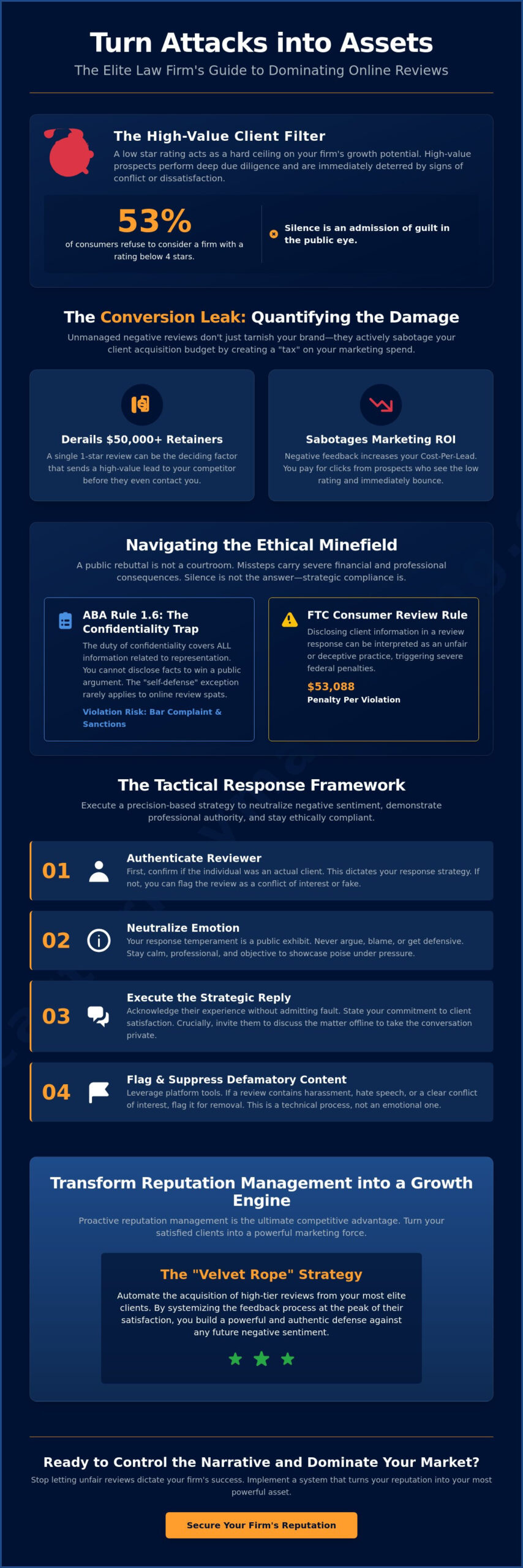
Ethical compliance isn't a cage; it's a strategic boundary. Most lawyers see ABA Rule 1.6 as a reason to stay silent while their brand is dismantled. That's a mistake that costs you market share and high-value retainers. While attorney-client privilege protects specific communications, the duty of confidentiality is broader. It covers all information relating to the representation. You cannot litigate the facts of a case in a Google comment section. The ABA’s self-defense exception is a trap. It generally only applies to formal legal proceedings, not public ego battles. If you reveal confidential facts to win a digital argument, you aren't just risking a bar complaint. You're inviting an FTC investigation under the Consumer Review Rule, which carries penalties up to $53,088 per violation.
The urge to correct the record is powerful. Resist it. In 2026, the most successful firms use confidentiality as a tool for professional dominance. They understand that a public spat makes them look unhinged, not innocent. Prospects are looking for a steady hand. They want to see that you can handle a hostile adversary without losing your composure or your license. Mastering how to respond to negative online reviews for lawyers requires you to trade immediate emotional satisfaction for long-term brand authority. You aren't just answering one critic; you're auditioning for every future client who reads that thread.
The 'No-Comment' Strategy That Actually Works
You need a response that projects authority without validating a relationship. An informational reply is your strongest shield. It demonstrates professionalism to prospects while keeping the Bar at bay. State your firm’s commitment to client satisfaction and invite the reviewer to discuss the matter privately. Be wary of generic GenAI tools. ABA Formal Opinion 512 warns that robotic replies can lead to inadvertent data leaks if the AI "learns" from your proprietary case data. If you want to scale safely, professional reputation management ensures your responses remain both tactical and compliant.
When the Reviewer is Not a Client
Not every critic is a client. Disgruntled employees, opposing counsel, and digital trolls often weaponize reviews to damage your brand. This is where you have the most tactical freedom. If a reviewer was never on your docket, say so. A polite clarification that your records show no such case exists is devastating to a troll's credibility. It signals to every future prospect that your firm is meticulous. It proves you have total command over your intake and case management. This is how to respond to negative online reviews for lawyers when the facts are clearly on your side. You aren't being defensive; you're being accurate.
The Tactical Response Framework: Steps to Neutralize and Dominate
Tactical dominance in the digital space requires a system, not a reaction. You don't just "reply" to a review; you execute a strategic rebuttal. When you are learning how to respond to negative online reviews for lawyers, you must realize the critic is merely a prop. Your real audience is the silent majority of prospects watching to see if you blink. If you follow a disciplined framework, you can transform a 1-star attack into a high-impact demonstration of your firm's intellectual authority.
- Step 1: The 24-Hour Cooling Period. Adrenaline is a poor strategist. Never hit "reply" while your pulse is elevated. A delayed, calculated response always beats an impulsive defense.
- Step 2: Authenticate the Reviewer. Cross-reference your CRM immediately. Verify if this individual ever signed a fee agreement or even had a consultation. If they aren't in your system, your tactical options expand significantly.
- Step 3: The Professional Pivot. Acknowledge the reviewer's frustration without admitting to their version of the facts. Move the conversation to a private channel as quickly as possible.
- Step 4: The Brand Reinforcement. Subtly inject your firm’s core values into the reply. Remind the public that your practice is built on a foundation of high-level results and rigorous standards.
- Step 5: The Post-Response Follow-up. Monitor the thread. If the reviewer escalates with further vitriol, it often works in your favor by making them look unstable to future prospects.
The Anatomy of a High-Authority Response
Stop apologizing for things you didn't do. An apology is a concession of failure. Instead, open with your firm’s standard of excellence. Never ask for a review to be deleted in a public reply; it looks desperate and weak. Use "Power Terms" that align with your lawyer marketing objectives. Terms like "diligent representation," "rigorous standards," and "uncompromising advocacy" signal to prospects that you are a serious operator. You aren't just defending your reputation; you're reinforcing your market position.
Template: The 'Disgruntled Client' Rebuttal
This modular template protects privilege while demonstrating empathy. It’s written for the next client, not the current critic. "At [Firm Name], we maintain a standard of uncompromising advocacy for every client. While ethical rules prevent us from discussing specific case details in a public forum, we take all professional feedback seriously. We invite you to contact our Senior Partner directly to schedule a private Resolution Call. We are committed to ensuring our client experience matches the elite results we deliver daily." This response is clinical, professional, and leaves the reviewer with nowhere to go but a private phone call they likely won't make.
Beyond the Reply: Removal, Flagging, and Suppression
Strategic rebuttals are only half the battle. If a review is fraudulent, defamatory, or violates platform terms, your goal is total erasure. Knowing how to respond to negative online reviews for lawyers includes knowing when to skip the reply and go straight for the jugular: permanent removal. Google Business Profile policies are strict. If a post contains harassment, hate speech, or represents a "Conflict of Interest," such as a review from a competitor or a disgruntled former employee, it is eligible for deletion. Most attorneys fail at flagging because they argue the facts of the case. Google doesn't care about the facts of your case. They care about their Terms of Service.
A "Third-Party" approach is your most effective weapon here. When a professional agency flags a review, the success rate climbs. We don't appeal to emotion. We cite specific policy violations with clinical precision. This removes the emotional "he-said-she-said" dynamic and forces the platform to act on a technicality. If the review stays, we pivot to suppression. We don't let one disgruntled voice define your brand. We use high-authority content for law firm website development to bury negative press under a mountain of positive assets. If you want to stop playing defense and start dominating your digital footprint, secure your firm’s reputation today.
Flagging for Success: The Policy-Based Argument
Success in removal requires a policy-based argument. Identify "Spam" patterns that suggest a competitor-led attack. Look for generic language or accounts with no other history. When Google refuses to remove a clearly defamatory post, don't keep hitting the "flag" button. You need a documented escalation process. Use your CRM data to prove the reviewer was never a client. This technical proof is the only language platform moderators respect. It transforms a subjective complaint into an objective policy violation. Mastering how to respond to negative online reviews for lawyers means being more prepared than the platform's automated filters.
The Suppression Strategy: Dominating the SERP
If removal fails, suppression is the only logical move. We use aggressive digital marketing for attorneys to flood the Search Engine Results Page (SERP) with positive, high-authority assets. This means more than just blog posts. Think video testimonials that humanize your wins and press releases that highlight high-value settlements. The objective is simple. Push the negative review off the first page. If a prospect has to scroll to page three to find a complaint, that complaint effectively doesn't exist. Multi-platform dominance makes a single negative voice irrelevant to your bottom line. You are building a digital fortress that no 1-star review can breach.
Scaling Reputation Management into a Growth Engine
Damage control is a baseline requirement. Market dominance is a choice. While most firms remain trapped in a cycle of reactive anxiety, elite practices treat their digital reputation as a high-yield asset. You've already mastered how to respond to negative online reviews for lawyers; now you must automate the acquisition of positive ones. This is the "Velvet Rope" strategy. It's about systematically curating your public image by soliciting feedback only from your most successful high-value clients. You are no longer just managing a profile. You are building a lead generation machine.
A superior Google rating is a primary pillar of your law firm SEO strategy. Google’s algorithms prioritize firms that demonstrate consistent, high-quality engagement. If your firm isn't integrating reputation data into its overall performance metrics, you're flying blind. You need to track review velocity and sentiment as rigorously as you track your billable hours. This is how you outpace the competition. You don't wait for the market to judge you. You dictate the terms of your own authority.
The Proactive Review Loop
Timing is everything in reputation growth. You must ask for reviews at the "Peak of Value." This is the exact moment of a successful verdict, a signed settlement, or a life-changing resolution. Use automated SMS and QR codes to remove every ounce of friction from the process. If a client has to search for your profile, they won't do it. Your intake team should also be trained to mention your high rating during the first call. It sets a standard of excellence before the representation even begins. This internal pride translates into external market authority.
Winning the Long Game
Authority is found in volume and consistency. A 4.8-star rating backed by 200 reviews is far more authoritative than a 5.0-star rating with only five reviews. Prospects look for the "wisdom of the crowd." Once you've scaled your reviews, turn those testimonials into high-performing social media ad creative. Let your satisfied clients do the heavy lifting of your brand development. If you're ready to stop worrying about how to respond to negative online reviews for lawyers and start dominating your local market, it's time for a professional intervention. Secure your firm's future with a strategic reputation engine that never sleeps.
Command Your Digital Narrative
Your firm’s reputation is either a high-yield asset or a silent revenue killer. We have established that mastering how to respond to negative online reviews for lawyers is a high-stakes strategic operation that dictates your firm’s market ceiling. It requires a clinical balance of emotional intelligence and strict adherence to professional standards. By shifting from reactive damage control to a proactive acquisition system, you ensure that a single 1-star review can no longer derail your conversion engine.
You don't have to navigate this ethical minefield alone. With over a decade of legal marketing dominance, Epic Web Results provides specialized expertise in high-stakes reputation management and a proven track record of suppressing negative search results. We transform digital liabilities into undeniable proof of professional power. Stop losing leads to negative press; get an aggressive reputation strategy from Epic Web Results today. Your path to total market superiority starts with a fortress-like reputation. It is time to secure your firm's future.
Frequently Asked Questions
Can a lawyer sue a client for a negative online review?
You can, but it is rarely the optimal move for your brand. Lawsuits often trigger the Streisand Effect, drawing more attention to the criticism than the original post. Many states have anti-SLAPP statutes that could result in you paying the reviewer’s legal fees. Focus on strategic rebuttal and suppression instead of litigation. You want to look like a victor, not a victim in the public eye.
Does responding to a negative review violate attorney-client privilege?
It does if you reveal any information related to the representation without informed consent. ABA Rule 1.6 is broader than privilege; it protects all information regarding the case. Even confirming someone was a client can be a violation in certain jurisdictions. Your goal is to draft a response that acknowledges the feedback while staying strictly informational. This is why learning how to respond to negative online reviews for lawyers is a core survival skill.
How do I get a fake negative review removed from Google?
Flag the review specifically for Spam or Conflict of Interest rather than Defamation. Google’s automated filters prioritize technical policy violations over complex legal arguments. If the reviewer was never a client, provide evidence through the Business Profile dashboard. Strategic flagging by a professional agency often yields higher success rates because we speak the platform's language. Don't waste time arguing the facts of the case in your report.
Should I use a templated response for all my negative reviews?
Absolutely not. Robotic, repetitive replies signal to prospects that you don't value individual outcomes. While you should use a tactical framework, each response needs to feel calculated and authoritative. Generic templates also fail to address specific policy violations you might need to highlight for removal. A personalized, high-impact rebuttal proves that your firm is attentive and strategically superior to the critic.
What is the best way to ask a client to change a negative review?
Resolve the underlying issue privately before making the request. Once the client is satisfied with the resolution, ask them if they would consider updating their feedback to reflect the current status. Never offer incentives, as this violates the FTC’s Consumer Review Rule and can lead to penalties up to $53,088. Professionalism is your only currency here. Let the resolution speak for itself.
How long should I wait before responding to a bad review?
Observe a strict 24-hour cooling period. Responding in the heat of the moment leads to emotional lapses and ethical mistakes. However, don't wait longer than 48 hours. Data from 2026 shows that 72 percent of consumers expect a response within one day. A prompt, calculated reply demonstrates that your firm is responsive and in total control of its operations.
Can I mention that the reviewer was never actually a client?
Yes, and you should. If your records confirm no relationship exists, stating this politely is a devastating tactical move. It immediately destroys the reviewer's credibility in the eyes of every prospect. It also provides a clear path for Google to remove the post for Misrepresentation. This is a key component of how to respond to negative online reviews for lawyers when facing digital trolls.
What happens if a negative review contains factually incorrect information?
Correct the misinformation using a high-level informational tone. Do not get into a he-said-she-said battle. Instead, state your firm’s standard procedures or general legal principles that contradict the reviewer’s claims. This educates future clients while neutralizing the false narrative. You aren't arguing with the critic; you are providing an objective correction for the benefit of the public.