

Your attorney bio is not a biography; it is a high-stakes sales page engineered for market dominance. If you're struggling with how to write compelling attorney bios that actually move the needle, you must first accept that your law school graduation date is the least interesting thing about you. With 96% of potential clients starting their legal search online, a dry, academic profile is a direct threat to your growth. You're likely tired of seeing high bounce rates on pages that should be closing six-figure deals.
We're going to transform your static resume into a high-octane conversion engine that commands absolute authority. This guide provides the strategic blueprint to balance human relatability with elite professional status while navigating the strict 2026 California Senate Bill 37 advertising disclosures. We'll strip away the sentimental filler to focus entirely on the mechanics of winning, scaling, and outmaneuvering every other firm in your territory. It's time to stop listing your history and start engineering your future.
What You Will Master
- Stop treating your profile as a list of credentials and start utilizing it as a high-stakes sales asset. Learn why the traditional resume format is the fastest way to lose a qualified lead.
- Discover the anatomy of high-impact profiles, including how to craft a Power Statement that commands attention. Integrate social proof and case results to establish immediate authority.
- Master the technical mechanics of visibility by learning how to write compelling attorney bios that serve as pillars for your broader SEO strategy. Win the search before the prospect even clicks your link.
- Follow a decisive five-step blueprint to project a Master Strategist persona. Address your prospect's primary pain points instantly to convert skeptical visitors into high-value clients.
- Identify why professional content development is the differentiator for elite law firms. Move beyond the standalone bio to integrate your profile into a total lead generation engine.
The Strategic Shift: Why Most Attorney Bios Fail to Convert
Most attorney bios are a waste of digital real estate. They are static, academic, and excruciatingly boring. If you want to master how to write compelling attorney bios, you must first accept that your profile is not a personal archive. While a standard biography focuses on the chronological arc of a life, an elite attorney bio must focus on the strategic arc of a victory. It is a high-stakes sales asset designed to trigger a conversion.
Your bio is likely the most visited page on your firm's website. Yet, most firms treat these pages like dusty filing cabinets. You are not just a lawyer; you are a solution to a specific, often devastating crisis. If your profile reads like a dry court transcript, you've already lost the prospect to a competitor who understands the psychology of dominance. Stop listing your history and start engineering your authority.
To sharpen your approach to professional communication, watch this tactical breakdown of legal writing principles:
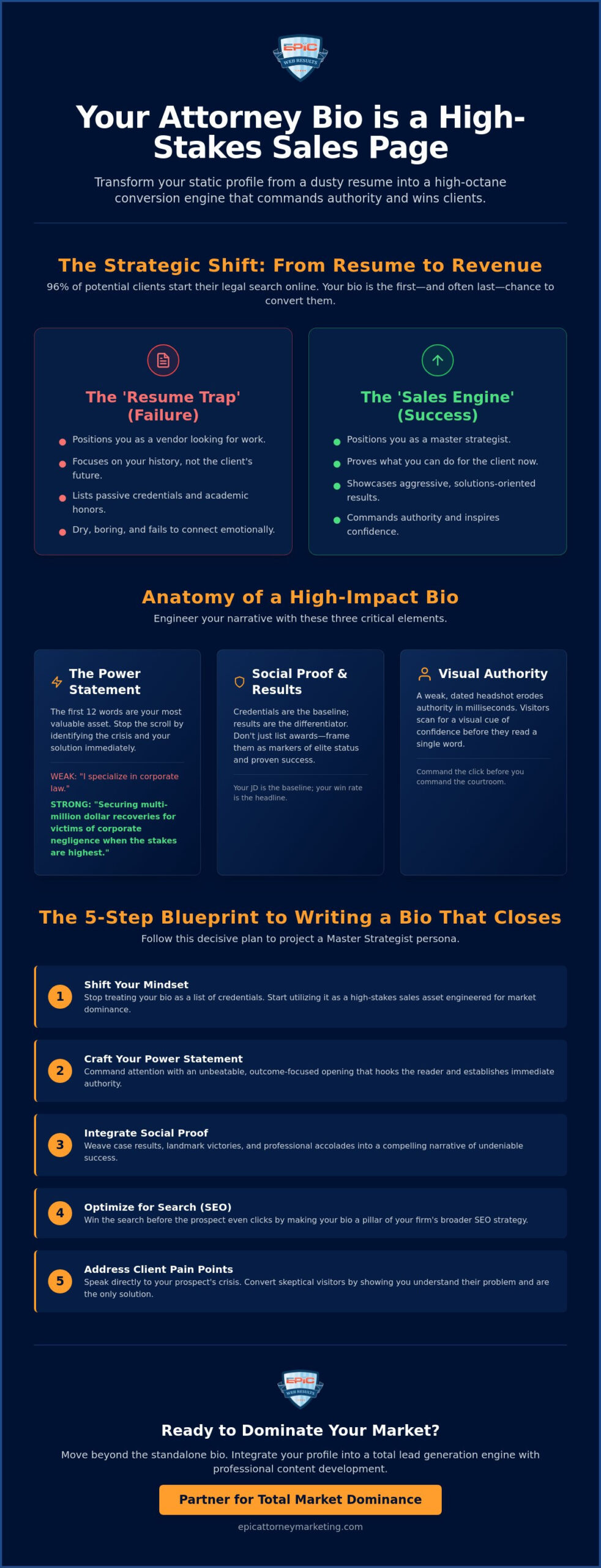
The 'Resume Trap' vs. The 'Sales Engine'
Prospective clients don't care about your Law Review honors. They care about their own survival. The 'Resume Trap' occurs when you prioritize your history over the client's future. A CV lists what you did; a sales engine proves what you can do for them. The psychological difference is profound. A CV positions you as a vendor looking for work. A marketing profile positions you as a master strategist who is the only logical choice for the job. Shift your language from passive credentials to active, aggressive solutions. Your JD is the baseline; your win rate is the headline.
The Data Behind the Click
Heatmap data from high-performing legal sites reveals a brutal truth. Visitors scan for two primary elements: your headshot and your track record. They are looking for a visual cue of confidence and a narrative of success. A weak, dated headshot erodes authority in milliseconds. A boring bio is a conversion killer that poisons your entire lead generation funnel. Since 96% of legal problems begin with an online search, your profile is the bridge between a bounce and a retainer. If that bridge is built on mediocre content, it will collapse under the weight of a skeptical prospect's scrutiny. You must command the click before you can command the courtroom.
The Anatomy of a High-Impact Bio: Elements That Command Authority
A high-impact bio isn't a laundry list of achievements. It's a carefully engineered narrative arc that positions you as the inevitable solution to a high-stakes problem. If you're researching how to write compelling attorney bios, you must understand that authority isn't granted; it's taken. You take it by controlling the narrative from the first sentence. Most lawyers bury their value under a mountain of legalese. You'll do the opposite. You'll lead with power.
Crafting the Unbeatable Power Statement
The first twelve words of your bio are the most expensive real estate on your site. This is your Power Statement. Stop saying you "specialize in" a practice area. That's vendor language. Elite strategists dominate their fields. A compelling hook identifies the crisis and offers the resolution immediately. For example: "Securing multi-million dollar recoveries for victims of corporate negligence when the stakes are highest." It's punchy. It's declarative. It stops the scroll because it speaks directly to the desired outcome. If your opening sentence doesn't make a competitor nervous, it's too weak.
Social Proof Beyond the JD
Credentials are the baseline. Results are the differentiator. To move beyond the standard professional bio guide, you must weave social proof into your narrative as objective fact. Don't just list awards; frame them as markers of elite status within a high-performing professional practice. Use grandiose but factual terms to describe your monumental proprietary methodologies. Whether it's a landmark case or a record-breaking settlement, these aren't just numbers. They're proof of your reliability. This is where you transition from a practitioner to a master negotiator. If you need to overhaul your firm's presentation, our strategic content development experts can refine these narratives for maximum impact.
The final element is the client-centric framework. Your bio should make the reader the hero of the story. They have a problem. You have the weapon. By balancing aggressive competence with strategic accessibility, you create a persona that feels both formidable and reachable. You aren't just another name on a masthead. You're the strategist they need to win. This isn't about being "authentic" in a soft, sentimental way. It's about being the undeniable authority in a crowded market. Every word must build momentum toward that single, inevitable conclusion.
SEO for Attorney Bios: Winning the Search Before the Click
Winning the search is the prerequisite for winning the client. If your profile is buried on page four, your expertise is irrelevant. Every bio must function as a high-performance pillar within your broader law firm seo strategy. This isn't about keyword stuffing. It's about strategic positioning. Google needs to see you as a definitive authority on specific legal issues. When you master how to write compelling attorney bios, you aren't just writing for people. You're feeding the algorithm exactly what it needs to rank you above your competitors.
Keyword Integration Without the Fluff
High-value search terms should feel like a natural part of your professional narrative. Don't just list your practice areas. Embed them into your results. Instead of saying you "do personal injury," describe how you "secure record-breaking settlements in catastrophic personal injury litigation." This satisfies intent-based queries while maintaining your status as a master strategist. Optimizing for "near me" searches is equally vital. Law firms are seeing better results by focusing on specific neighborhoods, especially since "near me" searches for lawyers have increased by 42% in the last two years.
Consider this practice area definition: "As a veteran trial lawyer based in Chicago, I dominate high-stakes commercial litigation and complex white-collar defense cases for clients requiring aggressive legal representation." This single sentence hits three primary keywords while projecting absolute authority.
Linking for Dominance
Internal linking is the connective tissue of a dominant website. Your bio should not be a dead end. It must link to high-performance content for law firm website assets, such as case studies or deep-dive practice area guides. This builds a web of authority that keeps prospects in your funnel and reduces bounce rates. When you link an attorney profile to a specific case win, you prove your reliability to both the user and the search engine. This creates a logical, clinical path from curiosity to conversion.
Finally, technical signals cannot be ignored. Implementing Schema markup for 'Person' and 'Attorney' entities is a non-negotiable step for elite firms. This structured data tells search engines exactly who you are, what you do, and where you practice. It transforms a simple page into a verified entity in the knowledge graph. If you aren't utilizing these technical advantages, you're leaving the door open for less-qualified competitors to steal your market share. Dominance requires precision in both prose and code.
5 Steps to Writing a Bio That Closes the Deal
Execution is the differentiator between a passive profile and a dominant sales asset. You've already learned why the resume format fails and how SEO provides the foundation. Now, you must assemble these elements into a decisive narrative that compels action. Learning how to write compelling attorney bios requires a clinical focus on the transition from a visitor's curiosity to a client's commitment. Follow this five-step blueprint to outpace your competition and secure high-value retainers.
Identifying the Client's Pain Point
Your bio must function as a mirror to your prospect's current crisis. If a business owner is facing a predatory lawsuit, they don't want to read about your undergraduate degree. They want to know you understand their anxiety. The first 100 words of your profile should focus entirely on the client's needs and the high-stakes environment they inhabit. Use tactical metaphors to describe your approach. Frame your legal services as a defensive shield or a strategic weapon. By mirroring their ambition or fear, you establish an immediate psychological connection. You aren't just another lawyer; you're the specific strategist who can resolve their specific chaos.
Once you've addressed the pain, you must establish the Master Strategist persona. Do this through specific, undeniable case wins. Don't just claim expertise; demonstrate it with the mechanics of your proprietary methodology. After proving your competence, share the 'why' behind your aggressive drive. This isn't about your love for golf. It's about the professional conviction that fuels your pursuit of market dominance. Finally, ensure your content is scannable. Use punchy, declarative headers that allow a busy executive to grasp your value proposition in seconds. If they have to hunt for your results, they'll find them on a competitor's page instead.
The Unapologetic Call to Action
A bio without a Call to Action (CTA) is a wasted marketing opportunity. This is the moment where you move the reader from passive research to active consultation. Most attorneys are too timid here. They assume the prospect will find the "Contact" page on their own. They're wrong. You must be direct. Tell the reader exactly what to do next. Whether it's scheduling a high-level strategy session or requesting a case evaluation, make the instruction clear and authoritative. Reduce friction by ensuring the contact method is decisively easy to locate. If you're ready to turn your firm's expertise into a conversion machine, our lead generation specialists can engineer a high-impact digital presence that commands the market.
Every sentence in your bio should build momentum toward this final click. If a word doesn't contribute to the sense of urgency or the proof of your authority, delete it. Dominance is built on precision, not fluff. When your bio concludes with an unapologetic CTA, you aren't just ending a page. You're starting a high-value client relationship.
Partnering for Total Market Dominance
Understanding how to write compelling attorney bios is only half the battle. The other half is the relentless execution of a superior strategy. Most law firm owners are consumed by the daily grind of litigation and firm management. They don't have the time or the tactical distance required to engineer a high-octane conversion engine. If you're still writing your own marketing copy, you're likely leaving millions in potential revenue on the table. Elite firms don't settle for "good enough" content; they demand market dominance.
Professional Content Development: The ROI of Elite Narrative
Top-tier attorneys are experts in the law, not necessarily in conversion psychology. There's a massive difference between a legal brief and a high-impact sales narrative. Professional content development is the differentiator that separates the market leaders from the also-rans. We specialize in strategic brand development that turns average websites into monumental marketing engines. By leveraging high-impact storytelling, we transform your professional history into a compelling proof of success. This isn't just about better prose. It's about a measurable return on investment through increased lead quality and higher retainer values.
Beyond the Bio: The Full Strategy
A bio is a single gear in a much larger machine. To achieve total dominance, your profile must be integrated into a comprehensive lawyer marketing engine. This requires a synergy between aggressive PPC, precision SEO, and elite law firm website design. If your site design doesn't support your authority, your bio won't convert. If your SEO is weak, your bio won't be seen. Every element must work in clinical unison to move prospects from skepticism to commitment. This is how you win the search before the client even picks up the phone.
Your next step is a brutal audit of your current digital presence. Look for conversion leaks. Identify where your authority is being eroded by mediocre content or technical failures. Don't let a weak profile be the reason a high-value client chooses your competitor. If you're ready to stop participating and start winning, it's time to partner with specialists who are as ambitious as you are. Dominate your market—let Epic Attorney Marketing build your engine.
Command the Market with an Elite Digital Presence
Your attorney bio is either a high-stakes sales asset or a costly liability. We've dismantled the traditional resume trap and provided the technical blueprint for how to write compelling attorney bios that actually move the needle. By shifting to a client-centric narrative and optimizing for precision search signals, you position yourself as the master strategist in a crowded legal market. You've seen why credentials alone are insufficient and how conversion architecture transforms a profile into a lead generation tool.
Don't let mediocre content stall your firm's expansion. Total market dominance requires more than just participation; it requires a custom-engineered conversion engine that works while you litigate. We bring over a decade of legal marketing dominance to every partnership, specializing exclusively in the aggressive law firm growth that high-achieving professionals demand. We don't just build websites; we build monumental profit centers. It's time to stop settling for high bounce rates and start commanding the absolute authority your practice deserves.
Stop leaking leads; get a high-performing marketing engine today.
You've already built the expertise through years of hard-won victories. Now, let's build the engine that proves your superiority to every potential client who finds you online.
Frequently Asked Questions
How long should a compelling attorney bio be?
Aim for 300 to 500 words to ensure you have enough depth for both search engines and human readers. Anything shorter feels like a hollow placeholder; anything longer risks losing a busy prospect's attention. Focus on high-impact results rather than filler. If you're wondering how to write compelling attorney bios that convert, prioritize the first 150 words to hook the reader instantly. Quality always trumps quantity in a high-stakes professional market.
Should I write my attorney bio in the first or third person?
Use the third person to establish an objective sense of authority and professional distance. It frames your achievements as undeniable facts rather than personal claims. While some boutique firms experiment with first person for relatability, elite firms use third person to project an image of a master strategist. This perspective aligns with how search engines and legal directories categorize entities. Keep the tone clinical and results-oriented to maintain a dominant market position.
How often should our firm update our attorney profiles?
Audit your profiles every six months to ensure your track record reflects your most recent victories. In a competitive market, a bio that hasn't been updated in two years signals stagnation. New landmark cases, updated board certifications, or recent awards must be integrated immediately. Frequent updates also signal to search engines that your content is fresh and relevant. Stale profiles are conversion killers that suggest your firm is no longer leading the field.
What are the most common mistakes in legal bios?
The biggest mistake is the Resume Trap, where lawyers list their education and history instead of their value proposition. Another critical error is burying case wins at the bottom of the page. Prospects want to see how you solve their specific crisis within the first ten seconds. Avoid using passive legalese or industry jargon that alienates the reader. If your bio reads like an obituary rather than a sales page, you're losing high-value clients.
Do I really need a professional headshot for my bio?
A high-end professional headshot is a mandatory trust signal in a digital market. It's the first thing most users look for when evaluating your profile. A dated or low-quality photo erodes your authority before a prospect reads a single word. Your visual presentation must match the aggressive competence of your written narrative. Don't settle for good enough. Invest in imagery that projects the image of a high-level negotiator who commands the room.
How can I make my bio stand out if I'm a junior associate?
Focus on your specific role within high-stakes cases and your dedication to a niche practice area. You don't need decades of experience to project authority; you need a narrative of intense focus and strategic contribution. Highlight your specialized training or unique methodologies that bring value to the firm's elite clients. Position yourself as a rising strategist who is deeply embedded in the firm's culture of winning. Use your bio to demonstrate ambition and technical mastery.
Is it okay to include personal interests in a professional law firm bio?
Include personal details only if they reinforce your professional image of discipline or strategic thinking. Mentioning you run marathons or play competitive chess can subtly signal a high-performance mindset. Avoid sentimental filler that distracts from your track record of success. Every word on the page must build momentum toward a conversion. If a personal interest doesn't contribute to your aura of exclusivity and uncompromising standards, leave it out.
How does my bio affect my law firm's SEO rankings?
Your bio is a critical pillar of your firm's entity-based search strategy. When you optimize profiles with specific practice areas and geographic keywords, you increase your chances of appearing in local searches. Search engines use these pages to verify your expertise and authority in a specific niche. Properly structured bios with Schema markup tell Google exactly what you do. Neglecting your bio's SEO is a strategic failure that lets competitors steal your local visibility.
Latest Insights forLaw Firm Growth.
Law Firm SEO Is Not About Chasing Rankings
Why Law Firm Attorney Bio Pages Are Critical for SEO and Conversion

ChatGPT, Gemini & Claude: How Clients Are Finding Lawyers

Building Authority with Long-Form Legal Content
What Law Firms Are Saying
Our Clients. Real Results.

-Jon Clarke

-Steven J. Picardi

-Frank Piscitelli

-Shimon Kohn
Ready to Grow Your Firm's Rankings and Visibility?