
Your law firm's website is either an elite growth engine or a ticking time bomb. With the average cost of a data breach for law firms reaching $5.08 million this year, mediocrity is no longer an option. If you're treating website security for law firms as a minor technical detail, you're effectively gambling with your firm's reputation and its future. The 2026 market demands more than just a digital brochure; it requires a fortress that commands authority and secures client trust at every touchpoint.
We know the anxiety that comes with navigating complex regulations like the new Rhode Island Data Transparency and Privacy Protection Act or the strict requirements of PCI DSS v4.0. You want total peace of mind without getting bogged down in technical jargon. This blueprint will show you exactly how to transform your site into an ironclad marketing asset that eliminates downtime and crushes your competitors in the search rankings. We're moving past basic defense to show you how technical health drives market dominance and ensures your revenue remains uninterrupted. It's time to stop playing defense and start building a digital presence that reflects your firm's uncompromising standards.
Key Takeaways
- Understand why law firms are now primary targets for cybercriminals and how to protect your brand from irreversible reputational damage.
- Identify the five essential pillars of website security for law firms that move beyond basic protection to provide high-assurance data integrity.
- Learn the direct correlation between your site’s technical health and its ability to dominate search results and convert high-value leads.
- Establish a Zero-Trust framework and a proactive response plan to eliminate the risk of security-related lead loss and operational downtime.
- Shift your perspective from viewing security as a cost to leveraging it as a strategic asset for aggressive firm growth and market superiority.
The High Stakes of Law Firm Website Security in 2026
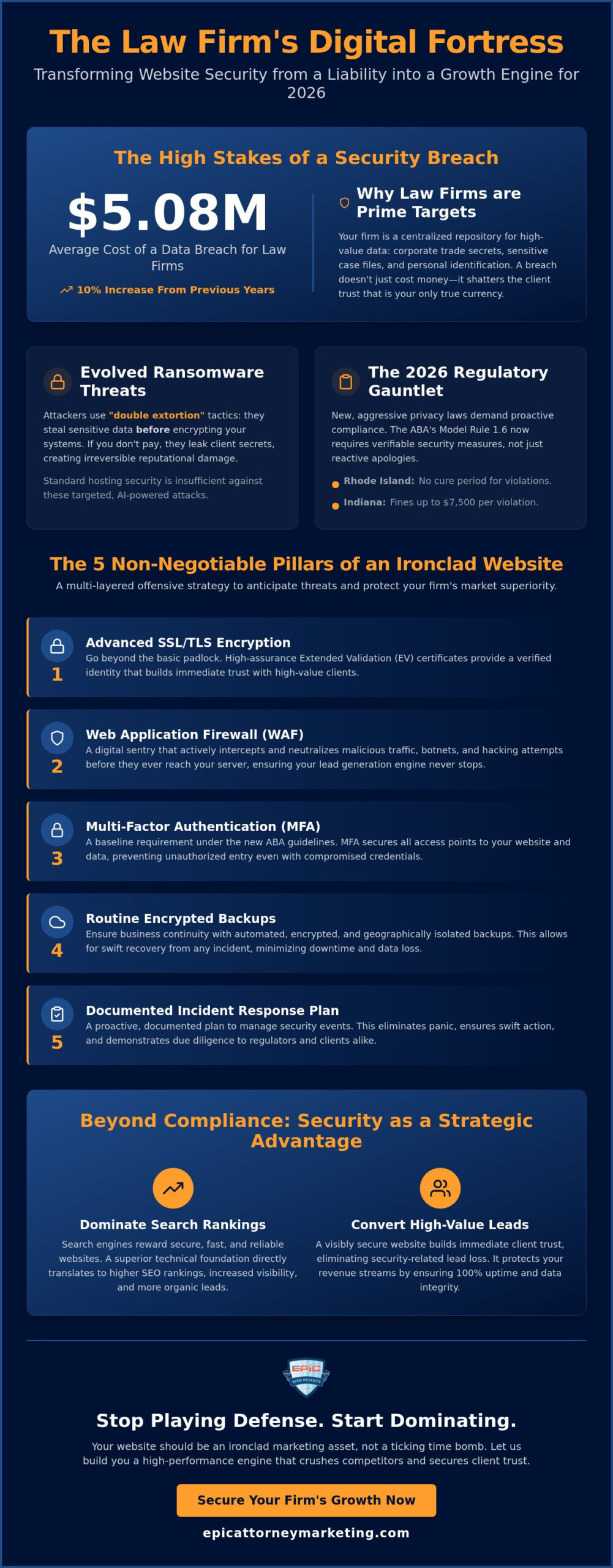
Law firms are the ultimate high-value targets for cybercriminals because they act as centralized repositories for sensitive corporate data, trade secrets, and personal identification. In 2026, the average cost of a data breach for law firms has hit $5.08 million, a 10% increase from previous years. This figure only accounts for the immediate financial fallout. It ignores the permanent brand erosion that occurs when your clients realize their secrets were left vulnerable on an unsecured server. Trust is the only currency a law firm has. Once that trust is broken, no amount of marketing can fix the damage.
To better understand the current threat landscape, watch this helpful video:
Effective website security for law firms is the strategic integration of technical defenses and ethical compliance designed to safeguard client confidentiality while fortifying the firm’s digital market authority. You must stop viewing security as a line-item expense. It's a strategic business asset. A secure website isn't just about defense; it's about building a high-performing marketing engine that clients trust and search engines reward. Mediocrity in your technical stack is a liability you can't afford.
Ransomware and the Legal Industry
Modern ransomware has evolved beyond simple encryption. Attackers now utilize double extortion tactics, where they steal sensitive case files before locking your systems. If you don't pay, they leak the data to the public or sell it to your client's adversaries. Standard hosting security is a joke in this environment. Most firms rely on out-of-the-box solutions that leave critical vulnerabilities wide open. These systems aren't built to withstand the targeted, AI-powered phishing attacks that are now standard practice for cybercriminal syndicates. You need a fortress, not a template.
The 2026 Regulatory Landscape
The regulatory environment is becoming increasingly hostile for firms with weak security. As of January 1, 2026, new comprehensive privacy laws in Indiana, Kentucky, and Rhode Island have fundamentally changed the compliance map. The Rhode Island Data Transparency and Privacy Protection Act is particularly aggressive because it offers no cure period for violations. Indiana's Consumer Data Protection Act allows for fines up to $7,500 per violation. These aren't suggestions; they're enforceable mandates.
The ABA’s interpretation of Model Rule 1.6 now demands proactive measures rather than reactive apologies. Reasonable efforts in 2026 include multi-factor authentication, encrypted backups, and documented incident response plans. These are the core information security principles that differentiate an elite firm from a liability. If your firm isn't meeting these technical baselines, you aren't just risking a hack; you're risking disciplinary action and malpractice claims. A proactive approach is the only way to ensure total peace of mind and maintain your competitive edge.
The 5 Non-Negotiable Pillars of an Ironclad Legal Website
Relying on a standard security plugin is like putting a screen door on a vault. In 2026, website security for law firms requires a multi-layered offensive strategy that anticipates threats rather than just reacting to them. You aren't just protecting files; you're protecting your firm's market superiority. If your site goes down or leaks data, your competitors will capitalize on that weakness instantly. Winning requires a fortress.
Advanced SSL/TLS encryption is the first pillar. The basic green padlock is no longer enough to signal authority to high-value prospects. High-assurance Extended Validation (EV) certificates are the new standard for elite practices. They provide a verified identity that builds immediate trust. A Web Application Firewall (WAF) acts as a digital sentry for your practice, intercepting and neutralizing malicious traffic before it ever touches your server. This isn't optional. It's the barrier that keeps your lead generation engine running while others are being dismantled by botnets.
Third, you need AI-driven threat detection. Modern attacks are too fast for manual intervention. Our systems use machine learning to identify attack patterns in real-time, shutting down suspicious IPs before they can probe for vulnerabilities. This proactive stance ensures your marketing remains uninterrupted. Secure lead capture is the fourth pillar. Every contact form and intake portal must be a hardened gateway. If a prospect's data is intercepted during the intake process, your reputation is finished before the first consultation. Aligning your protocols with FTC cybersecurity guidelines ensures you're meeting the highest standards of consumer protection.
Database and API Security
The back-end of your website is where the most sensitive data lives. Hardening this environment is critical to prevent SQL injections and unauthorized access. You must also secure every third-party integration. Whether it's your CRM or an AI chatbot, these are potential entry points for supply chain attacks. Regular penetration testing is the only way to verify your defenses. It's how we ensure our digital marketing for attorneys remains an unbreakable asset for our partners.
Redundant Backup Systems
A single backup is a single point of failure. We implement the "3-2-1" rule: three copies of your data, on two different media types, with one copy stored off-site and off-network. This isn't just about storage; it's about recovery. You must test your restoration speed quarterly. If your site is hit, you need to be back online in minutes, not days. Zero downtime is the only acceptable metric for a firm that intends to dominate its market.
Beyond Compliance: How Security Drives Law Firm SEO and Conversion
Stop viewing security as a defensive chore. In 2026, website security for law firms is an offensive marketing strategy. If your digital foundation is weak, you aren't just vulnerable to hackers; you're invisible to your best prospects. Google's algorithm is a ruthless gatekeeper that prioritizes user safety above almost everything else. If your site presents even a whisper of risk, you'll never achieve the visibility required for market dominance. Security is the silent engine that powers your law firm seo and ensures your marketing spend isn't wasted on a site that people are afraid to use.
The myth that robust security slows down your website is a relic of the past. In reality, a high-performance Web Application Firewall (WAF) accelerates your site by filtering out the massive volume of bot traffic that clogs standard servers. By offloading this junk traffic, your server resources are dedicated entirely to legitimate leads. This results in lightning-fast load times that satisfy both Google's Core Web Vitals and the short attention spans of high-value clients. Speed and security aren't in competition; they're a unified force for growth.
HTTPS as a Ranking Signal
Google made its preference for secure sites clear years ago, but in 2026, the stakes are higher. Technical health is now a primary differentiator in the search engine results pages (SERPs). If your site triggers a "Not Secure" warning in a prospect's browser, your bounce rate will skyrocket instantly. That warning is a brand killer. It tells a potential client that you can't be trusted with their data before they even read your bio. A secure, healthy site signals authority to search engines, leading to higher organic rankings and a lower cost-per-lead.
Trust Seals and Conversion Rate Optimization (CRO)
Visible security markers are psychological triggers that move a lead from hesitation to action. When a high-intent prospect is ready to share sensitive case details, they look for reassurance. Strategic placement of high-assurance trust seals and encrypted intake badges can increase form completion rates significantly. This is a critical component of elite law firm website design. Your intake process must mirror the professional integrity of your firm. If your digital "front door" looks flimsy, prospects will assume your legal work is equally careless. Secure design is the ultimate differentiator in a market saturated with mediocre, vulnerable websites.
Your Firm’s Cybersecurity Response and Prevention Framework
Reactionary firms are already obsolete. If you're waiting for a breach notification to act, you've already lost the war for market dominance. Only 34% of law firms currently maintain a formal incident response plan, a staggering failure of leadership that leaves the door wide open for competitors to seize your clients. Winning in 2026 requires a clinical, aggressive approach to website security for law firms. You need a framework that dictates terms to the digital landscape rather than begging for mercy from it.
- Vulnerability Assessment: We begin by stripping away the illusions of safety. This is a comprehensive audit that identifies every crack in your digital armor, from outdated scripts to insecure server configurations.
- Zero-Trust Architecture: Trust is a liability. We implement a Zero-Trust model for all administrative access, ensuring that every user and device is verified every single time they attempt to access your marketing engine.
- Real-Time Monitoring: Passive defense is useless. We deploy automated sentries that monitor traffic patterns 24/7, providing real-time alerts the second an anomaly is detected.
- Incident Response Plan: Speed is the only metric that matters during a crisis. You must have a documented, battle-tested plan that outlines exactly how your firm will neutralize a threat and restore operations.
- Quarterly Reviews: The threat landscape evolves daily. We schedule rigorous quarterly security reviews to adapt your defenses to the latest AI-powered attack vectors and updated NIST 2.0 standards.
The Human Element: Staff Training
Your staff is your greatest asset or your biggest vulnerability. Phishing remains the primary entry point for high-level breaches because even the best technical defenses can be bypassed by one careless click. We demand a culture of security where phishing simulations and strict password hygiene are non-negotiable firm policies. If your team isn't trained to spot sophisticated social engineering, your website security for law firms is built on sand. Security isn't just an IT task; it's a professional discipline that every member of your firm must master.
Vulnerability Management
The "Patch or Perish" rule is absolute. Managing CMS and plugin updates manually is a recipe for disaster in a high-performing practice. You don't have time to track every minor security release, but ignoring them for even 24 hours can be fatal. We utilize automated patching systems that deploy critical security updates the moment they're released. This ensures your high-performance marketing engine remains hardened against known exploits while you focus on high-stakes litigation. If you're ready to stop gambling with your firm's integrity, it's time to secure your market authority with a partner that treats your growth as a strategic operation.
Epic Security: Building High-Performance Marketing Engines That Don’t Break
Standard agencies fail because they treat your practice like a retail storefront. They apply generic security patches to a high-stakes environment where a single leak can end a career. We don't play those games. Our proprietary Epic Citadel Methodology integrates security into the very fabric of our digital marketing for attorneys. This isn't just about blocking bots. It's about building a digital asset that is fundamentally superior to anything your competitors are running. We don't just protect data; we protect your firm's future.
We turn technical defense into an aggressive growth strategy by eliminating the friction that kills conversions. A secure site is a fast site. A fast site is a ranking site. When we handle your website security for law firms, we're ensuring your reputation is ironclad and your leads are protected. You gain the peace of mind that comes from a partner who values your firm’s integrity as much as you do. We don't just participate in the market. We dominate it by building engines that don't break under pressure.
Managed Security for the Elite Firm
Elite firms don't settle for "add-on" security. They demand a comprehensive strategy where protection is baked into every action. Our high-tier Monthly SEO Retainer Fees reflect this commitment to excellence. We provide continuous monitoring and proactive hardening as a standard requirement, not an optional extra. While other agencies are reacting to the latest exploit, we've already neutralized it. This relentless focus on technical health is the reason high-achieving professionals choose Epic for total market dominance. We don't just maintain your site; we weaponize it against the competition.
Take Control of Your Digital Asset
The choice is binary. You can either maintain a vulnerable liability or invest in a strategic marketing engine. A weak website is a signal of a weak firm. In the 2026 legal market, prospects are too sophisticated to overlook a "Not Secure" warning or a sluggish, glitchy intake form. Transitioning to a secure, high-converting platform is the first step toward reclaiming your market authority. It starts with a clinical assessment of your current vulnerabilities. Don't wait for a crisis to realize your defenses are inadequate. It's time to audit your security posture and build the unbreakable foundation your growth requires.
Command Your Market with an Unbreakable Digital Foundation
Passive protection is no longer a viable strategy for high-achieving firms. You've seen the data; you understand the stakes. In 2026, website security for law firms is the definitive line between market leaders and those rendered invisible by technical failure. By deploying high-assurance encryption and a Zero-Trust architecture, you transform a potential liability into a high-performance growth engine that search engines reward and clients trust instinctively.
We bring over a decade of specialized legal marketing experience to the table. Our proprietary security-first development protocols are designed for one purpose: total market dominance. We have a proven track record of securing the reputations and revenue of elite firms across the nation. You don't have to settle for vulnerable templates or mediocre agency results that leave your firm exposed. It's time to build a digital presence that reflects the uncompromising standards of your practice and the high-stakes nature of your work.
Secure Your Practice and Dominate Your Market Today. Your firm's future deserves an unbreakable foundation that drives results.
Frequently Asked Questions
Is a standard SSL certificate enough for a law firm website in 2026?
No, a basic SSL certificate is a baseline requirement, not a security strategy. Elite practices in 2026 use high-assurance Extended Validation (EV) certificates to verify their identity and build immediate authority. Website security for law firms has evolved beyond the simple green padlock; you need a solution that signals uncompromising integrity to both high-value prospects and search engine algorithms.
How does website security affect my law firm’s Google rankings?
Security is a non-negotiable ranking factor that directly dictates your visibility. Google prioritizes secure, healthy sites and aggressively penalizes those that trigger browser safety warnings. Beyond the HTTPS signal, robust security protocols improve site speed by filtering out malicious bot traffic. This technical health translates into higher organic rankings and a dominant position in the search results.
Do I need a Web Application Firewall (WAF) if my hosting is "secure"?
You absolutely need a WAF regardless of your hosting provider's claims. While secure hosting protects the physical server, a Web Application Firewall defends the specific vulnerabilities of your website's application layer. It acts as a digital sentry, neutralizing SQL injections and cross-site scripting attacks before they can penetrate your intake forms or your client database.
What is the most common way law firm websites get hacked?
Most law firm websites are compromised through unpatched software and sophisticated phishing attacks. Cybercriminals target outdated plugins or CMS versions with known vulnerabilities to gain a foothold. Once they secure administrative access through a weak password or a compromised staff account, they can weaponize your site for double extortion or sensitive data theft.
How often should a law firm perform a security audit on their website?
You must conduct a comprehensive security review at least quarterly to maintain market dominance. The threat landscape in 2026 moves too fast for annual check-ups. Regular audits ensure your defenses are adapted to new AI-powered attack vectors and that your firm remains compliant with evolving state privacy laws in jurisdictions like Rhode Island and Indiana.
Can a security breach lead to disbarment or ethical sanctions?
A data breach can absolutely result in ethical sanctions or professional disciplinary action. Under the 2026 interpretation of ABA Model Rule 1.6, "reasonable efforts" to protect client data are now treated as an enforceable technical standard. Failing to implement multi-factor authentication or encrypted backups can be viewed as professional negligence, leading to malpractice claims and potential loss of licensure.
Does a secure website actually help convert more legal leads?
A secure website is a high-converting marketing engine that eliminates prospect hesitation. Visible security markers and a "Secure" browser status remove the psychological friction that causes high-intent leads to bounce. When prospects see high-assurance trust seals, they feel confident sharing sensitive case details, which directly increases your form completion rates and lowers your cost-per-lead.
What should I do immediately if I suspect my firm’s website has been compromised?
You must execute your formal incident response plan the moment you suspect a breach. This involves isolating the compromised systems, changing all administrative credentials, and contacting your strategic security partner to begin a forensic audit. Only 34% of firms have a formal plan in place; don't be part of the majority that panics and loses critical data during a crisis.