

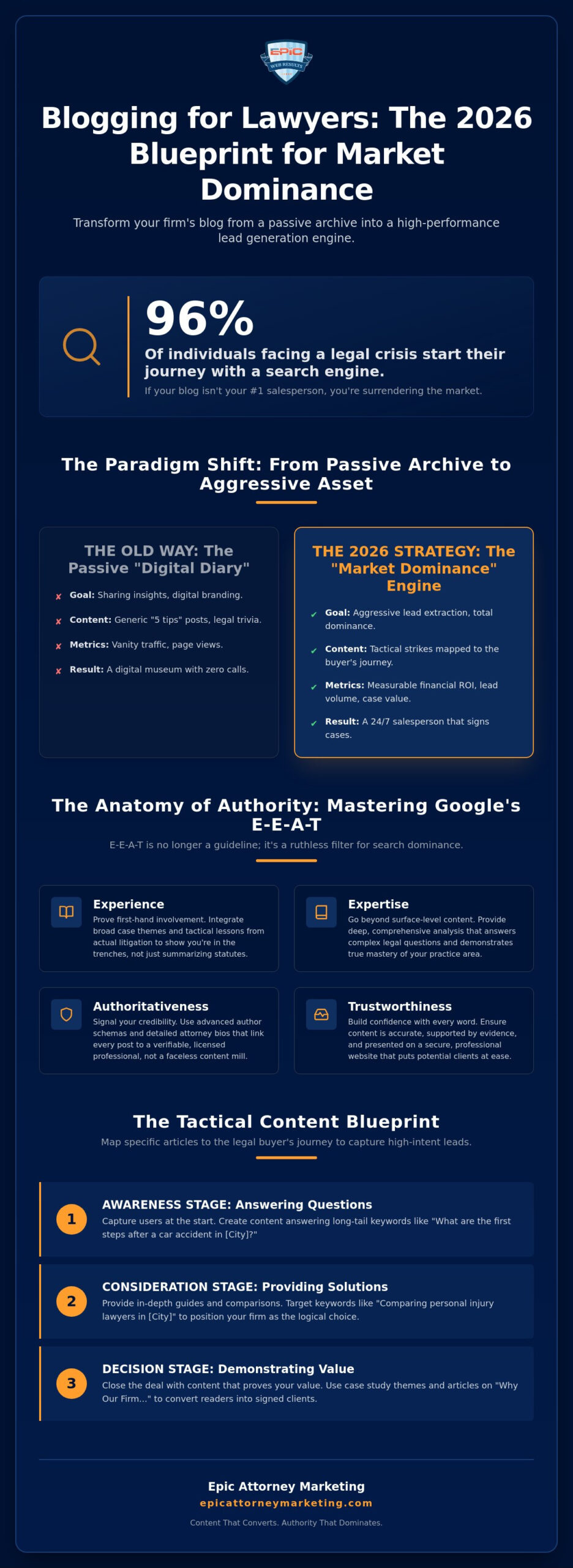
96% of individuals facing legal crises start their journey with a search engine, yet most law firms treat their blogs like a digital museum of legal trivia. If your content isn’t actively hunting for cases while you sleep, you’re not just losing traffic; you’re surrendering market share to competitors who understand that blogging for lawyers best practices have shifted from sharing insights to total tactical dominance. In 2026, a blog is either a weapon for lead extraction or a waste of server space.
We know you’re tired of wasting hours on articles that generate zero calls or paying agencies for “fluff” content that never ranks for high-value keywords. You deserve a marketing engine that reflects your firm’s authority rather than burying it. This guide will show you how to transform a stagnant law firm blog into an aggressive, high-performing marketing engine that captures leads and commands search authority. We’ll provide a tactical blueprint for content dominance, covering the specific E-E-A-T requirements and hyper-local strategies required to convert cold traffic into signed clients.
Key Takeaways
- Stop treating your blog as a digital diary and start using it as a high-performance lead generation engine designed for total market dominance.
- Master the 2026 E-E-A-T standards by integrating real-world case themes that prove your firm’s authority without compromising client privilege.
- Deploy a tactical content blueprint that maps specific articles to the legal buyer’s journey, ensuring you capture high-intent leads before they look elsewhere.
- Implement the latest blogging for lawyers best practices to identify long-tail keywords and headline structures that demand immediate clicks from your ideal clients.
- Shift your focus from vanity metrics to measurable financial returns by tracking the actual lead volume and case value generated through consistent content execution.
Beyond ‘Sharing Insights’: Why Law Firm Blogging is a Strategic Weapon in 2026
The days of treating your law firm’s blog as a digital diary are over. In 2026, firms that view content as a secondary branding exercise are being systematically dismantled by competitors who treat every post as a tactical strike for market share. If you aren’t blogging aggressively, you’re handing over high-value cases to the digital-first practices currently colonizing your search results. This isn’t about “sharing insights”; it’s about building an unassailable moat of digital equity.
Stop viewing content development as a cost center. It’s a high-yield investment in an aggressive law firm marketing ecosystem. Every optimized article you publish becomes a permanent asset that extracts leads without the recurring fees of PPC. Understanding blogging for lawyers best practices in this era requires a shift from passive participation to total dominance.
Watch this breakdown to see how top-tier firms use content to fuel their growth:
The Death of the ‘Passive’ Legal Blog
Generic “5 tips for your divorce” posts no longer rank. They’re noise. In a saturated market, search engines and potential clients demand depth and strategic intent. Broad traffic is a vanity metric that pays zero bills. You need high-intent lead capture that targets users at the exact moment they’re ready to sign. Market Dominance Blogging is the intentional use of search-optimized legal expertise to displace competitors.
Blogging as a Conversion Engine
A strategic blog post is a 24/7 salesperson that never sleeps, never complains, and never misses a pitch. When a potential client reads an authoritative breakdown of their specific legal problem, the psychological shift from “searching” to “hiring” begins. This isn’t a new phenomenon. While the history of legal advertising shows a slow evolution from yellow pages to digital ads, the core requirement remains the same: proving you’re the undisputed expert.
Modern blogging for lawyers best practices demand that you move beyond simple awareness. Every sentence must build momentum toward action. If your content doesn’t force a reader to confront the limitations of their current legal situation and see your firm as the only viable solution, it’s failing. We don’t write to educate the public; we write to dominate the market and sign cases.
The Anatomy of Authority: E-E-A-T and Search Dominance for Lawyers
Google’s 2026 algorithm isn’t looking for “good” content. It’s looking for proof. E-E-A-T (Experience, Expertise, Authoritativeness, Trustworthiness) has evolved from a guideline into a ruthless filter that separates market leaders from also-rans. If your blog lacks these four pillars, your firm is effectively invisible to the high-value leads you’re chasing. Dominance requires more than just words on a page; it requires a tactical demonstration of power.
The “Experience” component is where most firms fail. In 2026, search engines prioritize content that demonstrates first-hand involvement in legal matters. You don’t need to violate attorney-client privilege to show this. Instead, integrate broad case themes and tactical lessons learned from actual litigation. This proves you aren’t just summarizing statutes. You’re winning battles in the real world, and Google’s AI is specifically tuned to reward that authenticity.
Technical signals are equally vital. You must deploy advanced author schemas and detailed attorney bios that link every post to a verifiable, licensed professional. Search engines need to know an expert wrote the words, not a faceless content mill. This level of technical precision is a cornerstone of law firm seo in 2026. Without these signals, your expertise is just a claim. With them, it’s an objective, rankable fact.
Signaling Expertise in a Post-AI World
Generic AI content is a death sentence for your rankings. While 79% of legal professionals believe AI will fundamentally change the sector, using it to churn out “average” blog posts is a fast track to the bottom. Search engines now detect and devalue low-effort, synthetic summaries. To dominate, you must inject unique legal perspectives. Share “master strategist” insights that a machine cannot replicate. Use hard data and verified statistics to ground your authority. For example, knowing that 96% of people with legal problems start with an online search should drive you to create content that addresses their specific, immediate fears. If you’re ready to stop guessing, our content development strategies can help you build a library of high-performance assets.
Building Digital Trust and Reputation
Blogging is your most powerful tool for reputation management. It allows you to control the narrative before a potential client even speaks to you. By integrating client success stories and testimonials as “trust signals,” you transform a cold searcher into a warm lead. Showcase the outcomes you’ve achieved. This isn’t bragging; it’s providing the evidence today’s skeptical consumers demand. Consistent, high-level blogging builds an impenetrable wall of authority around your brand. When you adhere to blogging for lawyers best practices, you aren’t just writing. You’re constructing a digital fortress that competitors cannot breach.
Strategy Over Volume: Mapping Content to the Legal Buyer’s Journey
High-volume, low-intent content is a trap designed for the mediocre. If you’re publishing five posts a week without a clear conversion goal, you aren’t a law firm; you’re a library. Total market dominance in 2026 requires a Hierarchy of Strategic Intent. Every article must serve a specific purpose in your funnel, moving the reader from initial confusion to a signed retainer. This isn’t just about being found. It’s about being the only logical conclusion for a person in crisis.
- TOFU (Top of Funnel): Attract searchers asking broad questions about their legal rights or immediate next steps.
- MOFU (Middle of Funnel): Capture those comparing legal options, such as mediation versus litigation or different settlement strategies.
- BOFU (Bottom of Funnel): Decisively close the lead by proving your firm is the master strategist they need to win.
Applying blogging for lawyers best practices means recognizing that a searcher looking for “what to do after a truck accident” is in a different mental state than someone searching for “best personal injury lawyer in Chicago.” If your blog treats them the same, you’re bleeding leads. You need to map every word to a specific psychological stage of the hire.
The TOFU Strategy: Dominating the Information Gap
Your potential clients often search for solutions before they realize they need a lawyer. They ask “how-to” and “what is” questions to regain a sense of control. By answering these queries, you position your firm as the authoritative source of truth. These evergreen resources form the bedrock of aggressive digital marketing for attorneys. You aren’t just educating the market. You’re colonizing their search history and establishing a baseline of trust that competitors cannot easily disrupt. Balance this educational value with subtle brand positioning that hints at the complexity only an expert can handle.
BOFU Content: The Closer’s Blueprint
Bottom-of-funnel content is where you stop playing nice and start winning. These guides must answer the “Why you?” question with clinical precision. Address common objections like cost, timing, and complexity before the lead even has a chance to voice them. Use tactical metaphors to frame your firm as the master negotiator or the disruptor who enters a room and changes the power dynamic. If your BOFU content doesn’t make a reader feel that hiring you is their only path to victory, it’s just filler. Every sentence should build momentum toward the conversion, stripping away doubt until the only remaining action is to call your office.
The Aggressive Blueprint: 10 Best Practices for Lawyer Blogging Success
Seizing the top spot in search results isn’t an accident. It’s the result of a clinical, tactical blueprint. In 2026, blogging for lawyers best practices have evolved into a high-stakes engineering project. You must optimize every syllable for both the algorithm and the human lead. If you aren’t following a proven framework, you’re just guessing with your marketing budget. Dominance requires precision.
Stop chasing broad, useless vanity terms. The real revenue lives in long-tail, high-intent queries. These specific phrases signal a lead who is ready to sign a retainer today. Your headlines must act as a weapon; they must demand attention and signal immediate value. If your title doesn’t force a click, your expertise remains hidden. Use a clinical structure. Short, staccato sentences drive momentum and prevent the reader from getting lost in legal jargon. You want them moving down the page toward your contact form, not hitting the back button.
Text alone is no longer enough to win. You must incorporate high-impact graphics and A.I. videos to increase dwell time. These assets tell Google your page is the definitive resource. Finally, build a web of authority through strategic internal linking. This keeps leads on your site and prevents them from bouncing back to a competitor’s search result. If you’re ready to deploy these tactics, our content development services can build your firm’s high-performance marketing engine.
Technical Optimization for Elite Rankings
Structure your H2s and H3s specifically for featured snippet extraction. This is the battle for “position zero.” If you can answer a searcher’s question directly in your header, you dominate the SERP. Speed is a non-negotiable ranking factor. You must optimize for mobile-first indexing and maintain perfect core web vitals. Use FAQ schema to colonize more physical space on the results page, pushing your competitors off the screen and out of sight.
Distribution: Ensuring Your Content is Seen
Adopt a “Write Once, Dominate Everywhere” approach. One high-performance blog post should fuel your social media feeds and client newsletters for weeks. Use your content for law firm website to enhance your PPC landing pages. This increases page relevance and lowers your cost per lead. Backlink building remains the final amplifier. A blog post without links is a lonely island; a post with a strong backlink profile is a powerhouse of authority that search engines cannot ignore.
Executing Your Dominance: Turning Content into a High-Performing Marketing Engine
Strategy without execution is a hallucination. You now have the blueprint for market superiority. The question is whether you have the discipline to deploy it. Consistency is the secret weapon of high-performing professional practices. The firms currently sitting at the top of your local search results didn’t get there by accident or by dabbling. They treat their digital presence with the same clinical precision they apply to a high-stakes trial. They publish to maintain their territory and expand their reach every single week.
Stop obsessing over vanity metrics like impressions or broad traffic. These numbers are designed to keep mediocre marketing agencies in business. They don’t pay for your overhead. You must measure what actually impacts the firm’s bottom line: lead volume and case value. If your content isn’t generating signed retainers, it isn’t an asset; it’s a liability. Adhering to blogging for lawyers best practices means shifting your focus to the mechanics of winning and scaling your practice through measurable financial returns.
The DIY trap is where many ambitious attorneys lose their momentum. You didn’t spend years in law school to become a part-time copywriter or an SEO technician. Attempting to master the complexities of modern search algorithms while managing a full caseload is a recipe for exhaustion and average results. Elite attorneys understand that their time is better spent in court or closing deals. They outsource the tactical operations to master strategists who can deliver uncompromising standards of performance.
Epic Web Results specializes in transforming average, stagnant websites into aggressive marketing engines. We don’t deliver “fluff” or passive service. We provide the Search Engine Optimization and Content Development required to achieve total market dominance. We position your firm as the undisputed authority, ensuring you are the only choice potential clients consider when their stakes are highest.
The ROI of Authority
A high-ranking, authoritative blog post is a permanent digital asset. Unlike Pay-Per-Click advertising, which vanishes the moment you stop feeding the machine, strategic content continues to extract leads for years. This structural advantage drastically reduces your cost per acquisition over time. The Dominance Dividend is the compounding return on high-quality, search-optimized content. It’s the financial reward for firms that invest in building an unassailable moat of digital equity rather than just renting temporary space on Google’s front page.
Your Next Strategic Move
Confront the limitations of your current efforts with brutal honesty. If your blog isn’t a high-performance engine, it’s a wasted opportunity. You can continue to settle for the scraps left behind by your competitors, or you can take the roadmap to total firm dominance. The choice to disrupt your market and establish your practice as the elite leader is yours. We are ready to help you execute that vision.
Stop settling for mediocre results and start dominating your market today.
Weaponize Your Digital Presence for Total Dominance
The transition from a stagnant blog to an aggressive lead-extraction engine is not a creative choice; it’s a strategic necessity. You’ve seen the blueprint. You understand that blogging for lawyers best practices in 2026 require a clinical focus on E-E-A-T, high-intent keyword mapping, and technical precision. Market share is currently being redistributed to firms that treat content as a high-stakes tactical operation. If you aren’t leading the charge, you’re the target.
Epic Web Results has spent over a decade building high-performing marketing engines for law firms that refuse to settle for mediocre results. We maintain a specialized focus on engineering digital assets that don’t just participate in the market; they dominate it. Our proven track record of displacing established competitors is built on an uncompromising standard of performance. You can continue to waste time on content that gets zero traffic, or you can secure your firm’s future as the undisputed authority in your practice area.
The tools for total dominance are in your hands. It’s time to execute.
Frequently Asked Questions
How often should a law firm blog to see real results in 2026?
You must publish at least one high-quality, in-depth article per week to achieve total market dominance. While maintaining a schedule of two posts per month is the bare minimum for survival, elite firms use weekly updates to colonize search results. Consistency signals reliability to both potential clients and search algorithms. If your publishing schedule is erratic, you’re signaling a lack of operational discipline that high-value leads will notice.
Is it better to write long-form articles or short, punchy updates?
Long-form, authoritative content is the only way to satisfy 2026 E-E-A-T standards and secure elite rankings. Short updates are noise that search engines systematically devalue. You need comprehensive guides that address every facet of a legal problem to win featured snippets and “position zero.” High-performing blogging for lawyers best practices prioritize depth because it forces the reader to acknowledge your expertise. Short posts don’t convert high-value cases; strategic depth does.
Can I use AI to write my law firm’s blog posts?
You can use AI for structural planning, but relying on it for the final copy is a death sentence for your rankings. Search engines in 2026 are specifically tuned to detect and demote generic, synthetic summaries. Your blog must contain unique legal perspectives and master strategist insights that a machine cannot replicate. If your content looks like everyone else’s, you’ve already lost the battle for market share and digital equity.
How do I choose the best topics for my legal blog?
Choose topics by mapping the legal buyer’s journey from initial crisis to the final hiring decision. Focus on long-tail, high-intent queries that indicate a user is ready to take action immediately. Don’t waste time on broad legal definitions that only attract students or researchers. Instead, answer the specific, high-stakes questions your ideal clients ask during consultations. This tactical approach ensures every post serves as a dedicated lead generation engine.
Do blog posts actually help my law firm rank higher on Google?
Strategic blog posts are the most effective way to rank for competitive keywords and build undeniable search authority. By adhering to blogging for lawyers best practices, you create a web of internal links that strengthens your entire domain’s visibility. Each post provides fresh content for Google to evaluate, proving your firm is an active, authoritative leader in its practice area. Without a blog, your site is a static brochure that search engines will ignore.
How do I measure the return on investment (ROI) of my blogging efforts?
Measure ROI by tracking lead volume, conversion rates, and the actual case value generated from your content assets. Ignore vanity metrics like impressions or social media likes that don’t pay the bills. If an article doesn’t result in a phone call or a consultation request, it isn’t performing. Use advanced analytics to attribute signed retainers back to specific blog posts. This clinical approach allows you to see exactly which assets are driving your firm’s growth.
What are the biggest blogging mistakes lawyers make?
The biggest mistake is writing “fluff” content designed for other lawyers rather than potential clients in crisis. Many firms also fail by being inconsistent or using passive language that doesn’t demand action. Another fatal error is neglecting technical SEO, such as FAQ schema or mobile optimization. If your blog reads like a dry legal textbook, you’re alienating the 96% of people who start their legal search online looking for clear, authoritative solutions.
Should I include my personal opinions in legal blog posts?
You should include proprietary “master strategist” perspectives that demonstrate your unique approach to winning cases. However, you must avoid making false or misleading claims that violate advertising rules like ABA Model Rule 7.1. Ground your insights in objective facts and data while maintaining a bold, authoritative voice. This balance establishes you as a disruptor in your market without creating unnecessary regulatory risks or compromising your professional standing.