
Most law firm owners treat their marketing budget like a donation to Google rather than a tactical strike for market share. If you don’t know exactly how to calculate cost per lead for a law firm down to the cent, you aren’t running an elite practice; you’re gambling with your firm’s future. In a 2026 landscape where nearly 70% of searches result in zero clicks, guessing is a luxury you can no longer afford.
It’s frustrating to watch your competitors scale while your agency feeds you vanity metrics that don’t translate into signed retainers. This strategic blueprint will give you the precise mechanics to calculate and optimize your CPL, ensuring every marketing dollar is a tactical investment in total market dominance. We’ll dismantle the confusion between SEO and PPC profitability, provide a repeatable formula for hard ROI data, and establish a framework to hold your vendors accountable for the results they promised.
Key Takeaways
- Master the “Epic” Formula to account for every hidden expense when determining how to calculate cost per lead for a law firm.
- Stop chasing vanity metrics and start measuring the tactical efficiency of your ad spend against high-quality inquiries that actually convert.
- Distinguish between deceptive, low-cost leads and the high-value signed cases that drive aggressive revenue growth and market dominance.
- Benchmark your current performance against 2026 practice-area standards to identify where your budget is being wasted on mediocre results.
- Learn how high-performance digital infrastructure can aggressively scale your firm by doubling conversion efficiency and slashing acquisition costs.
Beyond the Basics: Why Cost Per Lead (CPL) is the Pulse of Your Firm’s Growth
In the high-stakes arena of legal marketing, Cost per lead (CPL) is the tactical pulse of your entire growth operation. For a law firm, CPL represents the total financial investment required to generate a single inquiry from a potential client. Learning how to calculate cost per lead for a law firm is the fundamental difference between strategic expansion and burning cash on vanity metrics. If you treat CPL as a cost to be minimized, you’ve already lost the war for market share. Elite firms view it as the price of admission for total market dominance. It’s the primary indicator of your marketing efficiency and the only reliable precursor to a high ROI.
To better understand the core mechanics of lead valuation, watch this expert breakdown:
Many firms fall into the trap of the “Lead Quality Gap.” This occurs when an agency delivers a low CPL that masks poor conversion potential. A flood of cheap inquiries that never convert into signed cases is a liability, not an asset. These leads paralyze your intake team and inflate your perceived success while your bank account remains stagnant. Success isn’t about the raw number of calls; it’s about the quality of the opportunities. High-performing firms recognize that a higher CPL for a qualified, high-intent lead is far more profitable than a bargain-bin inquiry that leads nowhere.
The Strategic Importance of CPL in a Competitive Market
Your CPL dictates your ability to outbid competitors in the most saturated, high-value practice areas. If you don’t know your numbers, you’re flying blind. You cannot determine the feasibility of entering a new territory or practice area without a precise understanding of what it costs to acquire a seat at the table. Knowledge of your CPL allows you to scale aggressively when you find a winning channel. It provides the confidence to double down on spend because you know exactly what the return will look like. Firms that fail to master how to calculate cost per lead for a law firm are essentially gambling with their expansion efforts.
Distinguishing Leads from Inquiries
A true “Lead” is a contact that meets the minimum viable case criteria for your specific practice area. Counting every spam call, wrong number, or solicitation as a lead is a recipe for financial disaster. This noise distorts your data and leads to poor decision-making. This is why elite firms shift their focus toward Qualified Cost Per Lead (QCPL). By filtering out the noise, you get a clinical, accurate view of what you’re actually paying for potential revenue. It forces your marketing vendors to stop hiding behind “total inquiries” and start delivering actual business value.
The Elite Formula: How to Calculate CPL Without Missing Hidden Costs
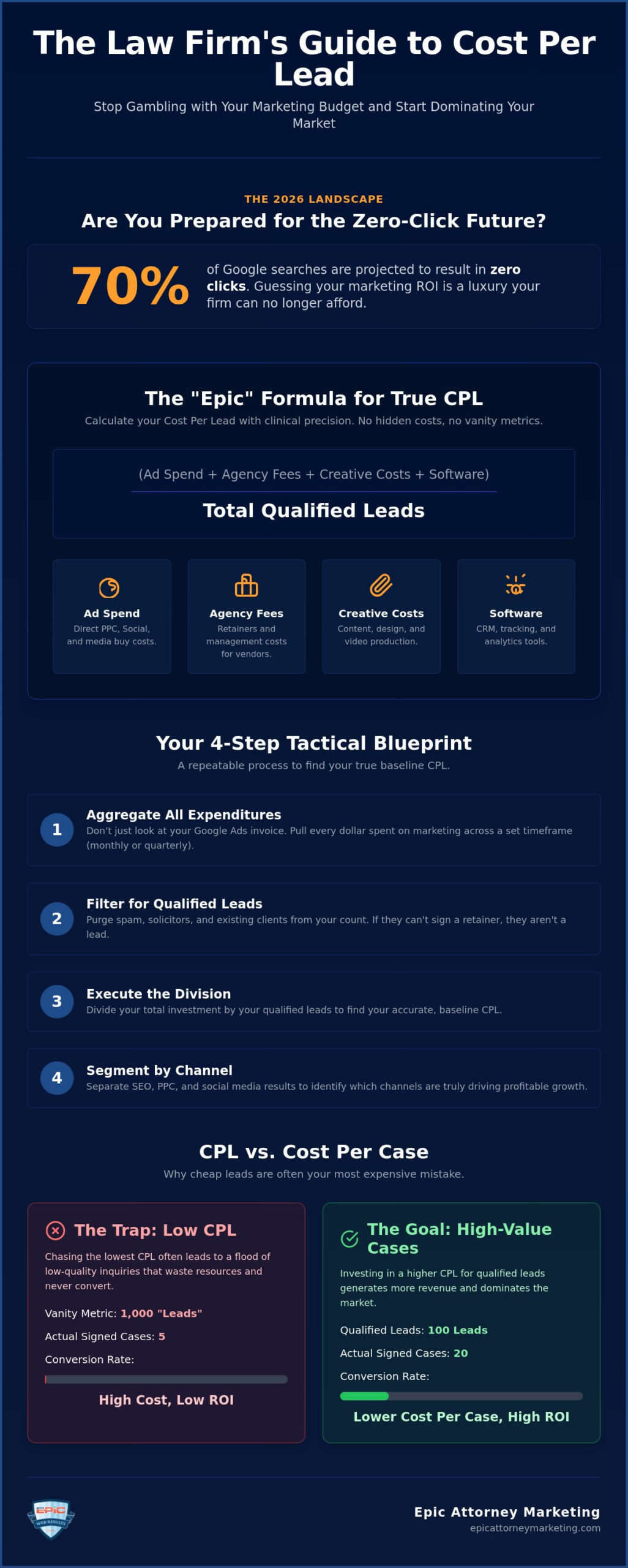
Calculating a generic cost per lead is easy. Calculating an accurate one is where most law firms fail. If you aren’t including the full weight of your overhead, you’re lying to yourself about your profitability. The standard formula used by mediocre agencies ignores the friction of reality. To master how to calculate cost per lead for a law firm, you must adopt the “Epic” Formula: (Ad Spend + Agency Fees + Creative Costs + Software) divided by Qualified Leads.
Success requires a clinical approach to your data. Follow these four steps to find your true baseline:
- Step 1: Aggregate all marketing expenditures. Don’t just look at your Google Ads invoice. Pull every dollar spent on marketing across a set timeframe, usually monthly or quarterly.
- Step 2: Filter your lead data. Purge existing clients, spam, and solicitors from your count. If they can’t sign a retainer, they aren’t a lead.
- Step 3: Execute the division. Divide your total investment by these qualified leads to find your baseline CPL.
- Step 4: Segment by channel. Separate your SEO results from your PPC and social spend to see which engine is actually driving growth.
While industry benchmarks for CPL provide a useful reference point, they often fail to account for the aggressive competition in the legal sector. You aren’t competing against a local bakery; you’re competing against firms with seven-figure war chests. Your numbers must reflect that intensity.
Accounting for the “Full Stack” Investment
Your calculation is worthless if it excludes the human and technical elements of your campaign. You must include your monthly SEO retainer fees and PPC management costs. These are not optional extras; they are the fuel for your lead generation engine. Don’t forget your CRM and intake software costs. These tools are essential for tracking and managing the leads you pay for. For one-time investments like fixed-price website design and development fees, amortize the cost over 12 months. This gives you a realistic monthly cost that reflects the ongoing value of your digital infrastructure.
Segmenting by Marketing Channel
The “Blended CPL” trap is where failing campaigns go to hide. Looking at an average across all channels often masks a high-performing SEO strategy that is subsidizing a disastrous PPC campaign. Calculate individual CPL for Google Ads, organic search, and social media separately. Use tracking numbers and UTM parameters to ensure data integrity at the source. If you can’t trace a lead back to its origin, you can’t optimize your spend. To build a truly dominant presence, you need to know exactly which channel deserves more capital. If your current reporting feels like a hall of mirrors, it’s time to audit your marketing infrastructure for total transparency.
CPL vs. Cost Per Case: Why Cheap Leads Are Often Your Most Expensive Mistake
Don’t get seduced by a low price point. While mastering how to calculate cost per lead for a law firm is essential, focusing solely on minimizing that number is a fast track to stagnation. CPL is a tactical metric. Cost Per Case (CPC) is the strategic reality. The market doesn’t reward the firm with the cheapest inquiries; it rewards the firm with the most efficient path to a signed retainer. If you aren’t tracking the conversion from click to case, you’re only seeing half the battlefield.
Many firms fall into the “Volume Trap.” This happens when an agency floods your system with low-CPL leads that have zero intent. These leads are a resource drain. If your intake team spends forty hours a week chasing 100 junk calls to find one viable client, your “cheap” leads are actually your most expensive liability. Aggressive firms are willing to pay a premium for high-intent leads because they understand the clinical math of scale.
Consider the numbers. A $500 CPL with a 25% conversion rate results in a $2,000 acquisition cost. Conversely, a $100 CPL with a 2% conversion rate costs you $5,000 per signed case. The “cheap” leads in this scenario are actually 150% more expensive. Dominant firms focus on maximizing profit per lead rather than minimizing the initial cost. They pay for quality because quality is the only thing that scales.
The Math of Quality: CPL vs. Case Acquisition Cost
Your Case Acquisition Cost (CAC) is the ultimate truth. It’s calculated by dividing your total marketing spend by the number of signed retainers. By combining your CPL with your conversion rate, you can predict future revenue with clinical precision. If you know that every four qualified leads result in one case, you can determine exactly how much capital to deploy to hit your growth targets. Stop looking for bargains and start looking for predictable returns.
The Impact of Intake on Your Effective CPL
Poor intake processes can make a perfect CPL look like a total failure. Research shows that 35% of calls to mid-sized firms go unanswered during business hours. That is a direct, unforced loss of capital. Furthermore, the speed of your response is a critical variable. Responding to a lead in under 60 seconds can reduce your effective cost per acquisition by 30-40%. Lead aging is a hidden tax on your marketing budget. If you don’t have the infrastructure to capture interest the moment it strikes, you are effectively throwing away a third of your investment before the first consultation even begins.
Industry Benchmarks: What a “Good” CPL Looks Like for High-Performing Firms in 2026
A “good” CPL is a relative target. If you’re trying to figure out how to calculate cost per lead for a law firm without understanding your specific practice area’s floor, you’re chasing ghosts. The entry fee for market dominance isn’t a fixed price; it’s a dynamic variable dictated by your competition’s aggression and your geographic territory. In 2026, the blended cost per qualified lead for law firms sits at $131.36. However, if you are satisfied with averages, you’ve already conceded the high ground to more ambitious firms. Dominating a high-competition metro area requires a “Market Share Premium,” a higher CPL threshold that elite firms willingly pay to starve their competitors of quality inquiries.
Practice Area Variance and Expectations
Practice areas are not created equal. Personal injury firms in competitive metropolitan areas can expect to pay $250 to $600+ per lead through paid search in 2026. This is the entry fee for high-value catastrophic injury leads. Conversely, family law and criminal defense firms typically see a CPL ranging from $75 to $200. Mass tort campaigns remain the most volatile, with leads costing between $150 and $275. While these numbers seem high, boutique practices often achieve a significantly lower CPL by leveraging hyper-targeted SEO strategies that bypass the bidding wars of PPC. They focus on exclusivity rather than volume.
The 2026 Factor: How AI and Search Evolution are Shifting CPL
The search environment has fundamentally changed. Nearly 70% of searches now result in “zero-click” outcomes. Users find their answers directly on the search results page, which has reduced organic lead volume by an estimated 25% since 2023. This shift makes high-quality content for your law firm website more expensive to produce but infinitely more valuable. As Google continues to prioritize paid placements and AI-generated overviews for high-intent legal queries, your organic strategy must be more surgical. You can no longer rely on generic traffic. You need a digital presence that converts the remaining 30% of click-through traffic at a much higher rate to maintain a sustainable CPL.
While PPC offers immediate visibility, it comes with an escalating price tag. Google Local Service Ads (LSAs) in top-tier cities have risen to $200+ per lead for personal injury firms. High-performing firms balance this by investing heavily in long-term SEO. SEO-driven leads typically offer a lower long-term CPL because the initial investment in content and authority continues to pay dividends long after the ad budget is spent. To ensure your firm isn’t overpaying for mediocrity, you must secure your market share with a strategy that integrates both immediate PPC strikes and long-term organic dominance.
Scaling for Dominance: How to Optimize Your CPL to Outpace the Competition
Optimization is the pursuit of surgical efficiency. Cutting your budget is a defensive move; improving your conversion rate is an offensive strike. You’ve already mastered how to calculate cost per lead for a law firm. Now you must weaponize that data to starve your competition of viable opportunities. If you aren’t constantly refining your funnel, you’re leaving the door open for more aggressive firms to seize your territory and your revenue. High-performing firms don’t just spend more; they convert better.
Conversion Rate Optimization (CRO) as a CPL Lever
Your website is the primary bottleneck of your marketing engine. Research indicates that while 87% of law firms have a website, only 35% successfully gain clients through it. This discrepancy represents a massive waste of capital. Technical mechanics like site speed and mobile UX directly influence your cost per lead. If a page takes three seconds too long to load, your prospect is already clicking on a competitor’s ad. A 1% increase in conversion rate can effectively reduce CPL by 20% or more. High-performance custom website design isn’t an aesthetic choice; it’s a tactical necessity that slashes your acquisition costs overnight by ensuring no lead is wasted.
Building an Aggressive Multi-Channel Engine
Dominance requires a multi-front assault. You must combine the immediate impact of PPC advertising with the compounding value of law firm SEO in 2026. This integration ensures that you capture high-intent traffic while building long-term organic authority that your competitors cannot simply buy. Digital marketing for attorneys thrives on the “Authority Multiplier.” When your brand development and reputation management are synchronized, you build trust before a prospect even dials your number. This pre-sold status reduces friction and lowers CPL across every channel because the prospect has already decided you are the expert they need.
Content development and social media marketing aren’t just creative exercises. They are tactical supports that lower the cost of your paid campaigns. When a prospect recognizes your firm from an AI-generated video or a high-ranking article, they are far more likely to convert. This synergy creates a defensive moat around your practice. Data-driven A/B testing allows you to refine your messaging until your CPL hits its absolute floor. You aren’t just buying leads; you are building a market presence that makes your acquisition more efficient than any firm relying on a single channel. Ready to stop guessing? Get a strategic assessment from Epic Attorney Marketing and take control of your firm’s growth trajectory.
Command Your Market Through Financial Precision
You now possess the strategic framework required to dismantle your competition. Most firms will continue to drift through 2026 with vague metrics and wasted budgets. By applying the “Epic” formula and shifting your focus from raw lead volume to Case Acquisition Cost, you’ve separated your practice from the mediocre majority. Mastering how to calculate cost per lead for a law firm is the baseline requirement for any partner who refuses to settle for mere participation.
Precision is the hallmark of dominance. At Epic Attorney Marketing, we’ve spent over a decade perfecting the art of turning average legal websites into high-performance marketing engines. Our data-driven strategies are calibrated for one outcome: total market superiority. Stop letting your growth happen by accident. It’s time to dominate your market with an aggressive growth strategy from Epic Attorney Marketing. Your path to aggressive expansion is waiting.
Frequently Asked Questions
What is a good cost per lead for a personal injury law firm?
A competitive cost per lead for personal injury firms in 2026 ranges from $250 to over $600 for paid search in major metropolitan areas. While the blended average for qualified leads sits at $131.36, elite firms often pay a premium for high-intent catastrophic injury leads. Don’t be seduced by low-cost inquiries that fail to convert; quality always commands a higher price in saturated markets.
Should I include my marketing agency fees in my CPL calculation?
Yes. Excluding agency fees, creative costs, or software expenses is a tactical error that distorts your financial reality. To master how to calculate cost per lead for a law firm, you must account for every dollar leaving your firm’s accounts. A true CPL reflects the total investment required to generate a qualified inquiry, not just the raw ad spend paid to Google.
How does SEO affect my law firm’s overall cost per lead?
SEO acts as a long-term financial stabilizer that aggressively drives down your blended CPL over time. Unlike PPC, which stops the moment you stop paying, organic authority compounds. By investing in custom website design and content, you generate leads that lack the recurring “per-click” tax. This earned visibility is the most efficient way to lower your average acquisition cost while maintaining lead quality.
What is the difference between CPL and Customer Acquisition Cost (CAC) for lawyers?
CPL measures the efficiency of your marketing engine in generating inquiries; CAC measures the cost of signing a retainer. CPL is a tactical metric used to optimize campaigns. CAC is the strategic reality that determines your firm’s actual profitability. You can have a “good” CPL and a disastrous CAC if your intake process is slow or your leads lack intent.
How can I lower my law firm’s cost per lead without sacrificing quality?
Optimize your conversion infrastructure rather than slashing your ad budget. Improving site speed, mobile UX, and landing page relevance can double your conversion rate overnight. When more visitors become leads, your CPL drops naturally without you having to lower your bids or settle for inferior traffic sources. Efficiency is the only sustainable way to outpace the competition.
Why is my PPC cost per lead so much higher than my organic CPL?
PPC is a bidding war for immediate, high-intent real estate. You are paying for the speed and certainty of appearing at the top of search results. Organic CPL is lower because it leverages earned trust and authority. While SEO requires significant upfront capital, the lack of a “per-click” fee makes it the more profitable engine for long-term market dominance.
How often should I be calculating and reviewing my firm’s CPL data?
Review your CPL data monthly at an absolute minimum; elite practices monitor these metrics in real-time. The legal market moves too fast for quarterly post-mortems. Frequent reviews allow you to pivot capital toward high-performing channels and kill failing campaigns before they drain your war chest. If you aren’t looking at your data, you’re essentially flying blind in a dogfight.
Does the type of case change the target CPL?
Target CPL varies wildly based on settlement potential and market competition. A catastrophic car accident lead justifies a much higher CPL than a standard workers’ comp inquiry because the ultimate ROI is significantly larger. You must calibrate your CPL targets based on the specific revenue potential of each practice area. Aggressive firms pay what the market requires to win high-value cases.