
Your domain name is not a mere digital address. It's the most undervalued strategic asset in your firm's arsenal. Most partners treat the question of how to choose a domain name for a law firm like a clerical task. They're wrong. In a hyper-competitive legal market, a mediocre URL is a silent killer of your digital authority. You've likely felt the frustration of finding your first choice taken or the anxiety of picking an extension that makes you look like a second-tier player. You're right to be cautious. A poorly chosen name doesn't just confuse clients; it actively throttles your SEO potential and limits your firm's capacity for aggressive expansion.
This guide provides the definitive 2026 blueprint to secure a high-performance domain that demands respect and drives measurable growth. We'll cut through the noise regarding .com versus .law extensions and show you how to acquire premium assets that position you as the undisputed leader in your practice area. You'll learn how to select a domain that's memorable, legally sound, and engineered for total market dominance. It's time to stop participating in the market and start owning it.
Key Takeaways
- Stop viewing your URL as a mere address and start treating it as the high-stakes foundation of your firm's SEO dominance and market authority.
- Master the hybrid strategy on how to choose a domain name for a law firm to balance long-term brand equity with immediate search visibility.
- Navigate the 2026 TLD landscape by leveraging the global trust of .com while exploiting the elite credibility of legal-specific extensions like .law.
- Execute a clinical acquisition strategy for premium digital real estate, including the due diligence required to identify and avoid domains with toxic histories.
- Learn why even a powerhouse domain is useless without a high-performance website design built to convert traffic into high-value clients.
The Strategic Impact of Your Law Firm's Domain Name
Stop thinking of your URL as a technical footnote. In the 2026 legal market, your domain is the high-value deed to your digital headquarters. While basic technical definitions might explain what is a domain name, they fail to capture its role as a strategic digital asset. It's the primary lever for firm valuation and market authority. If you treat this choice as an afterthought, you've already conceded ground to your most aggressive competitors.
To better understand how your firm's name interacts with your digital presence, watch this strategic overview:
Adopting a "Domain-First" mindset is non-negotiable. Many partners name their firm and then scramble to find a matching URL. This is backwards. Your digital footprint should dictate your branding because that's where the battle for clients is won. A high-authority domain acts as the foundation for all law firm SEO efforts. It's an investment that compounds over time. While other marketing costs rise, the authority of a premium domain only deepens, creating a wider moat around your practice.
First Impressions and Client Trust
A professional domain is your digital handshake. It either builds immediate trust or creates instant friction. There's a psychological weight to premium digital real estate. A domain like "Lawyer.com" signals established dominance. Conversely, "Smith-Legal-Help-123.net" signals amateurism. High-value clients aren't just looking for an attorney; they're looking for an elite partner. When you understand how to choose a domain name for a law firm, you choose to eliminate the subtle doubts that kill conversions before they even start.
The Foundation of Search Dominance
Your domain name is a critical component of your lawyer marketing engine. It directly influences click-through rates (CTR) in search results. Users are more likely to click a link that looks relevant and authoritative. This increased CTR signals to Google that your site is the premier answer to the user's query. Furthermore, your domain relevance impacts your Quality Score in paid campaigns, lowering your cost per lead. Don't make the mistake of thinking you can just "fix it later." Changing a domain once you've established authority is a high-risk operation that can result in catastrophic traffic loss. Get it right the first time.
Branded vs. Keyword-Rich Domains: Choosing Your Battleground
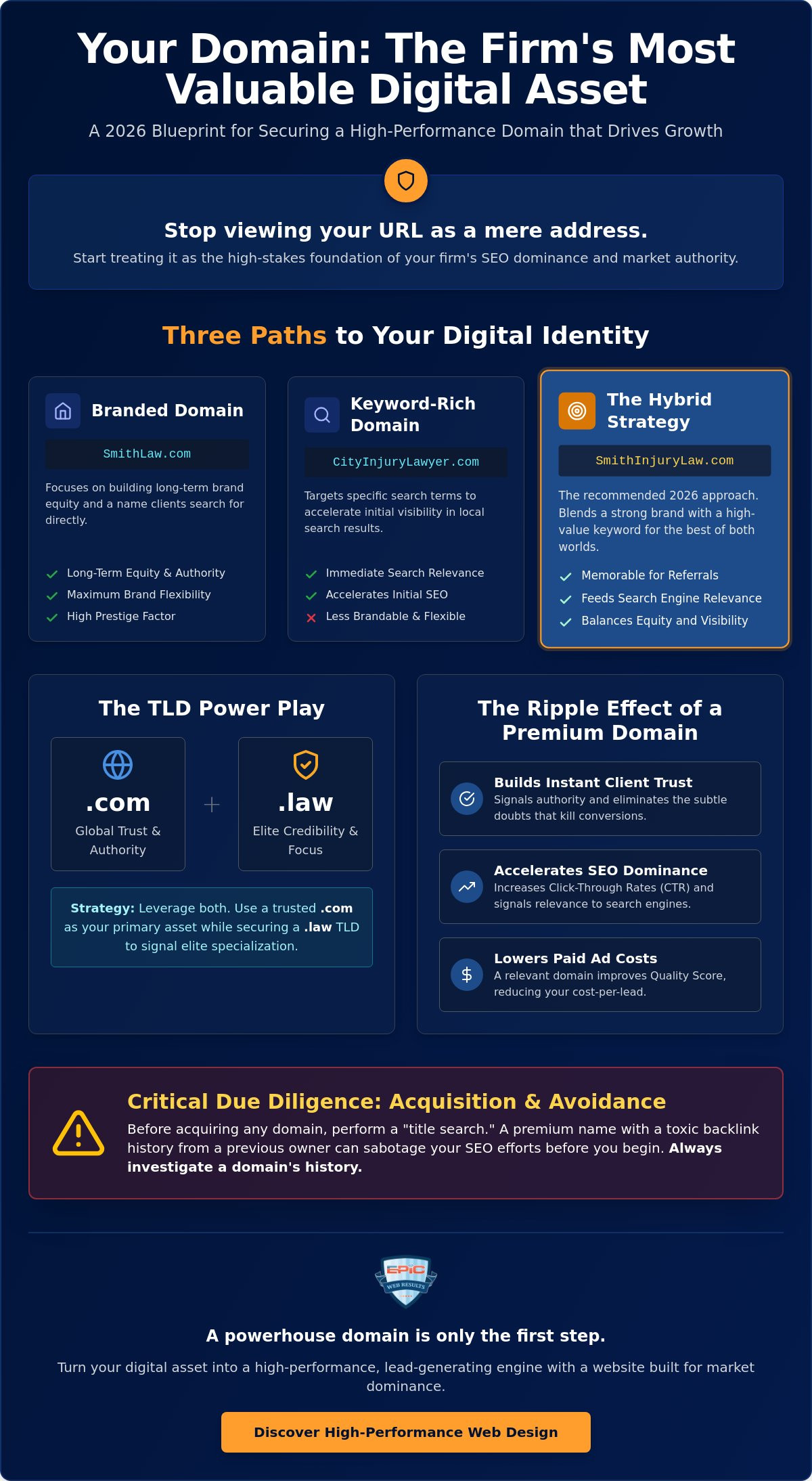
Selecting your domain is a tactical commitment that defines how you'll compete for the next decade. You're choosing between two primary camps: the Branded Domain (SmithLaw.com) or the Keyword-Rich Domain (CityInjuryLawyer.com). Both have merit, but they serve vastly different growth trajectories. While Google's algorithm has evolved to prioritize user intent, the debate over Exact Match Domains (EMDs) isn't dead. EMDs aren't the shortcut they were in 2015; however, they still provide a baseline of relevance that can accelerate your initial climb in local search results.
Smart firms in 2026 are increasingly adopting a "Hybrid Approach." This involves blending a strong brand identifier with a high-value practice area keyword, such as SmithInjuryLaw.com. This strategy offers the best of both worlds: it's memorable enough for word-of-mouth referrals while still feeding the search engine's hunger for topical relevance. When you're determining how to choose a domain name for a law firm, your decision must be filtered through your five-year expansion plan. Are you building a local lead-generation machine or a national prestige brand?
The Case for Branded Domains
Branded domains are about long-term equity. You're building an asset that clients search for by name, which is the ultimate form of SEO protection. These names offer total flexibility. If you start in criminal defense but want to expand into high-stakes corporate litigation, a branded name doesn't hold you back. This "Prestige Factor" is essential for firms targeting high-net-worth individuals or corporate clients who value legacy over a catchy URL. For a deeper look at the legalities of naming, consult this SBA guide on choosing a business name to ensure your digital identity aligns with your legal entity.
The Case for Keyword-Rich Domains
Keyword-rich domains offer instant relevance. They tell the user exactly what you do before they even click your link. This clarity often leads to higher click-through rates in competitive search results. If you specialize in a high-value niche, such as TruckAccidentAttorney.com, a keyword domain acts as a beacon for that specific persona. It's a clinical, results-oriented choice. While the direct SEO weight of the URL string has diminished, the psychological impact on a distressed user looking for a specific specialist remains a powerful conversion lever.
Your choice should reflect your firm's DNA. If you find yourself stuck between a name that sounds good and one that performs, you likely need a more sophisticated approach to brand development to bridge the gap. Don't let a generic name dilute your market authority. Pick the battleground where you can achieve total dominance, then build a digital fortress around it.
The TLD Power Play: .Com vs. Legal-Specific Extensions
The Top-Level Domain (TLD) you select is the digital flag you plant in your market. It signals your firm's reach and reliability. While hundreds of new extensions have flooded the internet, the .com remains the undisputed heavyweight champion. It's the gold standard for global and national authority. If you're analyzing how to choose a domain name for a law firm, your primary objective should always be securing the .com. It carries a level of inherent trust that no other extension can currently match.
However, the 2026 legal landscape has carved out a specific, high-authority niche for the "New Guard." Extensions like .law, .attorney, and .legal are no longer experimental vanity projects. They've become tactical tools for firms that want to project a modern, verified image. These extensions aren't just alternatives; they're restricted territories that offer unique advantages for firms willing to move beyond the traditional .com boundary.
The Dominance of .Com
Consumer bias is a hard-coded reality you can't afford to ignore. Most users still default to typing .com out of muscle memory. If you settle for a secondary extension as your primary brand while a competitor owns the .com version of your name, you're "domain leaking." You're essentially paying for their traffic. Every dollar you invest in brand awareness could inadvertently lead a client to your rival's site. Beyond the marketing risk, premium .com domains are high-value investment assets. They appreciate over time and provide a significant boost to your firm's total valuation.
When to Pivot to .Law or .Attorney
There are strategic moments when pivoting to a legal-specific extension is the superior move. If the .com you want is held by a squatter or a non-competing business, a .law extension allows you to secure a shorter, more punchy name. The .law TLD is particularly powerful because it's restricted. Only verified, licensed legal professionals can register them. This "Verified" status acts as a sophisticated trust signal. It tells high-value clients that you've passed a rigorous vetting process before they even read your first blog post.
These specialized extensions are also lethal weapons in digital marketing for attorneys. You can use them for hyper-targeted landing pages or high-intent PPC campaigns. A short, keyword-rich .attorney URL in a Google Ad can often drive higher click-through rates than a long, clunky .com. It provides immediate clarity of purpose. Dominant firms don't just pick one; they execute a defensive registration strategy. They own the .com, the .law, and the .attorney extensions to ensure no competitor can squat on their reputation. Total market control requires total ownership of your digital real estate.
Securing Your Digital Real Estate: Acquisition and Avoidance
Your ideal domain name is likely already owned. Don't let that stop you. In the high-stakes world of legal marketing, "taken" is simply the starting point for a negotiation. Understanding how to choose a domain name for a law firm involves mastering the art of acquisition. If a competitor or a squatter holds the digital real estate you need, you must execute a clinical plan to take it from them. This isn't about hope; it's about a calculated strategic strike.
Before you engage, you must perform a rigorous audit. A domain with a "toxic" history is a liability, not an asset. If the previous owner used the URL for spam or black-hat SEO, you'll inherit a Google penalty that could take years to scrub. You also need to clear the trademark hurdle. Using a domain that infringes on a national firm's intellectual property is an invitation for a cease-and-desist. Finally, always deploy a WHOIS privacy shield. Your firm's internal data and registration details should never be a matter of public record for competitors to scrape.
Aggressive Acquisition Tactics
High-value negotiations require anonymity. Use a professional domain broker to act as your proxy. If a squatter knows a successful law firm is calling, the price triples instantly. The acquisition follows a strict 5-step process: identify the registrant, conduct a valuation audit, engage through an anonymous broker, execute a formal purchase agreement, and oversee the secure technical transfer. Value the domain based on its projected traffic potential and the cost-per-click of its core keywords. If a premium domain saves you thousands in monthly PPC spend, it's worth a significant upfront investment.
Technical Due Diligence
Never buy a domain without inspecting its past. Use the Wayback Machine to see what was hosted there five or ten years ago. If you see pharmaceutical ads or low-quality link farms, walk away. Identifying a spammy history is essential to protect your future rankings. Once you've verified the domain is clean, ensure a secure ownership transfer. This includes pushing the domain to a secure registrar and locking the DNS settings to prevent hijacking. A clean transfer is the final step in securing your digital fortress.
If you're ready to secure a domain that commands authority, you need a partner who understands the mechanics of winning. Let's discuss your brand development strategy to ensure your new domain matches your firm's ambition.
Turning Your Domain into a Lead-Generating Engine
Securing a premium URL is a tactical victory, but it's only the first phase of digital conquest. Think of your domain as a high-performance chassis. It's built for speed and authority, but it won't move an inch without a high-performance engine under the hood. Knowing how to choose a domain name for a law firm is a critical skill, but the real war is won through conversion and scale. If your site looks like a relic from 2015, you're wasting the prestige of your digital real estate. High-value clients notice the disconnect between a premium domain and a mediocre user experience immediately.
Your law firm website design must match the prestige of your URL. This isn't about aesthetics; it's about psychological dominance. When a user lands on your site, they should feel the weight of your authority instantly. This design must be integrated into a total law firm marketing ecosystem where every touchpoint reinforces your firm's elite status. We don't build websites that just sit there. We build machines that hunt. At Epic Web Results, our approach transforms a simple address into a monumental asset that commands the attention of your most profitable leads.
Website Architecture for National Authority
Scale requires clinical structure. We favor subfolders over subdomains because they keep all ranking power concentrated within your primary domain. This concentration is vital for firms looking to dominate multiple practice areas without diluting their authority. Your architecture must also prioritize mobile responsiveness and lightning-fast load speeds. In the 2026 legal market, a delay of even one second is a gift to your competitors. We ensure your technical foundation is as aggressive as your growth goals, providing a seamless path from search result to signed client.
Scaling Beyond the URL
A domain is an empty vessel until you fill it with high-authority content development. You must build a backlink profile that justifies your domain's premium status. This isn't about volume; it's about elite associations. Our proprietary methodologies turn average domains into market-dominating forces by aligning technical precision with aggressive growth strategies. We don't just help you participate in the search results. We help you own them. If you're ready to stop playing defense and start dominating your market, it's time to elevate your strategy. There is no room for mediocrity in a top-tier practice.
Ready to dominate? Partner with Epic Web Results today.
Secure Your Digital Dominance
Your domain is the cornerstone of your firm's digital authority. Settling for a mediocre URL is a strategic concession you simply can't afford. By mastering how to choose a domain name for a law firm, you've secured the foundation. Now, you must build the fortress. Whether you've opted for a premium .com or a verified .law extension, your digital real estate is only as valuable as the high-value leads it generates. It's the difference between a static placeholder and a dynamic asset that commands market respect.
Dominance in the 2026 legal market requires more than just a clever address. It demands a high-performance ecosystem. This means pairing your authoritative domain with aggressive SEO strategies and custom website design engineered for national firms. With over a decade of legal marketing dominance, Epic Web Results knows how to turn your digital assets into a relentless growth engine. Stop participating in the market and start owning it. The path to total market superiority is waiting for you.
Scale Your Firm with the Master Strategists at Epic Web Results
Frequently Asked Questions
Is it better to have a short domain or a keyword-rich domain for a law firm?
Short domains are superior for brand recall and long-term prestige. While keyword-rich URLs once provided a massive SEO boost, their impact is now secondary to overall brand authority. A short, punchy domain reduces friction in word-of-mouth referrals and looks cleaner on marketing materials. If you're wondering how to choose a domain name for a law firm that balances both, a hybrid name is your best bet for market dominance.
Does the .law extension help with SEO rankings?
A .law extension doesn't provide an automatic ranking jump, but it serves as a powerful trust signal. Because these domains are restricted to verified legal professionals, they often see higher click-through rates from sophisticated clients. Google's algorithm prioritizes these user signals. If more users click your verified .law link over a generic competitor, your authority and rankings will climb naturally over time.
What should I do if the .com version of my law firm name is already taken?
You have two strategic paths: negotiate an aggressive acquisition or pivot to a high-authority legal extension. Don't settle for a clunky .net or a hyphenated mess. If the .com is squatted, hire a broker to secure it anonymously. If it's truly unavailable, a .law or .attorney extension is the only acceptable alternative for an elite firm that values its digital reputation.
Can I change my law firm's domain name without losing my Google rankings?
Yes, but you must execute a clinical technical migration to protect your traffic. This requires mapping 301 redirects for every single URL on your old site to the new domain. If you miss this step, you'll lose years of backlink equity and search visibility instantly. When you're researching how to choose a domain name for a law firm, it's vital to get it right the first time to avoid this high-stakes operation.
How much should a law firm expect to pay for a premium domain name?
Standard registration fees typically range from $10 to $50 annually. However, premium legal domains are high-value assets that often cost between a few hundred to several thousand dollars. Think of this as a one-time investment in your firm's digital foundation. The long-term ROI of a premium name far outweighs the initial acquisition cost when compared to monthly advertising spends.
Should I include my city or state in my law firm's domain name?
Include your location only if you intend to remain a local powerhouse forever. Geo-specific domains are lethal for local search dominance in competitive markets. However, they become a cage if you decide to expand nationally. If your five-year plan includes multiple states, stick to a branded domain that allows for unlimited geographic expansion without a forced rebrand.
What are the legal risks of choosing a domain name similar to a competitor?
The primary risk is a trademark infringement lawsuit or a cease-and-desist order. If your domain causes a likelihood of confusion with an established firm, you're inviting a legal battle you'll likely lose. Beyond the legal fees, you'll be forced to rebrand, which destroys your accumulated SEO value. Always perform a comprehensive trademark search before you commit to a new URL.
How many domain names should my law firm actually own?
You should own your primary domain plus all relevant defensive extensions. This usually means securing the .com, .law, and .attorney versions of your firm name. Defensive registration prevents competitors from squatting on your brand or stealing your traffic. It's a small price to pay for total control over your firm's digital reputation and long-term search presence.