
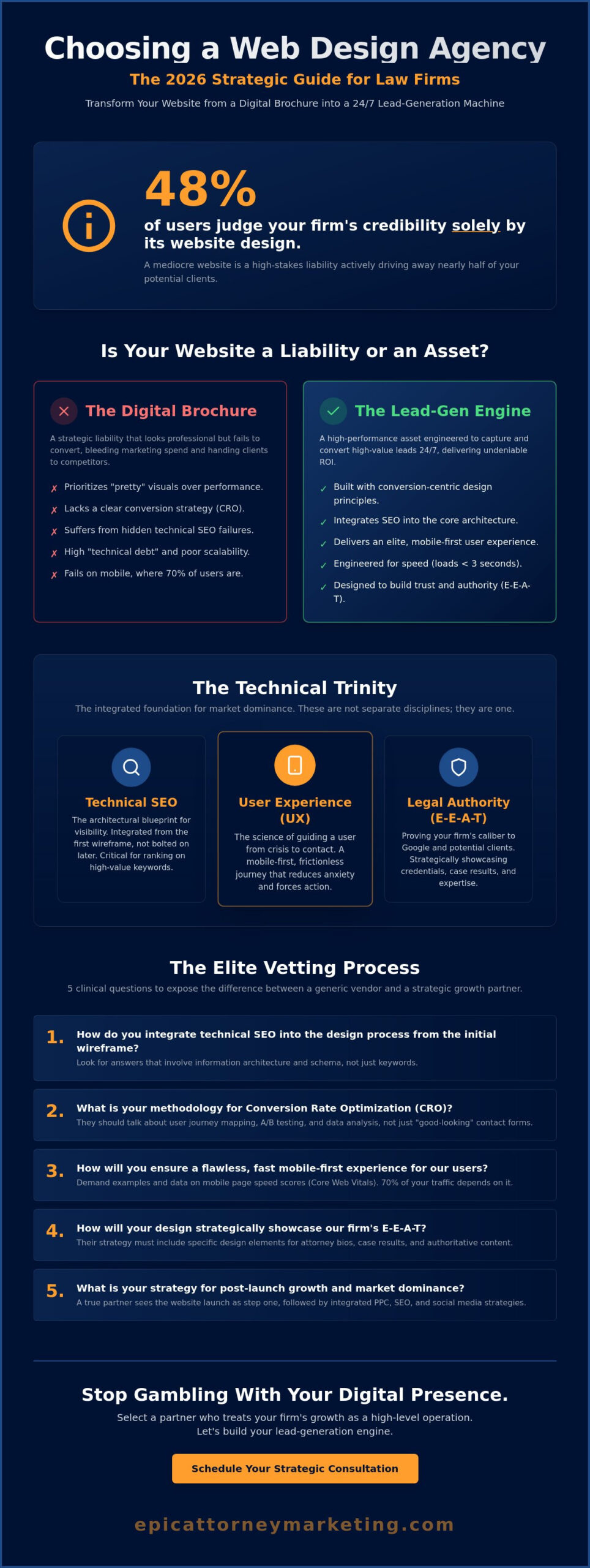
Your law firm website isn't a digital brochure; it's a high-stakes marketing engine where design must be subordinate to conversion. With 48% of users judging your firm’s credibility solely by its website design, mediocre visuals are a liability you can't afford. You've likely felt the sting of wasted marketing spend on sites that look professional but fail to capture high-value leads. Understanding how to choose a web design agency for a law firm requires moving past aesthetic preferences to focus on clinical, data-driven performance.
Stop gambling with your digital presence while your competitors achieve total market dominance. We've built this 2026 strategic guide to give you the exact framework needed to select a partner who treats your growth as a high-level operation. You'll learn how to identify hidden technical SEO failures, the impact of Answer Engine Optimization on your visibility, and why mobile-first design is the only acceptable standard for a modern practice. It's time to transform your website into a 24/7 lead-generation machine that delivers undeniable ROI.
Key Takeaways
- Stop prioritizing "pretty" visuals and learn why conversion-centric design is the only baseline for a high-performance firm in 2026.
- Discover the exact vetting framework for how to choose a web design agency for a law firm that understands the nuances of legal ethics and technical SEO.
- Identify the "Technical Trinity" of SEO, UX, and authority that forces potential clients to stay on your page and take immediate action.
- Uncover five clinical questions to ask potential partners to expose the difference between a generic vendor and a strategic growth asset.
- Learn why your website launch is merely the first step toward total market dominance through integrated PPC and social media strategies.
Beyond Aesthetics: Why Most Law Firm Websites Are Strategic Liabilities
Most law firm websites are silent killers of growth. They look professional, use the same gavel imagery as everyone else, and yet, they function like a paperweight. In 2026, aesthetics are a commodity. If your site doesn't operate as a clinical lead-generation machine, it is a strategic liability. High-achieving firms understand that conversion-centric design is the only baseline for success. This isn't about "making a good impression." It's about the mechanical precision required to move a user from a state of crisis to a signed retainer. Understanding how to choose a web design agency for a law firm starts with recognizing that your website is the central hub for all law firm marketing efforts.
The "Aesthetics Trap" is where firms prioritize flashy visuals over technical performance. You might have a site that wins design awards but fails to rank for high-value keywords. If your agency doesn't understand foundational web design principles like information architecture and conversion rate optimization (CRO), you're just paying for a digital brochure. Statistics show that 96% of people with legal problems begin their search online. If your site fails to capture them immediately, you aren't just losing a click; you're handing market share to your competitors.
To better understand the difference between a simple site and a high-performance asset, watch this helpful video:
The Lead-Generation Engine vs. The Digital Brochure
"Brochureware" is a death sentence in highly competitive legal markets. A brochure tells people you exist; an engine forces them to act. The psychology of a legal lead is rooted in anxiety and a need for immediate authority. High-performance design reduces friction in the client journey by providing clear paths to contact. When you evaluate how to choose a web design agency for a law firm, you must demand a strategy that prioritizes user intent. A site that loads in under 3 seconds on mobile is no longer an "extra." It's a requirement for survival when 70% of your traffic is coming from smartphones.
The Hidden Cost of "Cheap" Web Design
An underperforming website is your firm’s most expensive employee. It works 24/7 but fails to close deals. Cheap design often comes with technical debt. This includes poor coding that kills your long-term scalability and hidden SEO failures that keep you off page one. Consider the opportunity cost. If 48% of users judge your credibility by your design, a "budget" site is actively driving away half of your potential high-value cases. Real growth requires an elite strategic partner who treats your website as a high-level operational asset, not a creative experiment. To ensure this professionalism is reflected in every aspect of your business, consider how resources like The CEO Creative can help maintain a consistent brand identity through high-quality custom stationery and office supplies.
The Technical Trinity: Integrating SEO, UX, and Legal Authority
High-performance web design is an engineering discipline, not a creative hobby. If your agency separates "design" from "SEO," they're building you a beautiful car without an engine. In the 2026 digital landscape, your site’s architecture must be built specifically to appease search algorithms while simultaneously commanding human trust. This technical trinity of SEO, User Experience (UX), and legal authority is what separates market leaders from firms that simply exist. When evaluating how to choose a web design agency for a law firm, you must demand a partner who integrates law firm SEO into the very first wireframe. Design choices like image compression, script loading, and header hierarchy aren't just technical details; they're the variables that determine your visibility.
Google’s focus on E-E-A-T (Experience, Expertise, Authoritativeness, and Trustworthiness) means your layout must actively prove your firm’s caliber. This is achieved through strategic placement of attorney credentials, verified case results, and authoritative content marketing for law firms. A potential client visits an average of 3 to 4 law firm websites before making contact. If your site doesn't immediately signal dominance through its technical structure and content layout, you'll be the firm they skip. Your digital presence should be a clinical demonstration of your superiority in your practice area.
Design That Commands Search Engine Respect
A site that looks good but can't be crawled is worthless. Elite agencies prioritize the strategic placement of content for law firm website pages to ensure maximum indexing efficiency. This involves optimizing Core Web Vitals to guarantee that your firm’s search visibility isn't throttled by slow interactions. Internal linking structures must be designed with surgical precision. These links aren't just for navigation; they guide search bots to your most valuable landing pages, concentrating your ranking power where it generates the highest ROI. If you want to see how these elements combine for total market control, you should look into custom website design strategies that treat code as a competitive weapon.
UX Strategies That Force Conversions
User Experience is the art of removing every possible obstacle between a prospect and a contact form. We utilize the "3-Second Rule" as a strict benchmark for mobile performance; if a user can't understand your value proposition and see a way to contact you within three seconds, they're gone. Strategic Call to Action (CTA) placement should be dictated by eye-tracking data, not gut feelings. By simplifying complex legal information into digestible, high-impact visuals, you reduce the cognitive load on the user. This creates a frictionless path from their initial search to a high-value lead for your firm. Mobile-first design is the only standard that matters when the majority of your traffic is looking for help while on the move.
Generalist vs. Legal-Specific Agencies: Evaluating Strategic Alignment
Hiring a generalist agency to build your law firm’s website is like hiring a divorce attorney to handle complex patent litigation. They might understand the basic mechanics of the law, but they lack the surgical precision required to win. When you are deciding how to choose a web design agency for a law firm, the first fork in the road is specialization. A generalist builds sites for bakeries, plumbers, and tech startups. They don't understand that a personal injury lead has a completely different psychological profile than a corporate litigation prospect. They miss the nuance of "intent" behind high-value keywords, often delivering a site that attracts traffic but fails to convert it into revenue.
Your website must be a cohesive part of your broader digital marketing for attorneys strategy. A specialist partner doesn't need a learning curve. They already know your competitors’ playbooks. They understand which design elements trigger trust in a victim and which ones signal authority to a CEO. Most importantly, they operate within the strict ethical rules for attorney advertising that vary by jurisdiction. A generalist’s ignorance of these regulations can lead to costly bar complaints or forced site takedowns. You need a partner who views compliance as a design requirement, not an afterthought.
Why Niche Expertise Is Non-Negotiable
Niche expertise isn't a luxury; it's a defensive necessity. A legal-specific agency understands that "PI leads" require immediate, friction-reducing contact points, while "Criminal Defense leads" need a sense of absolute discretion and urgent protection. They navigate the minefield of state bar compliance within the design framework itself. You need a partner who knows that certain superlatives or specific "results" claims require very specific disclaimers. This specialized knowledge ensures your site remains a high-performing asset rather than a legal liability. When you consider how to choose a web design agency for a law firm, specialized knowledge should be your primary filter.
Red Flags in Generalist Portfolios
Scrutinize an agency’s portfolio for results, not just variety. A sea of generic, "pretty" websites is a major red flag. Look for the following indicators of a generalist who doesn't understand the high-stakes legal market:
- Over-reliance on stock imagery of gavels, scales of justice, or staged handshakes that feel disconnected from modern legal reality.
- A total lack of specific lead-capture mechanisms like intake form integrations or AI-driven chat tools tailored for legal inquiries.
- Failure to demonstrate measurable ROI or conversion data in a professional services context.
If an agency can't show you how their design directly increased the number of qualified intakes for a firm similar to yours, they are the wrong partner. You aren't looking for a vendor to fulfill a creative brief. You are looking for an elite strategist to secure your market dominance. Prioritizing proven industry performance over a diverse but irrelevant portfolio is the only way to ensure your digital investment pays off.
The Elite Vetting Process: 5 Questions to Ask a Potential Partner
Choosing a partner is a high-stakes negotiation. You aren't just buying a website; you're investing in a revenue engine. Most agencies hide behind vague promises and flashy portfolios. You must strip away the marketing fluff with clinical interrogation. If an agency cannot answer these five questions with data-backed certainty, they aren't an elite partner. Mastering how to choose a web design agency for a law firm requires you to be an interrogator, not a passive observer.
- Question 1: How does your design specifically support my SEO strategy? Demand to see how they architect for crawlability and keyword hierarchy from day one.
- Question 2: Can you show me a case study where design directly increased conversion rates? Visuals are worthless if they don't move the needle on qualified intakes.
- Question 3: How do you handle the integration of legal-specific intake software? Your site must bridge the gap between a click and your practice management system, ensuring seamless data flow into your internal platforms.
- Question 4: Who owns the site and the code after the project is complete? Avoid proprietary CMS traps that hold your firm’s digital assets hostage.
- Question 5: What is your process for ongoing optimization after the launch? Static sites die. You need a partner who uses heatmaps and A/B testing to refine your performance.
Interrogating the Technical Claims
Move past the generic "we do SEO" sales pitch. Ask how they architect for it. An elite agency should discuss schema markup, script optimization, and the elimination of technical debt. You must verify claims of "custom design" versus modified templates. A template might save money upfront, but it limits your ability to scale and dilutes your brand authority. Demand transparency on site ownership. You should own every line of code and every pixel. If you want a partner who provides this level of transparency and performance, look into the custom website design strategies engineered by Epic Web Results.
Assessing Long-Term Scalability
Your firm will grow; your website must be ready. Ask how the agency handles future practice area expansions or the addition of new partners. A high-performance build should be modular and scalable. This is a core component of aggressive lawyer marketing in a competitive landscape. Data-driven design iterations are essential. Your agency should analyze user behavior to identify where prospects are dropping off and fix those leaks. If they don't have a plan for the day after the launch, they aren't a strategic partner; they're just another vendor. Real market dominance requires a website that evolves alongside your firm’s ambitions.
From Selection to Dominance: Positioning Your Firm for Total Market Control
The launch of your website isn't the finish line. It's the beginning of a high-stakes campaign for total market control. If you treat your site as a static digital asset, you've already lost the war for visibility. In 2026, the most successful firms recognize that deployment is merely the first step in a continuous tactical operation. Real growth requires a website that acts as the foundation for aggressive PPC and social media strategies. Transitioning from a passive site to an active marketing engine is the only way to ensure your firm remains the undeniable choice in your practice area. Your goal isn't just to participate; it's to achieve total dominance.
Continuous content development is the fuel for this engine. It maintains your authority and signals to search algorithms that your firm is the most relevant answer to a user's crisis. When you finally decide how to choose a web design agency for a law firm, you must select a partner that views your site as a living, evolving weapon. A high-performance site must be refined through clinical data analysis to capture every possible lead. High-value cases are won by firms that treat their digital presence as a high-level strategic operation, not a creative project. Epic Web Results transforms average sites into high-performing assets by focusing on measurable financial returns and market superiority.
The Post-Launch Optimization Roadmap
Static websites die in competitive markets. Your digital presence requires a roadmap centered on constant improvement. We utilize A/B testing on your landing pages to squeeze every bit of efficiency out of your conversion rates. Monitoring your search rankings is just the baseline. You must also use heatmaps to identify where prospects are losing interest and fix those "leaking" lead points immediately. With chatbot adoption reaching 19% in 2026, integrating AI-driven intake tools is no longer optional. It's a requirement for firms that want to capture the 70% of legal website traffic coming from mobile devices. Data dictates your design iterations, ensuring your firm never falls behind.
Partnering with a Master Strategist
There is a massive chasm between a common vendor and an elite strategic partner. A vendor follows instructions; a strategist dictates the path to victory. Epic Web Results doesn't just build websites. We engineer market leaders. Our focus is on total firm dominance, stripping away the emotional sentimentality of marketing to focus entirely on the mechanics of winning and scaling. We understand that your ambition is to scale, and we provide the technical infrastructure to make it a reality. Stop settling for mediocre results from generic service providers who don't understand the legal landscape. It's time to align your firm with a partner that is just as ambitious as you are. Schedule your strategic consultation with Epic Web Results and take the first step toward total market control.
Claim Your Market Superiority Today
Stop accepting mediocre results from vendors who treat your firm like a side project. You now possess the clinical framework for how to choose a web design agency for a law firm that prioritizes conversion over vanity. A high-performance website is an active marketing engine, not a digital brochure. It requires the technical integration of SEO and UX to force prospects into action. If your current partner can't explain their architecture for 2026 search environments, they're a liability to your growth.
Epic Web Results brings over a decade of specialized legal marketing experience to every project. We don't just build sites; we engineer lead-generation engines that deliver measurable financial returns. Our results-driven strategic partnerships are designed for firms that refuse to settle for anything less than total market dominance. It's time to stop gambling with your digital presence and start winning. You have the ambition to lead your market, and we have the technical precision to get you there.
Dominate Your Market with Epic Web Results
Frequently Asked Questions
How much should a law firm website design cost in 2026?
Investment levels depend entirely on your firm’s scale and competitive goals. Industry data from early 2026 shows that professional websites for small to mid-sized firms typically range from $3,000 to $12,000. If you are pursuing market dominance with a fully custom, SEO-integrated engine, costs can exceed $20,000. Avoid "budget" providers that deliver generic shells; these often become strategic liabilities that fail to generate high-value leads.
How long does it take to build a custom legal website?
A high-performance build generally requires 8 to 12 weeks to move from strategy to launch. This window allows for deep competitor analysis, technical architecture, and the creation of authoritative content. While some vendors promise faster turnarounds, they often sacrifice the technical precision required for long-term scalability. Rushing the process leads to technical debt and missed opportunities for lead capture in high-stakes markets.
Do I really need a legal-specific agency, or can a local generalist do the job?
Generalists lack the niche expertise required to navigate complex state bar advertising rules and legal lead psychology. Understanding how to choose a web design agency for a law firm means finding a partner who already knows your competitors’ playbooks. A specialist ensures your site is compliant and built for the specific "intent" behind legal keywords. Generalists often deliver "pretty" sites that fail to convert high-value prospects into signed clients.
What features are essential for a high-converting law firm website?
Mobile-first architecture and sub-3-second load times are non-negotiable in 2026. With over 70% of legal traffic coming from mobile devices, your site must be thumb-friendly and lightning-fast. Essential features include friction-free intake forms, AI-driven chat tools, and prominent trust signals like verified case results. Your website must act as a clinical lead-generation machine that moves users from a state of anxiety to immediate action.
How does web design affect my law firm’s Google rankings?
Design and SEO are inseparable in modern search environments. Google prioritizes sites with clean code, logical header hierarchies, and superior Core Web Vitals. If your design is cluttered or slow, your rankings will suffer regardless of your content quality. Learning how to choose a web design agency for a law firm requires vetting their ability to architect for search engines from the very first wireframe.
Will I own my law firm website after it is built?
Ownership must be an absolute requirement in your contract. You should own 100% of the code, design assets, and content upon final payment. Avoid agencies that use proprietary content management systems to lock you into their ecosystem. Demand full administrative access and ensure your site is portable. If an agency tries to lease you a website, they are a vendor, not a strategic partner.
What is the difference between a custom design and a legal website template?
Templates are generic, mass-produced shells that dilute your firm’s unique authority. While they cost less upfront, they often carry bloated code that kills site speed and limits SEO potential. Custom design is a clinical engineering process built for your specific growth goals. It allows for the unique branding and technical precision required to outperform competitors in aggressive practice areas like personal injury or criminal defense.
How often should a law firm update its website design?
A full strategic overhaul is typically necessary every 2 to 3 years to keep pace with technological shifts. However, high-performing firms engage in monthly optimization based on user heatmaps and search data. If your site hasn't been touched since 2023, it is likely obsolete. Continuous iterations ensure your firm maintains its competitive edge and remains the dominant choice for potential clients searching online.