
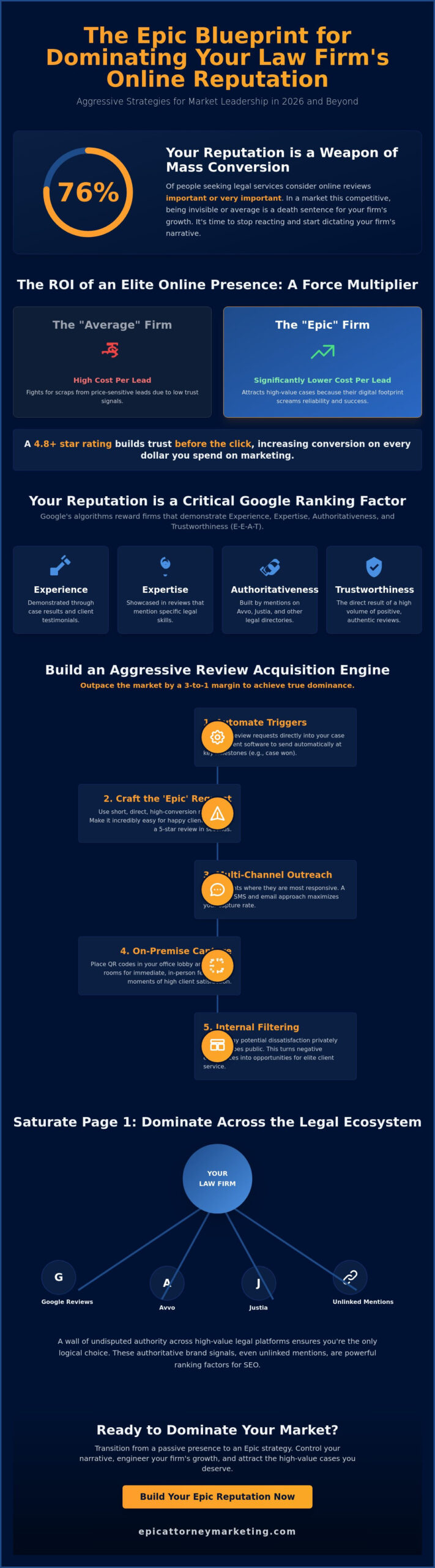
Your law firm's online reputation is not a vanity metric; it's a high-stakes weapon of mass conversion. If you are still asking how to improve my law firm's online reputation, you are already trailing the elite firms that treat their digital footprint like a tactical operation. Law Firm Owners who ignore this reality lose. In a market where 76% of people seeking legal services consider online reviews important or very important, being invisible or average is a death sentence for your growth.
You're likely tired of seeing high-value cases slip through your fingers because of a single stale review or a competitor's polished Avvo profile. It's time to stop reacting to feedback and start dictating your firm's narrative. We'll show you how to transform your digital presence into an elite, high-converting authority that dominates search results. This Epic blueprint covers the aggressive strategies needed for 2026, including compliance with the new SB 37 advertising mandates and the mechanics of a self-sustaining system that generates 100% positive Page 1 results.
Key Takeaways
- Stop playing defense and learn why total control of your digital narrative is the only way to win in 2026.
- Deploy an automated review acquisition engine that captures high-value feedback at the precise moments that matter most.
- Saturate Page 1 of Google by dominating high-authority platforms like Avvo and Justia to ensure you're the only logical choice.
- Master the tactical framework for how to improve my law firm's online reputation by turning negative feedback into a demonstration of elite professionalism.
- Transition from a passive presence to an Epic strategy that treats your firm's reputation as a scalable engine for market dominance.
What is Law Firm Reputation Management in 2026?
Your reputation is no longer a collection of "nice to have" comments on a profile. In 2026, it is the primary engine of your firm's growth. If you are still trying to figure out how to improve my law firm's online reputation by simply waiting for happy clients to speak up, you are losing. Passive management is a recipe for failure in a market where your competitors are actively weaponizing their social proof. You must move from a defensive posture to one of total digital narrative control. It's the difference between hoping for the best and engineering a win.
Law firm reputation management is the strategic saturation of Page 1 with authoritative brand signals. This process involves more than just monitoring; it requires the aggressive curation of every digital touchpoint a potential client encounters. Modern Reputation Management ensures that when a high-value lead Googles your name, they see a wall of undisputed authority. You aren't just managing feedback. You're engineering the perception of your dominance.
To better understand how these pieces fit into your overall strategy, watch this video on simplifying your marketing approach:
The ROI of an Elite Online Presence
An elite reputation is a direct force multiplier for your marketing budget. When your firm carries a 4.8 star rating or higher, your cost per lead drops significantly. Why? Because trust is built before the click. High-performing Law Firm Owners know that a stellar reputation increases the conversion rate of every dollar spent on PPC and social media. The "average" firm fights for scraps from price-sensitive leads. The "Epic" firm attracts high-value cases because their digital footprint screams reliability and success. This is how you scale without burning cash on low-quality traffic.
Reputation as a Search Ranking Factor
Google has evolved. Its algorithms now lean heavily on E-E-A-T signals: Experience, Expertise, Authoritativeness, and Trustworthiness. Your reviews and brand mentions aren't just for show; they're critical ranking signals. Google tracks how often your firm is mentioned across the web, even on high-authority legal sites where those mentions are unlinked. These "unlinked mentions" on platforms like Avvo or Justia serve as third-party validation of your status. If you want to dominate organic SEO, you must ensure your brand is consistently associated with excellence across the entire legal ecosystem. A fragmented or weak reputation will anchor your rankings, regardless of how much you spend on traditional SEO tactics.
Building an Aggressive Review Acquisition Engine
If your strategy for how to improve my law firm's online reputation relies on your staff remembering to ask for a review, you've already lost. Elite firms don't leave their growth to chance. They build a battle-tested engine that runs on autopilot. In 2026, the "Review Gap" is the distance between your firm and the top of the market. If your competitor has 100 reviews, you need 300. You must outpace the market by a 3-to-1 margin to achieve true dominance. This isn't about being liked; it's about making your firm the only logical choice for a high-value lead.
Dominance must be ethical. California's SB 37 and the ABA Model Rules are clear: no guarantees and no paying for testimonials. You can find detailed guidance on reputation management for law firms to ensure your aggressive tactics remain compliant. The goal is to capture authentic, high-impact feedback at the exact moment of peak client satisfaction. Research shows that 77% of consumers regularly read reviews, and 49% trust them as much as personal recommendations. If you aren't capturing that trust, you're handing cases to your competitors.
The 5-Step Automated Review Workflow
Successful firms treat review acquisition as a technical process. First, integrate review triggers directly into your case management software so requests send automatically when a milestone is hit. Second, craft the "Epic" request. It must be short, direct, and high-conversion. Third, use a multi-channel approach including SMS and email. Fourth, place QR codes in your office for immediate feedback. Finally, implement internal filtering. This allows you to address dissatisfaction privately before it ever reaches a public forum, protecting your brand's elite status. If you want to scale effectively, you need an automated reputation system that works while you're in court.
Optimizing Your Google Business Profile
Your Google Business Profile is the most important asset you own for local visibility. It's often the first thing a lead sees. To dominate, you must use keyword-rich review responses. When a client mentions a specific practice area, mirror that language in your reply to boost your local rankings. High-quality, professional photography is also non-negotiable. Grainy cell phone shots signal an average firm. Professional imagery builds instant trust and positions you as an authority before a single word of your copy is read. This is how you improve my law firm's online reputation while simultaneously crushing the local search results.
Saturating Page 1: Beyond Google Reviews
Search results are digital real estate. If you don't occupy all ten spots on Page 1, you're leaving the door open for intruders. To truly master how to improve my law firm's online reputation, you must extend your reach far beyond Google Reviews. You need to dominate the high-authority legal directories that Google trusts implicitly. Profiles on Avvo, FindLaw, and Justia aren't optional; they're tactical outposts. If these profiles aren't fully optimized and active, they're wasted space that a competitor's negative press could easily fill. Page 1 saturation is the only way to achieve total brand dominance.
Deploying law firm SEO acts as both a sword and a shield. By ranking your own assets, including your blog posts, partner bios, and directory profiles, you physically push negative or neutral content to Page 2. Nobody looks at Page 2. It's the digital equivalent of an unmarked grave. Your goal is to create a monolithic wall of positive, authoritative content that makes any detractor invisible.
Optimizing for AI Overviews and LLMs
AI search engines like Perplexity and Google Gemini don't just browse; they synthesize. They cite authorities they perceive as the most trustworthy based on a massive web of data. To be recommended by an AI, your firm needs consistent signals across the web. You must use structured data, specifically Schema markup, to feed these bots the exact information they need about your firm’s expertise and reputation. If the bots can't verify your elite status through structured data, you won't appear in "Top 10" AI-generated recommendations. This technical layer is now a cornerstone of modern reputation management.
The Power of Strategic Legal PR
Strategic PR isn't about vanity; it's about authority. Regular press releases secure high-authority backlinks that strengthen your overall domain. More importantly, they create positive news hits that Google loves to rank. When you position your partners as "Elite Experts" through guest contributions in respected legal journals, you're building a fortress. This massive influx of authority signals drowns out minor negative mentions. It’s a numbers game. When you flood the zone with high-level professional wins, a single bad review becomes a statistically irrelevant outlier. This is the aggressive path for those wondering how to improve my law firm's online reputation in a crowded market.
Neutralizing Negative Feedback: The Tactical Response Framework
A negative review is not a crisis. It is a tactical opportunity to showcase your elite professionalism to your next high-value lead. Most attorneys react emotionally, but winners react strategically. When you are looking at how to improve my law firm's online reputation, you must view every detractor as a prop on a stage. You aren't replying to the critic; you're replying to the $50,000 client who is currently vetting your firm. If you handle a hit with clinical precision, you prove you can handle their high-stakes legal matter with the same composure.
The Epic Golden Rule is simple: never argue, never get defensive, and never reveal client secrets. Violating attorney-client privilege in a public forum is a fast track to a Bar grievance. Instead, focus on the "Response for the Reader." If the review is a fake or a blatant competitor attack, flag it immediately. Platforms like Google have specific protocols for removal, but you must be persistent. While you wait for a platform to act, your public response should remain the picture of authority. This is how you improve my law firm's online reputation while others are busy winning shouting matches that nobody cares about.
The 3-Part Response Template
Success requires a standardized, battle-tested workflow. Use this three-part framework for every legitimate negative mention:
- The Acknowledge: Briefly state that you take all client feedback seriously. This shows you're attentive without admitting to any specific fault or malpractice.
- The Pivot: Move the conversation offline immediately. Provide a direct phone number or a specific name to contact. This protects the firm's privacy and stops a public thread from growing.
- The Reassurance: End with a statement about your firm's uncompromising standards. This part is strictly for the benefit of future readers who want to know that excellence is your baseline.
When to Take Legal Action
Defamation in the legal sector has a high bar for proof. Pursuing legal remedies for a bad review often triggers the "Streisand Effect," where your attempt to hide information actually draws more attention to it. Before you file a lawsuit, consult with an elite law firm marketing agency to evaluate the ROI of removal versus suppression. In many cases, it is more cost-effective to drown out a single negative voice with a flood of new, positive authority signals. If you are ready to stop playing defense and start dominating your market, contact us today for a strategic audit.
Scaling Your Dominance with Epic Reputation Strategy
Your reputation is the bedrock of digital marketing for attorneys. It's the invisible force that determines whether a lead clicks your ad or scrolls to the next firm in the search results. Elite firms don't hope for a good reputation; they engineer it through aggressive systems and clinical execution. If you're still asking how to improve my law firm's online reputation, you must shift your mindset from passive observer to master strategist. You aren't just managing reviews. You're building a fortress that makes your firm the only logical choice in your market.
Market dominance brings a specific type of freedom. When your digital footprint screams authority, you gain the leverage to increase your fees. You stop competing on price and start competing on prestige. This allows you to stop taking every case that walks through the door and start selecting high-value matters that actually drive ROI. A dominant reputation acts as a filter. It attracts the elite clients and repels the tire-kickers who drain your resources. Stop playing defense. Start building an Epic brand that dictates its own terms and leaves competitors fighting for scraps.
The Long-Term Asset: Brand Equity
A strong reputation is more than a conversion tool; it's a massive financial asset. If you ever plan to scale through mergers or eventually sell your practice, your brand equity will be the deciding factor in your firm's valuation. Reviews have a compounding effect. A decade of consistent 5-star feedback creates a lead generation engine that is nearly impossible for new competitors to disrupt. As you scale into multiple practice areas, this established trust follows you. It provides an immediate strategic advantage in every new market you enter. You're not just winning today; you're securing your firm's future value.
Your Next Move for Market Dominance
Dominance requires constant vigilance. You must conduct a regular "Reputation Audit" to identify current vulnerabilities before your competitors exploit them. This is not a job for amateurs or generalist vendors. You need a partner that understands the high-stakes, results-oriented nature of lawyer marketing. An effective audit should cover several critical areas:
- Identify every platform where your firm is currently mentioned or rated, including niche legal directories.
- Analyze the "Review Gap" between your firm and your top three local competitors.
- Scan for unlinked mentions that are failing to build your SEO authority.
- Evaluate your Google Business Profile for keyword optimization and high-impact professional imagery.
We specialize in transforming passive digital presences into elite authorities that own their search results. If you're ready to seize total control of how to improve my law firm's online reputation, the time for action is now. Get an Epic Reputation Audit for Your Firm Today and start your journey toward undisputed market leadership.
Secure Your Seat at the Top of the Market
Passive marketing is a luxury you can't afford in 2026. You've seen the blueprint for total digital saturation and the tactical frameworks required to neutralize detractors. If you aren't engineering your firm's reputation with clinical precision, you're leaving your growth to chance. Mastering how to improve my law firm's online reputation is the foundation for attracting high-value cases and scaling your practice beyond your current limitations. Your digital footprint should be an undeniable testament to your elite status.
Epic Attorney Marketing provides the strategic advantage needed to win. With over a decade of battle-tested legal marketing experience, we build custom reputation engines designed specifically for high-stakes law firms. Our results-first methodology focuses on total SERP dominance; we ensure that when potential clients search for you, they find a wall of authority. It's time to stop playing defense and start building a brand that commands respect and higher fees. Your path to the top starts with a single, decisive move.
Dominate Your Market with an Epic Reputation Strategy
Frequently Asked Questions
How do I remove a fake Google review for my law firm?
Flag the review through your Google Business Profile dashboard immediately by selecting the "report a violation" option. You must prove the content violates specific policies, such as spam or conflict of interest. If Google refuses to remove it, your only tactical move is suppression. Flood your profile with verified five-star reviews to push the fake hit out of sight.
Can I offer discounts or incentives for client reviews?
No. Offering any form of compensation for reviews violates ABA Model Rule 7.2 and state mandates like California's SB 37. Violations are high-stakes, with civil penalties ranging from $5,000 to $100,000 per instance. Ethical growth relies on automated systems that capture authentic feedback without resorting to prohibited "quid pro quo" tactics.
Which review sites matter most for attorneys in 2026?
Google Business Profile is the undisputed king for local visibility and map rankings. Beyond Google, you must dominate high-authority legal directories like Avvo, Justia, and FindLaw to build the E-E-A-T signals Google requires. AI search engines now pull from these specific platforms to determine which firms are worth recommending to potential clients.
How long does it take to see an ROI from reputation management?
You'll typically see a shift in conversion rates and lead quality within 30 to 60 days of deploying an automated engine. Long-term financial gains are even more significant as your authority grows. The average three-year return on investment for law firm SEO is approximately 526%, proving that a dominant digital footprint is a massive revenue driver.
Is it ethical to ask for reviews before a case is settled?
It's ethical and often more effective to ask for feedback during moments of peak satisfaction. You don't need to wait for a final settlement to request a review. Triggers like a successful motion or a positive consultation are the best times to capture the momentum of a winning relationship before the client moves on.
What happens if a competitor is posting negative reviews about my firm?
Document the pattern of the attack and report it to the platform's legal department as a violation of their terms of service. Coordinated attacks are often traceable and can be removed with persistent follow-up. While you fight the platform, focus on how to improve my law firm's online reputation by scaling your own legitimate review acquisition to drown out the malice.
How does my online reputation affect my SEO rankings?
Google treats your star rating and review velocity as critical trust signals within its ranking algorithm. High ratings and frequent feedback improve your click-through rate, which tells Google your firm is the most relevant choice. If your reputation is stagnant, your organic rankings will eventually drop as more active competitors take your place.
How much should a law firm spend on reputation management services?
Monthly retainers for active reputation management typically range from $500 to $10,000 depending on the firm's size and goals. Project-based work for removing or suppressing specific negative results can range from $1,000 to $50,000. Your investment should be scaled to the value of the cases you intend to win through your elite digital presence.