
If 88% of your potential clients are walking away because your site feels like a digital relic, you aren't just losing clicks. You are handing market share to your rivals on a silver platter. You know your firm is the elite choice, yet your current digital presence likely tells a different story. High bounce rates on expensive PPC campaigns and confusion over technical jargon like Core Web Vitals are symptoms of a failing strategy. It's time to stop settling for mediocre results.
Improving user experience on a lawyer's website is the tactical elimination of every barrier between a client's legal crisis and your firm's solution. We will transform your static digital brochure into a high-performance conversion engine that commands immediate authority and crushes the competition. This article provides the definitive 2026 roadmap for total market dominance. You'll learn to master the shift to AI-powered search, navigate the latest data privacy laws in states like Kentucky and Indiana, and implement the high-impact UX standards that turn casual visitors into your highest-quality leads. The era of passive marketing is over; it's time to scale.
Key Takeaways
- Stop treating your site as a cost center; learn why legal UX is the tactical foundation for scaling firm revenue and stopping budget leaks.
- Master the technical pillars of improving user experience on a lawyer's website by weaponizing Core Web Vitals and mobile-first logic to outperform local rivals.
- Align your information architecture with client psychology to answer urgent legal questions immediately and capture high-intent "panic search" leads.
- Build a high-performance conversion engine using psychology-driven CTAs and strategic trust signals that command authority without clutter.
- Execute a clinical audit of your current digital presence to identify friction points and prepare for a strategic overhaul that leaves competitors behind.
Beyond Aesthetics: Why UX is the Strategic Foundation of Law Firm Revenue
Most lawyers treat their website like a digital business card. That's a fatal mistake. In the high-stakes legal market, improving user experience on a lawyer's website is the tactical reduction of friction. It's about moving a person from a state of crisis to a state of relief by making your solution the easiest path to follow. Think of user experience design as the digital architecture of trust. It's the difference between a site that sits there and one that sells.
Elite firms have moved past the era of the "brochure site." They now operate high-performance conversion engines. These engines don't just look professional; they're engineered to capture intent. If your site is a maze of legal jargon and slow-loading pages, you're essentially telling potential clients you're too busy or too disorganized to handle their case. Friction is the enemy of revenue. Every unnecessary click is an opportunity for a lead to bounce and call the firm listed next in the search results.
To see how these principles apply to accessibility and law firm growth, review this analysis:
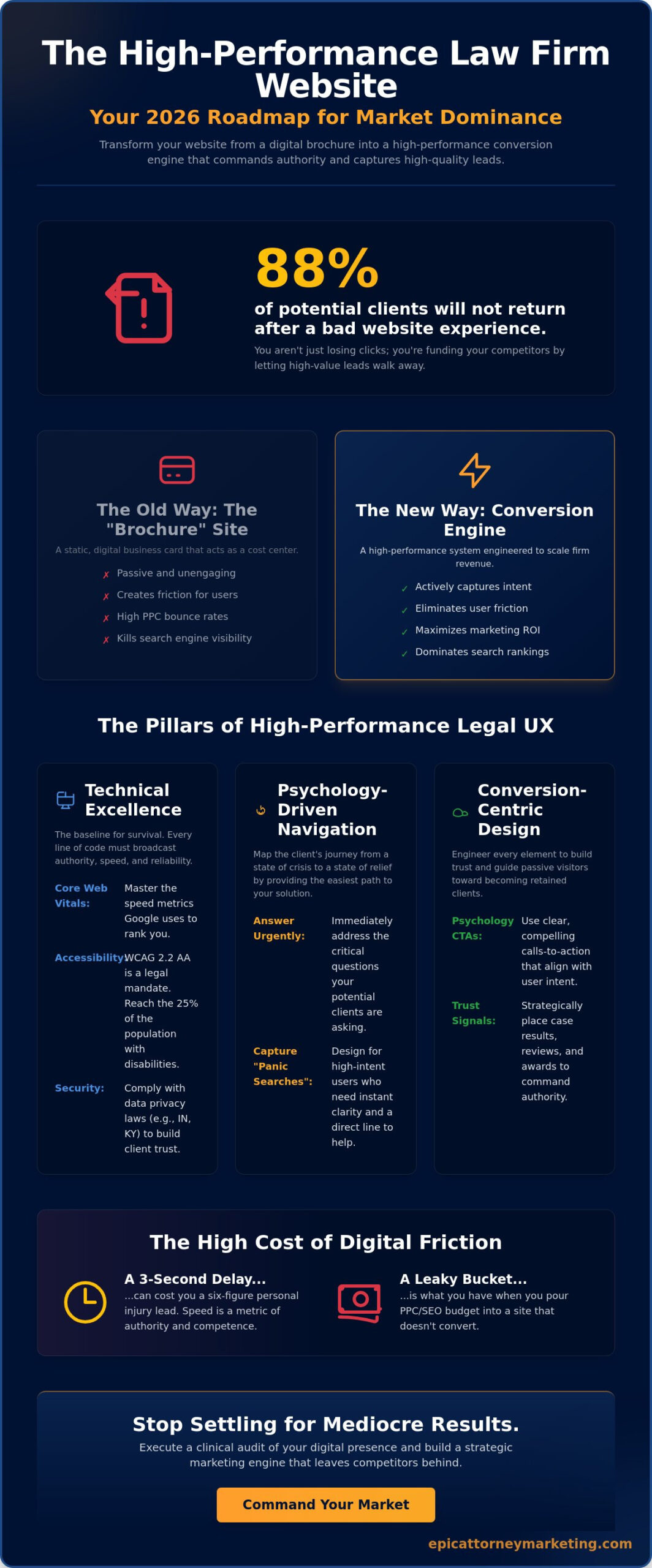
If your site is slow or confusing, you're pouring money into a leaky bucket. You can spend thousands on PPC or SEO, but if the landing page doesn't convert, you're just subsidizing your competitors. Data from The Modern Firm in January 2025 shows that 88% of consumers who have a bad experience on a website are unlikely to return. You don't get a second chance to make a first impression. In 2026, Google's search algorithms treat UX as a primary ranking signal, especially for "Your Money Your Life" (YMYL) content. A poor user journey doesn't just hurt your conversion rate; it actively kills your visibility.
The Cost of Friction in the Legal Sector
Speed is a metric of authority. A three-second delay in page loading can cost you a six-figure personal injury lead. When a potential client is in a "panic search" phase, they demand instant clarity. High-performance design sends an "Immediate Authority" signal that settles the user's anxiety. Relying solely on referrals for growth is a strategy for stagnation. You need a digital presence that commands respect before you ever pick up the phone.
UX as a Competitive Differentiator
Superior site flow is a weapon you can use to steal market share from established, slower-moving rivals. While they hide behind cluttered layouts and outdated tech, your firm can provide a seamless, trust-based journey. Your website is your 24/7 high-level negotiator. It should handle the heavy lifting of lead qualification and trust building while you focus on litigation. By improving user experience on a lawyer's website, you aren't just updating a design; you're upgrading your firm's ability to win.
The Technical Pillars of High-Performance Legal UX
Technical excellence isn't a "nice-to-have" feature. It's the baseline for survival. If your site's foundation is cracked, your marketing spend is wasted. Improving user experience on a lawyer's website starts with a clinical focus on the metrics that Google and your clients actually care about. This means moving beyond basic "responsive" design into a territory of high-performance stability. We follow rigorous U.S. Web Design System design principles to ensure every technical element serves a specific conversion goal. Every line of code must broadcast authority and reliability.
Accessibility is no longer just a moral choice; it's a legal mandate. As of April 24, 2026, the DOJ has set clear precedents for digital compliance under Title II. Law firms must adhere to WCAG 2.2 Level AA standards to mitigate litigation risk and expand their reach to the 25% of the population with disabilities. Simultaneously, your technical infrastructure must broadcast security. With new consumer data privacy laws active in Indiana, Kentucky, and Rhode Island as of January 1, 2026, your site needs to handle sensitive information and data access requests with surgical precision. If your site doesn't feel secure, high-value clients will never trust you with their cases.
Speed as a Conversion Metric
Performance is binary: you're either fast enough to capture a lead or slow enough to lose them. In 2026, the benchmark is clear. Sub-2-second load times are the minimum requirement for elite firms. Server-side optimization is the only way to maintain mobile user retention when every millisecond counts. Largest Contentful Paint is a critical lead-retention metric that measures how quickly the primary content of your page becomes visible to a user in crisis. If you aren't hitting these marks, you're effectively invisible to the market. Firms that dominate their local area prioritize custom website design to ensure their technical performance outpaces every competitor.
Mobile Optimization for the Client in Crisis
Mobile users account for 60% of all online traffic. These aren't people browsing for fun. They're often in high-stress situations, searching with one hand while dealing with a legal emergency. Improving user experience on a lawyer's website for mobile means offering "app-like" performance on a standard browser. Lead forms must be ergonomically designed for thumb navigation, and click-to-call buttons must be prominent and functional. If your mobile flow is clunky or requires excessive pinching and zooming, you've already lost the lead. You need a mobile interface that facilitates a seamless transition from panic to consultation.
Psychology-Driven Navigation: Mapping the Crisis-to-Consultation Journey
Most law firms design their websites to stroke the partners' egos. Elite firms design for the client's mental state. Improving user experience on a lawyer's website isn't about aesthetics; it's about psychological engineering. When a potential client lands on your site, they're usually in one of two modes: "Panic Search" or "Research Search." A victim of a sudden car accident needs a "Call Now" button and immediate reassurance. A corporate client looking for long-term litigation support needs deep authority and structured data. If your navigation doesn't segment these paths instantly, you're losing half your audience before they even scroll.
Information architecture is the silent killer of conversion rates. If a user has to hunt for your practice areas, they'll leave. You must organize your site to answer the user's primary question: "Can this person solve my specific problem?" By following established Usability.gov guidelines, we know that reducing cognitive load is essential. Every unnecessary menu item or confusing label creates a "micro-frustration" that erodes trust. With Google's May 2026 shift to an AI-powered default search experience, your site's structure must also be clear enough for AI summaries to extract and present your expertise accurately to users before they even click.
The 3-Second Rule for Practice Area Clarity
You have three seconds to signal that the user is in the right place. If your hero section is filled with vague imagery of gavels or skylines instead of clear, jargon-free practice area headers, you're failing. Eliminate the legalese. Use "Car Accident Lawyer" instead of "Plaintiff's Tort Litigation." At this critical decision point, strategic placement of social proof is mandatory. A single, high-impact testimonial near your primary practice header can validate the user's choice and stop the "Panic Search" in its tracks. Don't make them look for your wins; put them front and center.
Streamlining the Path to Contact
Users don't read; they scan. Research confirms that 79% of people scan for keywords rather than reading full paragraphs. We utilize the "F-Pattern" of digital reading to place your most critical information where eyes naturally land. This is where custom law firm website design becomes a tactical advantage. Your "About" page shouldn't be a dry biography of your law school honors. It's a sales tool designed to humanize the firm and bridge the gap between a digital screen and a physical consultation. Every element of the layout should guide the user toward the contact form with clinical precision. If your navigation feels like a labyrinth, your prospective clients will find the exit long before they find your phone number.
Conversion-Centric Design: Turning Passive Visitors into Retained Clients
Passive traffic is a vanity metric. If your visitors don't convert, your SEO and PPC budgets are effectively donations to your competitors. Improving user experience on a lawyer's website requires a clinical focus on the conversion event. You don't want "users"; you want retained clients. This transition happens when design meets psychology. High-converting calls-to-action go beyond the generic "Contact Us" button. Use action-oriented language that promises a specific outcome, such as "Start My Case Evaluation." In 2026, the demand for immediacy is absolute. Live chat and AI concierges are no longer optional. They serve as your digital intake team, providing the instant response that modern legal clients demand.
Trust signals must be woven into the fabric of the site. Most firms hide their best testimonials on a dedicated "Reviews" page where no one goes. Place them contextually near lead forms to provide the final push a hesitant lead needs. Clutter is the enemy of authority. Your site must present awards, case results, and reviews in a way that reinforces your expertise without overwhelming the user's primary journey. If your design doesn't immediately validate your firm's success, you're asking the client to take an unnecessary risk.
Designing for Trust and Authority
Visual hierarchy is your most potent tool. Use color and scale to highlight your firm’s wins and primary conversion points. Generic stock images scream mediocrity and erode trust instantly. High-quality photography of your actual team and office broadcasts real-world expertise and stability. When improving user experience on a lawyer's website, your client testimonials must be contextually placed near lead forms to provide social proof at the exact moment of decision.
Maximizing Lead Capture Efficiency
Form friction is a silent revenue killer. There's a direct mathematical relationship between the number of fields in your form and your conversion rate. Every extra field is a barrier. For high-intent legal leads, multi-step forms often outperform single-page lists by reducing perceived effort. We use the "Yes-Ladder" technique, starting with low-friction micro-conversions that build momentum toward a full consultation request. Integrating law firm marketing automation directly into the UX ensures that every captured lead is nurtured immediately. Ready to stop losing leads? It's time to maximize your conversion engine through strategic design.
Strategic Implementation: Building Your Firm’s Marketing Engine
Market leaders don't tinker at the edges of their digital presence. They build engines designed for total dominance. Improving user experience on a lawyer's website is not a one-time design project; it's a clinical, ongoing strategic operation. If you're merely making incremental changes to an outdated site, you're wasting time. You're essentially putting a new coat of paint on a failing structure. A strategic overhaul is the only way to ensure your firm remains the primary choice in an increasingly aggressive 2026 landscape.
Your competitors are likely satisfied with "good enough." This is where you crush them. By identifying the specific leak points in your current user journey, you stop hemorrhaging high-value leads. We use heatmaps and A/B testing to observe exactly how potential clients interact with your content. This isn't guesswork. It's a data-driven approach that ensures every pixel on your site serves the bottom line. Continuous optimization is the only way to maintain your lead and force local rivals into a state of permanent catch-up.
The Epic Audit Process
The first step toward dominance is a surgical analysis of your current performance. We analyze user behavior data to pinpoint where high-value leads are dropping off and why. Our technical stress-testing ensures your site exceeds 2026 mobile and speed standards, including the rigorous Core Web Vitals discussed in previous sections. This audit aligns your site architecture with your broader digital marketing for attorneys goals. We don't just find problems; we engineer the solutions that turn your digital presence into a high-performance asset.
Your Path to Total Market Dominance
The ROI of a high-performing marketing engine is measured in decades, not just months. When you commit to a website built for authority and conversion, you aren't just buying a service. You're securing your firm's future. Epic Attorney Marketing acts as the master strategist for elite firms that refuse to settle for mediocre results. We execute the design strategies that command respect and convert traffic with clinical precision. The market won't wait for you to catch up. It's time to claim your territory and dominate your local area. Contact Epic Attorney Marketing today to begin your strategic overhaul.
Secure Your Firm's Digital Dominance
The window for mediocrity has closed. In 2026, your website is either a high-performance conversion engine or a liability that benefits your competitors. By mastering technical pillars like Core Web Vitals and implementing psychology-driven navigation, you transform your digital presence from a static brochure into a relentless lead generator. Improving user experience on a lawyer's website is the single most effective tactical move you can make to stop the leak in your marketing budget and command authority.
Epic Attorney Marketing has spent over a decade establishing market dominance for elite firms. We specialize in high-stakes legal niches, delivering custom, mobile-responsive designs that convert at the highest levels. Don't let your rivals claim the territory you deserve. It's time to stop the attrition and start scaling with a partner that understands the mechanics of growth. Your firm is ready for the next level; make sure your digital foundation is as strong as your legal reputation.
Stop Leaking Leads—Build Your High-Performance Marketing Engine Today
Frequently Asked Questions
How does user experience (UX) specifically impact my law firm's SEO rankings?
User experience directly dictates your visibility because search engines prioritize user satisfaction metrics. Google's 2026 algorithms use Core Web Vitals and engagement signals like bounce rate to determine your site's relevance. If users flee your page in seconds, your rankings will tank regardless of your backlink profile. High-performance UX keeps visitors engaged, signaling to search engines that your firm is the authoritative answer to the user's crisis.
What are the most common UX mistakes that cause potential clients to leave a lawyer's website?
Most firms kill their conversion rates with slow loading speeds and excessive legalese that creates cognitive friction. If a potential client can't find your phone number or understand your practice areas within three seconds, they'll leave for a competitor. Cluttered layouts and generic stock imagery also erode the trust necessary for high-stakes legal retention. You must eliminate every barrier between the user's problem and your solution.
Is a custom website design necessary for good UX, or can I use a template?
Custom website design is the only way to achieve total market dominance. Templates are rigid and often bloated with unnecessary code that slows down your site's performance. A custom build allows you to engineer a specific conversion path tailored to your firm's high-value practice areas. If you want to outperform local rivals, you can't rely on the same generic framework they're using.
How can I measure if my law firm's website has a good user experience?
You measure UX by analyzing hard data like conversion rates, bounce rates, and technical metrics in Google Search Console. Heatmaps and session recordings provide a clinical view of where users encounter friction or abandon the journey. If your lead volume isn't growing at the same rate as your traffic, your UX is failing. Measurement is binary; your site either converts or it doesn't.
Does adding more content to my site negatively affect the user experience?
Content only hurts UX if it's poorly structured or irrelevant to the user's intent. Strategic content development uses clear headings and bullet points to ensure information is scannable for the 79% of users who don't read full paragraphs. When executed correctly, deep content builds your E-E-A-T signals and authority without creating cognitive overload. It's about quality and structure, not just word count.
How much does improving the UX on a lawyer's website typically cost?
The investment required for improving user experience on a lawyer's website depends on your firm's specific growth targets and current technical debt. View this as capital expenditure for a high-performance marketing engine rather than a simple overhead expense. The real cost isn't the redesign; it's the six-figure leads you lose every month to a site that fails to convert visitors into clients.
What is the difference between UI and UX for legal websites?
User Interface (UI) is the visual skin of your site, while User Experience (UX) is the strategic skeleton. UI covers your color palette, typography, and button styles. UX focuses on the psychological journey from the initial search to the final consultation request. A beautiful UI is useless if the UX is confusing; you need both to command authority and drive measurable lead volume.
How often should a law firm update its website design to maintain a top-tier user experience?
Elite firms perform a strategic overhaul every two to three years to stay ahead of evolving technical standards and competitor moves. However, optimization should be a continuous, data-driven process rather than a one-time event. If you wait five years to update your digital presence, you're effectively handing your market share to more aggressive rivals who prioritize modern performance standards.