
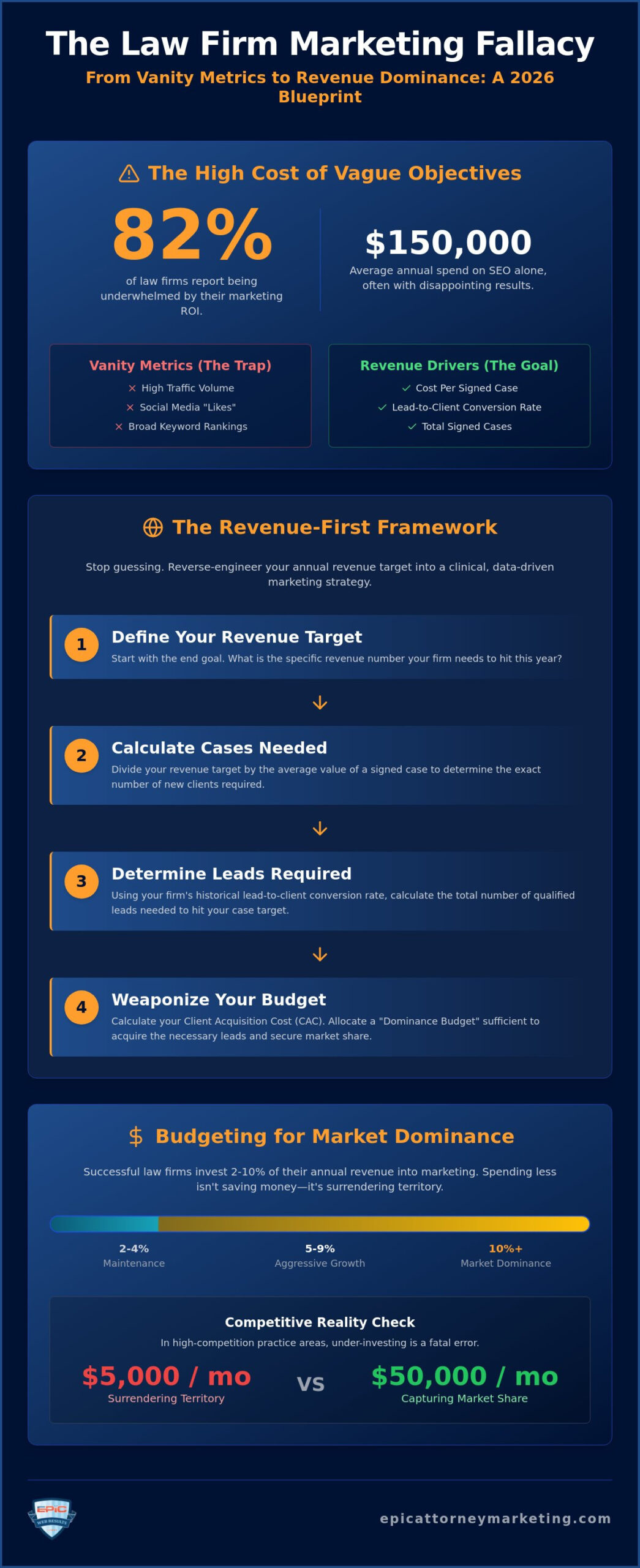
Why are you celebrating a traffic spike when your firm’s billable hours are flatlining? It’s a bitter pill to swallow, but 82% of law firms report being underwhelmed by their ROI despite the average firm spending up to $150,000 annually on SEO alone. You’ve likely felt the frustration of wasted ad spend and the fog of technical jargon that leads nowhere. Setting realistic marketing goals for a law firm isn’t about playing it safe or lowering your expectations. It’s about using cold, hard data to weaponize your budget for maximum impact.
You deserve a clear roadmap to predictable revenue and the confidence that your marketing spend is actually moving the needle. We’re going to stop chasing vanity metrics and start reverse-engineering your revenue targets into a high-octane strategy. This 2026 blueprint reveals the exact mechanics of market dominance. We’ll explore how to transition from inconsistent lead flow to total practice area authority using proven tactics in SEO, PPC, and AI-driven automation.
Key Takeaways
- Stop burning capital on vanity metrics and discover why high traffic without strategic conversion is a liability, not an asset.
- Master the Revenue-First Framework for setting realistic marketing goals for a law firm by reverse-engineering your annual targets into actionable math.
- Weaponize your growth strategy by shifting from “attainable” targets to aggressive market positioning that forces competitors out of your practice area.
- Identify the elite KPIs that dictate your P&L, focusing on the only metric that truly matters: Cost Per Signed Case.
- Transition from passive maintenance to a high-octane marketing operation designed for total market dominance in 2026.
The Fallacy of “More Leads”: Why Most Law Firm Marketing Goals Fail
Most law firms are drowning in data but starving for profits. They chase “more leads” as if volume alone guarantees a healthy practice. This is a fatal strategic error. Traffic is a vanity metric; it looks impressive on a monthly report but does nothing to pay your overhead. If your marketing agency is bragging about clicks while your phone stays silent, you’ve fallen into the volume trap. Setting realistic marketing goals for a law firm requires moving past superficial numbers and confronting the Lead Quality Gap.
A wish list is a hope. A blueprint is a weapon. High-performing firms don’t just “want to grow.” They build a comprehensive marketing plan that treats every marketing dollar as a soldier sent to capture market share. If your objective is simply “more traffic,” you’re effectively inviting everyone to your front door without verifying if they actually have a case. This lack of precision is why so many firms see their budgets evaporate into the void of low-intent search queries.
To better understand how these objectives should function in a competitive environment, watch this strategic breakdown:
Vanity Metrics vs. Revenue Drivers
Rankings are a means, not an end. If you’re ranking for broad terms that don’t convert, you’re losing money. Data from the 2026 research brief indicates that 72% of law firms are now shifting their focus toward higher-quality leads rather than sheer volume. Social media “likes” and high-level traffic stats are digital noise. Revenue drivers are the KPIs that actually impact your P&L. You must define success by signed cases and lead-to-client conversion rates. Anything else is just a distraction from your bottom line.
The High Cost of Vague Objectives
Vague goals are the fastest way to burn a budget. When you tell a vendor you want to “increase visibility,” you’re giving them permission to waste your capital on broad, expensive PPC campaigns. This ambiguity explains why 82% of law firms report being underwhelmed by their marketing ROI. 2026 requires an aggressive stance. You aren’t in this to merely participate; you’re here to dominate your practice area. Setting realistic marketing goals for a law firm means choosing targets that are measurable, unapologetically ambitious, and tied directly to your revenue targets.
The Revenue-First Framework: Reverse-Engineering Your Marketing Math
Stop guessing. Marketing is not a creative exercise; it is a clinical calculation. If you cannot map your annual spend to a specific revenue outcome, you are gambling with your firm’s future. High-achieving partners don’t start with a budget and hope for the best. They start with a revenue target and work backward to the dollar. Understanding the core elements of a professional services marketing plan is the first step in moving from emotional guesswork to a data-driven strategy. This reverse-engineering process is the only reliable way of setting realistic marketing goals for a law firm that actually intends to win.
To dominate your market in 2026, you must establish a “Dominance Budget.” Verified data shows law firms typically spend between 2% and 10% of their annual revenue on marketing. If you are in a high-competition practice area like Personal Injury, your budget must lean toward the aggressive end of that spectrum. This isn’t just about spending money. It’s about securing market share. If your competitors are spending $50,000 a month on digital channels and you are spending $5,000, you aren’t “saving money.” You’re surrendering your territory. If your current trajectory feels stagnant, our advanced Lead Generation systems can help realign your spend with your growth ambitions.
Defining Your Client Acquisition Cost (CAC)
Your Client Acquisition Cost is the heartbeat of your firm’s profitability. To calculate it, divide your total marketing spend by the number of signed cases over a specific period. You must track this across every channel, including SEO, PPC, and content development. The “Golden Ratio” for a healthy law firm is maintaining a CAC that allows for significant profit margins after overhead. For attorneys, an elite CAC should never exceed 33% of your average case value, effectively securing a 3:1 ROI as the absolute baseline for your firm’s growth. If you don’t know this number for every practice area, you don’t have a strategy; you have a leak.
Determining Necessary Lead Volume
Once you have your revenue target and average case value, the math becomes undeniable. If you need 100 new cases to hit your goal and your lead-to-client conversion rate is 10%, you need 1,000 leads. However, you must account for “ghost leads.” Research indicates that 26% of law firms do not respond to online leads at all, and many inquiries will be unqualified. You must over-provision your lead volume to compensate for these variances. Setting realistic marketing goals for a law firm also requires acknowledging practice area volatility. A Criminal Defense firm might need a high volume of lower-value leads, while a high-stakes PI firm focuses on a smaller pool of catastrophic injury cases. Adjust your lead volume targets to match the specific rhythm of your practice.
SMART Goals vs. Aggressive Market Positioning
Standard marketing advice tells you to be “attainable.” In a hyper-competitive legal market, attainable is just another word for invisible. If your goal is to merely match your competitors, you’ve already lost. True market dominance requires a shift from passive participation to aggressive positioning. Setting realistic marketing goals for a law firm in 2026 means using cold data to determine what it takes to crush the competition, not just survive alongside them. You aren’t building a practice to be one of many; you’re building it to be the only choice.
Competitive intelligence is your primary weapon. Consider that 75% of potential clients visit between two and five websites before making contact. If your goals don’t position you as the undisputed authority among those five, your budget is effectively subsidizing your competitor’s growth. You must look at critical marketing goals through the lens of offensive strategy. Every milestone you set should be a calculated step toward making your firm the inevitable destination for high-value cases.
The Problem with “Attainable” Goals
Safe goals allow your rivals to steal your market share while you pat yourself on the back for hitting a low bar. When we talk about “Attainable,” we mean “Strategic.” It’s about resource allocation. If you want to own the Personal Injury space in your city, an attainable goal is one backed by the necessary capital and technical execution to displace the current leader. This is how Epic Attorney Marketing builds Lawyer Marketing plans that prioritize dominance over mere presence. We don’t aim for the middle of the pack. We aim for the top. Anything less is a waste of your firm’s potential.
Specific and Measurable: The Technical Edge
Stop setting vague objectives like “getting more calls.” That’s amateur hour. Your goals must be surgically precise. You need to aim to “increase high-value PI leads by 25% via organic search within six months.” This level of specificity forces accountability. It requires implementing tracking systems that leave no room for ambiguity or “gut feelings.” If you can’t measure the exact source of a signed case, you can’t scale your success.
Every goal must be tied to your firm’s highest-margin practice areas. Don’t waste your energy ranking for low-value terms that don’t move the needle on your P&L. Setting realistic marketing goals for a law firm requires a ruthless focus on relevancy. If a marketing activity doesn’t directly contribute to signed cases in your most profitable sectors, cut it. Your milestones must be time-bound and high-stakes to create the urgency required for rapid scaling. Dominance is not a long-term dream; it’s a series of short-term, aggressive victories.
Benchmarking Success: KPIs That Actually Impact Your P&L
Stop measuring what doesn’t matter. If your metrics don’t show up in your bank account, they’re digital clutter. Traffic is a ghost; revenue is the reality. Setting realistic marketing goals for a law firm requires a ruthless focus on KPIs that directly influence your Profit and Loss statement. While mediocre agencies report on impressions, elite firms track the Cost Per Signed Case. This is the only figure that truly dictates your ability to scale. If you don’t know exactly what it costs to put a new file on your desk, you aren’t managing a strategy. You’re managing a liability.
Lead response time is the silent killer of legal marketing ROI. Research shows that 26% of law firms do not respond to online leads at all. Even a five-hour delay can cost you a high-value case. In 2026, a response under five minutes isn’t a goal; it’s a requirement for survival. If you’re spending thousands to generate leads only to let them die in an unmonitored inbox, you’re subsidizing your competitors. Speed to lead is the ultimate competitive advantage.
SEO and Organic Growth Metrics
Organic search is the backbone of sustainable firm growth, driving 66% of all call conversions in the legal industry. You must measure your Law Firm SEO health by your Organic Authority Score and your ownership of SERP real estate. This means ranking for high-intent “money” phrases that indicate a ready-to-hire client, not just general informational queries. High-performance Content for Law Firm Websites must be engineered to increase dwell time and build immediate trust. If your site doesn’t project total authority within the first three seconds, your organic traffic will bounce to the next listing.
PPC and Direct Response Metrics
Paid search is a high-stakes auction where only the precise survive. Setting realistic marketing goals for a law firm involves maintaining aggressive click-through rates (CTR) on high-intent ad copy. However, a click is useless without conversion. You must benchmark your landing page conversion rates against industry leaders and ruthlessly purge wasted spend through “Negative Keyword” lists. Stop paying for clicks from people looking for “free legal advice” when you want high-value litigation. If your current PPC strategy feels like a black hole for cash, it’s time to audit your marketing engine and stop the bleeding.
Scaling for Dominance: Implementing Your 2026 Marketing Engine
Maintenance is a death sentence. If your firm is just “keeping the lights on” with its marketing, you’re losing territory every day. Setting realistic marketing goals for a law firm in 2026 requires an aggressive pivot from passive spending to a high-octane growth engine. With 79% of legal professionals already integrating AI into their workflows, the barrier to entry has vanished. The market is saturated. To survive, you must view your marketing as a high-level strategic operation, not a back-office expense. You are either the predator or the prey in this environment. There is no middle ground for those who want to lead.
Surviving 2026 means deploying elite-tier Digital Marketing for Attorneys. This isn’t about DIY templates or generalist advice. It’s about surgical precision. You need a partner who understands that a five-hour delay in lead response is a financial catastrophe. Vetting an agency shouldn’t be about their “creative vision.” It should be about their clinical commitment to your specific revenue targets and their proven ability to execute under high-stakes pressure. If they can’t explain the math behind your growth, they don’t belong at your table. You need a strategist, not a vendor.
The Elite Strategic Partner Advantage
Boutique agencies outperform massive “lawyer mills” every single time. Dominance requires customization, not a production line. Massive agencies treat your firm like a number, applying the same stale strategies to every client in their portfolio. This approach fails because it ignores the unique competitive landscape of your specific practice area. Specialized legal expertise in SEO and PPC allows for the identification of high-intent “money” phrases that generalists miss. Epic Attorney Marketing doesn’t just build websites; we turn underperforming digital assets into high-velocity lead generation engines. We focus entirely on the mechanics of winning and scaling your firm’s profitability.
Your Next Steps to Market Dominance
Stop tolerating mediocrity. Your first step is a ruthless audit of your current trajectory. Are you setting realistic marketing goals for a law firm that actually wants to lead, or are you just following the pack? If your goals don’t make your competitors nervous, they aren’t ambitious enough. Cut the dead weight of underperforming channels that offer high “visibility” but zero signed cases. Your capital is too valuable to waste on vanity metrics. Focus your resources on the 20% of activities that drive 80% of your revenue. This clinical approach to growth is what separates the market leaders from the also-rans.
Ready to stop participating and start dominating? Contact Epic Attorney Marketing today. We’ll build your custom 2026 growth blueprint and weaponize your marketing for total market superiority. The time for “steady growth” is over. The time for dominance is now.
Weaponize Your Strategy for Total Market Superiority
The era of passive growth is dead. You’ve seen the blueprint; now it’s time to execute. Dominance isn’t achieved by accident or by following the crowd. It’s built through the clinical application of revenue math and a relentless focus on the KPIs that actually dictate your P&L. Setting realistic marketing goals for a law firm in 2026 requires you to abandon safe, middle-of-the-road objectives in favor of aggressive market positioning. If your strategy doesn’t force your competitors to react, it isn’t a strategy at all. It’s just a wish list.
You need a partner who is as ambitious as you are. With over a decade of specialized legal marketing experience, Epic Attorney Marketing has a proven track record of turning underperforming websites into high-velocity lead-generation engines. We don’t offer creative experiments; we provide results-oriented strategic partnerships designed for firms that refuse to finish second. Stop settling for average and start dominating your market; get your custom growth blueprint from Epic Attorney Marketing today. Your future market share depends on the decisions you make right now. Let’s start winning.
Frequently Asked Questions
What is a realistic marketing budget for a law firm in 2026?
A realistic budget typically falls between 2% and 10% of your annual revenue. For firms seeking aggressive expansion, monthly digital spends often range from $5,000 to $50,000 across SEO, PPC, and lead generation channels. You must view these funds as a strategic investment in market share rather than a simple overhead cost. Anything less than this range often fails to provide the momentum required for total dominance.
How long does it take to see ROI from law firm SEO?
You should expect to see significant movement within six to twelve months. SEO is a high-stakes, long-term play for total practice area authority. While initial technical wins occur quickly, true market dominance requires consistent backlink building and content development. It remains the most sustainable way to lower your client acquisition cost over time while securing 66% of industry call conversions.
What is the average cost per lead for personal injury lawyers?
Average costs vary wildly based on your specific geographic market and the level of competition. High-competition cities naturally demand a higher investment to secure top-tier leads than rural areas. Instead of focusing on a generic number, you should calculate your allowable acquisition cost based on your average case value. This ensures your marketing math remains profitable regardless of market fluctuations.
Can I set marketing goals without historical data?
You can start by reverse-engineering your desired revenue targets using industry benchmarks. Use standard lead-to-client conversion rates to estimate the volume you need to hit your billable hour goals. Setting realistic marketing goals for a law firm without data requires a commitment to tracking every click from day one. This builds the foundational data set you’ll need for future aggressive scaling.
How often should a law firm revisit its marketing goals?
You must audit your KPIs monthly and perform a deep strategic review every quarter. The legal market moves fast, especially with the 79% AI adoption rate among professionals. Monthly check-ins allow you to pivot spend away from underperforming channels quickly. Quarterly reviews ensure your tactical execution still aligns with your firm’s high-level growth ambitions and market positioning.
Why is my law firm website getting traffic but no cases?
You likely have a lead quality gap or a conversion bottleneck. High traffic is useless if it comes from low-intent search queries or if your website friction is too high. Check your lead response time immediately. Since 26% of firms fail to respond to online leads, you can win simply by being faster. If you don’t answer within five minutes, your traffic will find a competitor who does.
Is PPC or SEO better for reaching aggressive growth goals quickly?
PPC delivers immediate lead flow, while SEO builds long-term market equity. For aggressive growth goals, a dual-track approach is mandatory. Use PPC to capture immediate market share and SEO to dominate organic search results where the highest quality leads reside. Relying on just one channel leaves your firm vulnerable to sudden algorithm shifts or rising ad costs.
What are the most common mistakes attorneys make when setting goals?
The most common errors include chasing vanity metrics and setting vague, low-stakes objectives. Many attorneys under-budget for their actual competition, failing to recognize that dominance requires out-investing the current market leader. Avoid the trap of “attainable” goals that allow your rivals to steal your territory. Precision and aggression are the only paths to a high marketing ROI.