
If 85% of your potential clients trust Google reviews as much as a personal recommendation, your lack of a strategic social proof engine isn't just a missed opportunity; it's professional negligence. You've likely watched competitors with half your experience capture the market share you deserve because they look more credible on a search results page. It's frustrating to see mediocre firms win simply because they've mastered the optics of authority while 92% of prospects read at least five reviews before calling. You want to scale, but the threat of a State Bar investigation keeps your growth strategy stuck in the past. Successfully using client testimonials in law firm marketing is the only way to bridge the gap between your actual expertise and your public perception.
This article provides the tactical blueprint to weaponize your reputation while remaining bulletproof against regulatory scrutiny. We promise to show you how to deploy social proof that forces prospects to choose your firm over any other option. We will dissect SB 37 compliance protocols in effect as of January 2026, actor portrayal disclaimers, and the specific conversion frameworks needed to secure total market superiority.
Key Takeaways
- Identify the psychological drivers behind the modern "Trust Deficit" and why social proof is mandatory for converting high-value leads.
- Master the ethical framework for using client testimonials in law firm marketing to achieve market dominance without triggering State Bar scrutiny.
- Transition from generic five-star reviews to high-impact narratives using a proven conflict, action, and resolution structure.
- Execute a multi-channel distribution strategy that embeds social proof into practice area pages and high-intent PPC landing pages.
- Construct an automated reputation management system that transforms client success into a permanent, self-sustaining lead generation engine.
The Psychology of Social Proof: Why Testimonials Are Non-Negotiable in 2026
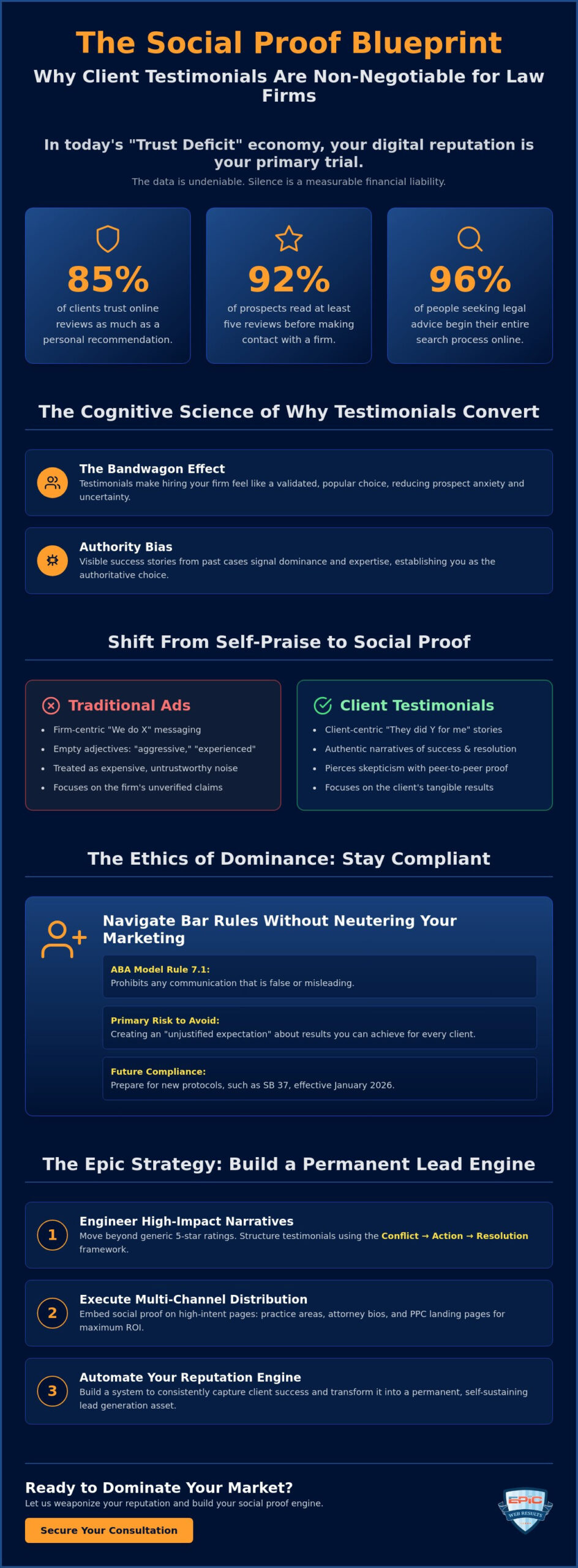
Social proof in a high-stakes legal environment is the difference between a prospect clicking your phone number or bouncing to your competitor's site. It is not just about being liked. It is about establishing an undeniable track record of victory that bypasses a prospect's inherent skepticism. The Psychology of Social Proof dictates that when people are uncertain, they look to the actions of others to determine the correct behavior. Since 96% of people seeking legal advice begin their search online, your digital presence is your primary trial. If you lack visible evidence of success, you've already lost the case before it even starts.
The "Trust Deficit" is a massive barrier for any firm looking to scale. Modern prospects start from a place of deep-seated doubt; they assume your marketing is a polished facade designed to hide mediocre results. Using client testimonials in law firm marketing allows you to break through this wall by letting your results speak through the voices of those you've served. While you might see testimonials as a compliance hurdle, your competitors are using them as aggressive weapons. When a firm has 100+ reviews and you only have five, the market perceives them as the safer, more authoritative choice. Silence is not neutral. It is a measurable financial liability that drains your ROI.
To better understand this concept, watch this helpful video:
The Cognitive Science of Legal Hiring
Hiring a lawyer is an anxiety-ridden process. Prospects face a massive information asymmetry where they don't understand the law and feel vulnerable to exploitation. Testimonials trigger the Bandwagon Effect, making the choice to hire you feel validated by a crowd. They also leverage Authority Bias, where your success in previous cases signals your dominance in the current one. Beyond the legal outcome, "soft skills" testimonials about communication and empathy reduce the fear of that first consultation. These stories act as cognitive shortcuts. They allow a client to stop overthinking and start trusting. When 85% of clients trust Google reviews as much as personal recommendations, these shortcuts become your most valuable conversion assets.
Testimonials vs. Traditional Advertising
Traditional legal ads are often just expensive noise. Every lawyer claims to be aggressive, experienced, and dedicated. To a savvy prospect, these are empty adjectives. Peer-to-peer communication is the only thing that pierces the bubble of self-praise. Clients trust strangers on the internet more than they trust your "About Us" page. By transitioning from firm-centric "We do X" messaging to client-centric "They saved my business" narratives, you shift the focus to the only person that matters: the client. This is the foundation of effective lawyer marketing and a core pillar of digital marketing for attorneys. You aren't just selling legal services; you're selling the peace of mind that comes from proven reliability.
The Ethics of Dominance: Navigating Bar Rules Without Neutering Your Marketing
Compliance is not a suggestion. It's a survival requirement. Many law firms neuter their marketing out of a misplaced fear of disciplinary action, but you don't have to sacrifice impact for safety. Using client testimonials in law firm marketing requires a sophisticated understanding of the boundary between aggressive promotion and ethical violation. ABA Model Rule 7.1 is the baseline. It prohibits any communication that is false or misleading. A testimonial becomes a liability the moment it creates an "unjustified expectation" about the results you can achieve. You aren't just selling a dream; you're documenting a reality within a strict legal framework.
The stakes reached a new peak on January 1, 2026, with the implementation of California’s SB 37. This law demands total transparency. Every advertisement must identify a licensed attorney responsible for the content and disclose a physical office location. If you use actors to portray clients, a clear "Dramatization. Actor portrayal" disclaimer is mandatory. The cost of cutting corners is astronomical. Violations of SB 37 now carry penalties ranging from $5,000 to $100,000 per occurrence. Beyond state rules, you must also account for FTC rules on consumer testimonials, which target fake reviews and the suppression of negative feedback with clinical precision.
Mandatory Compliance Framework
To remain bulletproof, you must eliminate the word "guarantee" from your vocabulary. Instead, focus on the process and the client's experience. Every high-impact testimonial should be paired with a conspicuous disclaimer stating that "prior results do not guarantee a similar outcome." This doesn't diminish your credibility; it reinforces your professional integrity. The "Truth in Advertising" standard requires that every claim is verifiable. If a client mentions a specific settlement amount, you must have the documentation to back it up. If you're concerned about your firm's current exposure, an expert reputation management audit can identify and neutralize potential ethical landmines.
LinkedIn and Third-Party Platform Ethics
Third-party platforms are a double-edged sword. You can't always control what a client posts on Google or Yelp, but you are responsible for what you "adopt" or "incorporate" into your own marketing. LinkedIn endorsements and recommendations are particularly dangerous. They can often include prohibited language or misleading praise that you didn't solicit. You must monitor these platforms relentlessly. Your primary social proof should never live exclusively on a platform you don't own. Your law firm website design must serve as the central, controlled hub for your testimonials. This allows you to frame the narrative, include necessary disclaimers, and ensure every word complies with the latest Bar mandates.
Engineering High-Impact Testimonials: Beyond the Five-Star Rating
A five-star rating is a participation trophy. It is the bare minimum required to exist in the digital marketplace. To achieve total market dominance, you need narratives that hit like a sledgehammer. Using client testimonials in law firm marketing effectively means moving beyond "he was a great lawyer" and into the realm of strategic storytelling. Generic praise is noise. It doesn't answer the prospect's deepest fear: "Can this person solve my specific, high-stakes problem?"
High-impact testimonials follow a clinical structure: Conflict, Action, and Resolution. Your goal is to mirror the prospect's current pain and show them the exact path to victory. If your testimonials don't highlight the specific obstacle your client faced, they lack the weight needed to trigger a hiring decision. You aren't just looking for a pat on the back; you're looking for proof of your firm's tactical superiority.
The 5-Question Extraction Method
Extracting these stories requires a deliberate framework. You can't leave it to chance. Use these five questions to pull high-conversion data from your satisfied clients:
- What was the primary obstacle or fear before hiring us? This identifies the Conflict and builds immediate rapport with prospects facing similar issues.
- What did you find as a result of working with our firm? This validates the Action you took and your firm's professional competence.
- What specific feature of our service did you like most? This highlights your unique selling proposition in the client's own words.
- What are three other benefits of our representation? This builds a broader value proposition beyond just the case outcome.
- Would you recommend us, and if so, why? This provides the ultimate social proof and a clear endorsement for future clients.
Structuring the Narrative for Conversion
Once you have the raw data, you must engineer the narrative. The "Before-During-After" model is the gold standard for legal case stories. Start with the client's anxiety, explain how your firm navigated the complexity, and conclude with the measurable success achieved. Don't ignore "soft" benefits. Mentioning clear communication or empathy often does more to reduce the anxiety of the initial consultation than listing your trial wins. It makes you appear human and accessible in a field often seen as cold and clinical.
When using these transcripts, clean them up for clarity but don't polish them into oblivion. The client's authentic voice is what builds trust. If it sounds like a marketing department wrote it, it'll be treated with the same skepticism as a billboard. Choosing the right medium also matters. High-stakes personal injury or family law cases benefit from the raw emotional impact of video. Corporate or transactional work might favor concise, high-density text testimonials. Regardless of the medium, the goal remains the same: proving your reliability through objective, third-party facts.
Tactical Deployment: Multi-Channel Distribution for Maximum ROI
Deployment is a tactical operation. If your social proof is buried on a page titled "Testimonials," you've already failed. Prospects rarely visit dedicated review pages. High-performing firms embed proof directly into the decision-making path. Using client testimonials in law firm marketing means placing evidence exactly where the friction is highest. This is a non-negotiable standard for elite lawyer marketing strategy. You must move from passive storage to aggressive distribution across every digital touchpoint. Practice area pages are your primary battlegrounds. A prospect researching a specific legal issue needs to see a success story related to that exact problem. This creates a "Halo Effect" that boosts the perceived authority of all content for law firm website pages. When 92% of potential clients read at least five reviews before contacting you, making those reviews accessible is a matter of survival.
The Conversion-Focused Website Layout
High-friction points like contact forms and fee explanation pages are where prospects hesitate. A well-placed review here acts as a psychological safety net. Review badges from third-party sites build instant visual authority without cluttering the design. Don't underestimate the power of a social proof sidebar. It ensures that no matter where a user scrolls, they are confronted with your success. This layout forces the prospect to acknowledge your track record before they ever reach out. If your current conversion rates are stagnant, it's time for a comprehensive social proof audit to identify your firm's hidden growth leaks.
Testimonials in Paid and Organic Search
Paid search is too expensive for mediocre landing pages. Your Google Business Profile is often the first thing a prospect sees. High-velocity review collection directly influences your local map rankings. It signals to Google that your firm is active and reliable. Use review extensions in Google Ads to boost your click-through rates in paid campaigns. These gold stars are not just decorations. They are trust signals that lower your cost per lead. On the organic side, implement Schema Markup to ensure those stars appear in search results. It makes your listing physically larger and more authoritative than the text-only links of your competitors. For social media, take your video testimonials and create 15-second snippets for retargeting. If a prospect visits your site and doesn't convert, show them a success story on their Instagram feed the next day. This is how you achieve total market saturation.
The Epic Strategy: Turning Client Success into a Permanent Lead Engine
Market dominance is never an accident. It is the result of a relentless, automated system that converts every courtroom victory into a public trust signal. Relying on sporadic, manual requests for feedback is a strategy for the mediocre. Using client testimonials in law firm marketing must be treated as a high-level strategic operation that runs in the background of your practice. When 53% of consumers refuse to even consider a law firm with a rating below four stars, your reputation is not just a vanity metric. It is the literal foundation of your digital marketing for attorneys. If you aren't actively scaling your social proof, you are effectively ceding your market share to competitors who are.
Your firm's authority should compound over time. A library of 100 high-impact testimonials creates a barrier to entry that new competitors simply cannot overcome. This isn't just about collecting praise; it's about managing your digital footprint with clinical precision. Responding to every review, especially the rare negative ones, demonstrates a level of professional accountability that resonates with high-value prospects. A well-handled critique can often do more to prove your firm's integrity than a dozen generic five-star ratings. You are building a permanent lead engine that works while you sleep.
Automating the Ask
The secret to a high-velocity review engine is removing human error. You must integrate review requests directly into your case closing workflow. Timing is everything. The moment a client receives their settlement or a favorable verdict is when their gratitude is at its peak. Data from 2025 suggests that SMS requests generate significantly higher response rates for lawyers compared to email, as they bypass cluttered inboxes and trigger immediate action. While you must remain ethical and avoid "review gating" or prohibited incentives, you can and should make the process frictionless. Provide direct links to your Google Business Profile and use clear, punchy instructions to ensure the client actually follows through.
Dominating the Market with Epic Attorney Marketing
At Epic Attorney Marketing, we don't just "do" marketing. We engineer systems for total market superiority. Our "Aggressive Blueprint" for firm growth treats reputation management as a tactical weapon, not a secondary service. We integrate your social proof into every layer of your digital presence, from your high-performance website design to your hyper-targeted PPC landing pages. We ensure that when a prospect searches for legal help, your firm appears as the only logical choice. Don't settle for being just another option in a crowded market. Dominate your market—schedule your aggressive growth strategy session today.
Secure Your Market Superiority Through Strategic Social Proof
You've seen the blueprint. Mediocrity is a choice, and in 2026, it's an expensive one. By mastering the psychology of trust and automating your review engine, you transform your firm from a simple service provider into a dominant market leader. You now have the tactical framework to navigate SB 37 and ABA rules while extracting high-impact narratives that drive measurable revenue. Successfully using client testimonials in law firm marketing requires more than just a five-star rating; it demands a relentless commitment to objective proof.
We've spent over a decade establishing legal marketing dominance for firms that refuse to settle. As a national authority on law firm SEO and PPC, we specialize in high-conversion legal website design that turns prospect skepticism into signed contracts. Your competitors are already trying to catch up. Don't give them the opportunity to bridge the gap.
Stop playing defense and start dominating; get your aggressive marketing blueprint now.
The market rewards those who prove their value with clinical precision. It's time to claim your position at the top.
Frequently Asked Questions
Are client testimonials ethical for lawyers to use in marketing?
Client testimonials are ethical when they represent objective facts and avoid promising future results. Using client testimonials in law firm marketing is a standard industry practice, but you must ensure every statement is verified and backed by written consent. Failure to do so risks disciplinary action and severe financial penalties under new regulations like California's SB 37.
What is ABA Rule 7.1 and how does it affect lawyer reviews?
ABA Model Rule 7.1 prohibits any communication about a lawyer's services that is false or misleading. A review becomes misleading if it omits facts or creates an unjustified expectation that the same results can be obtained for others. You are responsible for the content you adopt on your site. Ensure every testimonial includes a prominent disclaimer to stay compliant.
Can I use video testimonials on my law firm's website?
Video testimonials are one of the most powerful conversion tools available to modern firms. They humanize your practice and build immediate rapport. If you use actors for these portrayals, laws like SB 37 require a "Dramatization. Actor portrayal" disclaimer. Authenticity is always the superior choice for building genuine authority.
How do I handle a negative review on Google as an attorney?
Handle negative reviews with surgical precision and professional restraint. Never ignore them, but never reveal confidential client information in your response. Acknowledge the feedback and move the conversation offline. A strategic response proves to prospects that you are accountable and focused on client satisfaction, which often neutralizes the original complaint's impact.
Should I use a disclaimer when posting client success stories?
You must use specific disclaimers for every success story you publish. Phrases like "Prior results do not guarantee a similar outcome" are mandatory to prevent misleading prospects. These disclosures protect your license while framing your successes as objective historical facts rather than future promises.
How many testimonials do I need to see a conversion lift?
Data shows that 92% of potential clients read at least five reviews before contacting a lawyer. While five is the entry point, market dominance requires a compounding library of social proof. High-performing firms often target 100 or more reviews to trigger the Bandwagon Effect and bury less-proven competitors in search results.
Can I offer a discount or incentive for a client review?
Offering discounts or financial incentives for reviews is a direct ethical violation and a major regulatory risk. Both the ABA and the FTC prohibit incentivized testimonials because they compromise the authenticity of the feedback. Focus on building an automated collection system that requests reviews based on the merit of your results instead.
Do testimonials help with my law firm's SEO rankings?
Testimonials are a critical component of local search visibility. Google uses review velocity, quantity, and diversity as primary signals for ranking your firm in the local map pack. High-quality reviews containing keywords related to your practice areas help search engines understand your authority. This makes using client testimonials in law firm marketing a core pillar of any aggressive SEO strategy.