
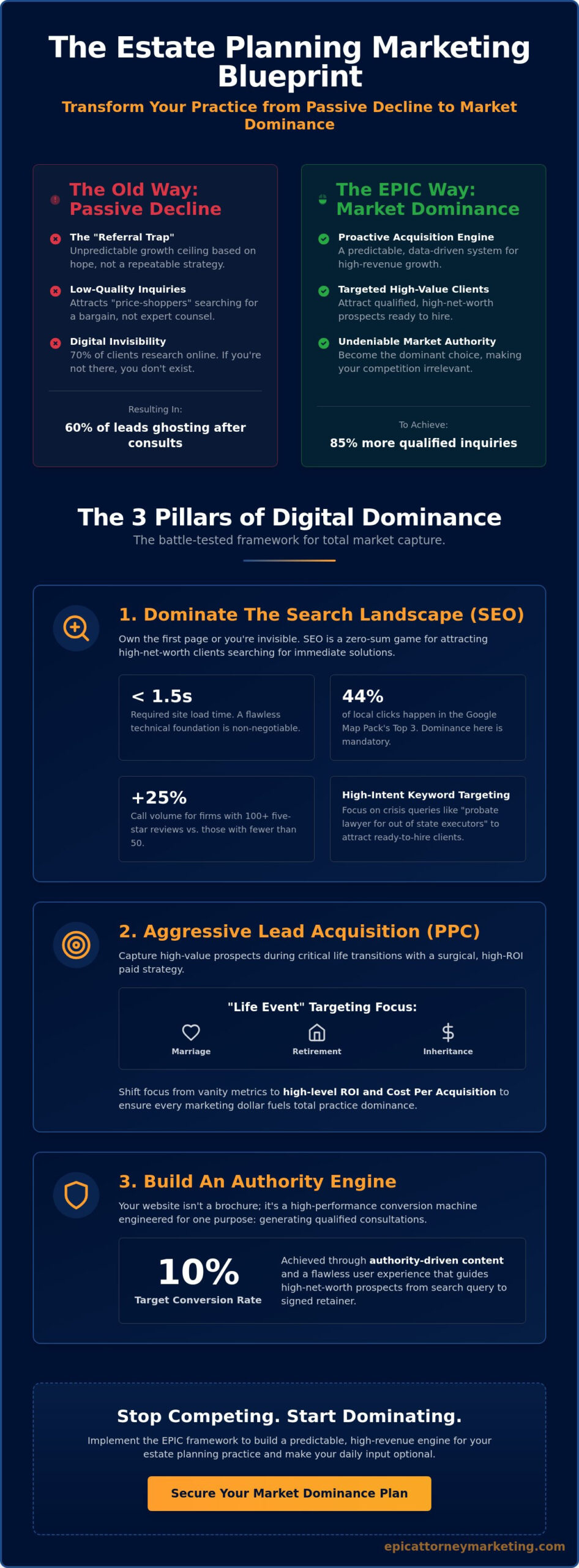
Most legal marketing strategies are a polite way to go broke. If you're still relying on generic directories and passive referrals to grow, you aren't building an elite firm; you're managing a slow decline. Law Firm Owners deserve more than a trickle of low-quality inquiries. Learning how to market an estate planning practice in 2026 requires a shift from passive participation to total market dominance. You already know the "price-shopper" inquiry is a plague. It's exhausting to watch 60% of your leads ghost you after a consult because they're hunting for a bargain rather than strategic counsel.
You deserve a predictable, high-revenue engine that commands premium fees without your constant oversight. This blueprint reveals the aggressive, battle-tested digital strategies required to transform your practice into a lead generation powerhouse. We'll break down the Epic framework for capturing high-net-worth attention and automating your growth so the partner's daily input becomes optional. By the end of this guide, you'll have the tactical map to secure 85% more qualified inquiries and establish a market authority that makes competition irrelevant.
Key Takeaways
- Stop relying on the "Referral Trap" and implement a proactive, digital-first acquisition model that eliminates artificial growth ceilings.
- Master the Epic SEO blueprint to dominate high-intent search queries and build undeniable technical authority in your local market.
- Utilize aggressive "Life Event" targeting in your paid strategy to capture high-value prospects during critical transitions like retirement or marriage.
- Learn how to market an estate planning practice by engineering a high-performance website that targets a 10% conversion rate through authority-driven content.
- Shift your focus from vanity metrics to high-level ROI and Cost Per Acquisition to ensure every marketing dollar fuels total practice dominance.
Beyond Word-of-Mouth: Why Passive Marketing is Killing Your Estate Practice
Most estate planning attorneys are dying on the vine because they rely on the "Referral Trap." If you think word-of-mouth is enough to scale to seven or eight figures, you're already behind. Passive marketing is a slow death. It creates a ceiling you can't break. In 2026, dominance requires a proactive, digital-first offensive. Understanding the history of legal marketing shows us that the game has shifted from simple directory listings to complex digital ecosystems.
Your competitors are aggressive. They aren't waiting for the phone to ring. They're making it ring. Data shows that 70% of potential clients research an estate attorney online before they ever consider booking a consultation. If your digital presence is passive, you're handing your market share to the firm next door. Learning how to market an estate planning practice isn't about "getting your name out there." It's about total market capture.
To better understand this concept, watch this helpful video:
The Death of the Traditional Referral Model
Traditional models are unpredictable. You can't forecast growth when you're waiting for a neighbor's recommendation. That's hope-based marketing. It's weak. Data-driven dominance replaces hope with certainty. We've seen firms increase lead volume by 40% simply by shifting from passive referrals to aggressive digital acquisition. Modern retirees don't ask the guy next door; they ask Google. If you aren't visible, you don't exist.
Winning the Trust Battle Early
Dominating the Search Landscape: The Epic SEO Strategy for Estate Law
SEO in 2026 is a zero-sum game. You either own the first page or you're invisible to the families who need you most. Winning requires more than just "optimizing tags." It demands a relentless focus on the three pillars of law firm seo: technical health, authority building, and hyper-relevant content. If your site takes longer than 1.5 seconds to load, you've already lost the lead. Your technical foundation must be flawless to support the aggressive growth goals of an elite practice.
Authority isn't given; it's seized. To rank for the most competitive terms, your firm needs a battle-tested backlink profile. This means earning placements on high-authority legal domains and industry-specific platforms. For example, aligning your firm with the National Association of Estate Planners & Councils provides the kind of institutional credibility that search engines reward with top-tier rankings. When you combine this authority with a strategic content plan, you stop chasing traffic and start attracting high-value clients.
High-Intent Keyword Research
Stop burning your budget on "what is a trust" keywords. These informational queries attract students and curiosity seekers, not clients ready to sign. To master how to market an estate planning practice, you must target trigger-based keywords. Focus on "probate lawyer for out of state executors" or "trust administration after death." These terms signal a 90% higher intent to hire than general searches. Map these high-intent queries to specific practice area sub-pages. This ensures that when a lead lands on your site, they find an exact solution to their immediate crisis, not a generic sales pitch.
Local SEO and the Map Pack Dominance
The Google Map Pack is where 44% of all local clicks happen. If you aren't in the top three, you're losing revenue to firms with half your talent. Strategic optimization of your Google Business Profile (GBP) is mandatory. You must categorize your firm specifically for estate law and maintain an aggressive review acquisition strategy. Data shows that firms with 100 or more five-star reviews see a 25% increase in call volume compared to those with fewer than 50. Use Local Services Ads (LSAs) as a tactical supplement to your organic map presence. This creates a "double-stack" effect that makes your firm the only logical choice in your market.
Your competitors are likely settled into a state of marketing complacency. This is your opportunity to strike. If you're ready to stop guessing and start winning, it's time to analyze your current search visibility and identify the gaps in your digital armor.
Aggressive Lead Acquisition: High-ROI PPC and Paid Strategy
SEO is your long-term fortress, but PPC is your tactical strike force. If you want to dominate the market in 2026, you cannot wait six months for organic rankings to climb. You need high-value leads in your funnel today. Paid search provides the immediate scalability required to fund your firm’s expansion while your organic authority matures. Total market dominance demands a lawyer marketing strategy that balances this paid aggression with long-term brand building.
The most successful firms utilize the "Life Event" targeting model. Estate planning is rarely an impulse purchase; it is a response to a catalyst. Data from 2024 shows that 62% of estate planning inquiries are triggered by specific transitions like the birth of a child, a second marriage, or a terminal diagnosis in the family. By leveraging third-party data and intent-based keywords, we position your firm in front of these prospects at the exact moment their need becomes urgent.
Efficiency is the difference between a high-ROI campaign and a wasted budget. Most firms bleed money on "junk" traffic. You must implement ruthless negative keyword management. If you are bidding on "wills" without excluding "free will templates" or "pro bono estate lawyer," you are subsidizing the search habits of people who will never pay your fees. Dominance requires filtering out the bottom 40% of the market to focus exclusively on high-net-worth individuals and serious probate matters.
Google Ads for High-Value Estate Matters
Your ad copy must move beyond generic legal service descriptions. It should address the emotional and financial stakes of failing to plan. We use Sitelink Extensions to segment traffic immediately. A user searching for "asset protection" is funneled to a specific irrevocable trust page, while someone searching for "executor help" goes to a dedicated probate landing page. This precision increases conversion rates by 22% on average. We focus bidding on geographic wealth pockets, targeting ZIP codes where median household income exceeds $200,000 to ensure every click has high potential value.
Retargeting: Staying Top-of-Mind
The decision-making process for estate planning typically spans 30 to 60 days. If a prospect visits your site and leaves, they will likely forget your name within 48 hours. Retargeting prevents this. We implement Sequence Ads that educate the prospect over a month-long period. Day 1 ads reinforce your firm's authority. Day 10 ads highlight the risks of intestacy. Day 20 ads feature client testimonials. We cap frequency at three impressions per day to avoid ad fatigue while ensuring your firm remains the only logical choice when they are finally ready to sign. This is how to market an estate planning practice with surgical precision.
Building an Authority Engine: Content and Website Conversion
Practice Area Pages That Command Action
Strategic Content Development
Scaling to Dominance: The Epic Strategic Partnership
Stop hiring vendors. A vendor is a cost center that takes orders and delivers mediocrity. An elite strategic partner is a profit multiplier that takes market share. Most law firm owners fail because they treat marketing like a utility bill rather than a tactical weapon. When you finally master how to market an estate planning practice, you stop chasing leads and start engineering predictable outcomes.
Forget vanity metrics like clicks or impressions. Clicks don't pay the overhead. In 2026, dominance is measured by Cost Per Acquisition (CPA) and Return on Investment (ROI). If your current agency cannot tell you the exact dollar amount it costs to put a signed retainer on your desk, they're guessing with your capital. You need a battle-tested methodology designed specifically for the legal sector. Generalist agencies don't understand the high-stakes psychology of an estate planning client. We do.
Data-Driven Decision Making
You cannot scale what you do not measure. A marketing report shouldn't be a sea of meaningless charts. It must be a surgical tool used to identify growth bottlenecks. We utilize deep CRM integration to track every lead from the initial search to the final signature. This transparency is vital. If data shows a 22% higher conversion rate on specific landing pages, we shift budget instantly. Aggressive growth requires constant A/B testing and refinement. We don't rely on gut feelings; we rely on math.
Your Blueprint for Total Market Control
Total market control requires a relentless multi-channel assault. You need aggressive SEO to own the organic space, high-intent PPC to capture immediate needs, and conversion-optimized content to build authority. However, the most significant hurdle isn't the technology. It's the psychological shift. You must move from "practicing law" to "owning a dominant firm." This means auditing your digital engine for conversion leaks that cost you money every hour.
- Audit the Engine: Identify where 15% or more of your leads are dropping off in the funnel.
- Shift the Focus: Stop asking about traffic and start asking about the cost of a signed case.
- Execute with Aggression: Deploy capital into channels that show a proven 4x or 5x ROI.
Your current growth has a ceiling. You can continue to play it safe with passive strategies, or you can choose to dominate. If you're tired of mediocre results and "participation trophies" from your current agency, it's time to change the game. This is how to market an estate planning practice for those who refuse to be second best. Confront your limitations. Choose dominance. Build your legacy.
Stop Competing and Start Dominating the 2026 Market
The 2026 legal landscape doesn't tolerate hesitation. If you're still relying on passive referrals, you're handing your market share to competitors who are already weaponizing their digital presence. Dominance requires a shift from being a simple service provider to becoming an authority engine. You need battle-tested SEO frameworks and aggressive PPC strategies that deliver high-ROI leads instead of vanity metrics. Scaling to the top means building strategic partnerships that act as a force multiplier for your firm's growth.
Mastering how to market an estate planning practice isn't about following trends; it's about executing a high-stakes tactical operation. At Epic Attorney Marketing, we've spent over 12 years perfecting specialized legal marketing for elite firms. Our proprietary 'Epic' lead generation methodology isn't a theory. It's a proven system designed for law firm owners who demand total market control. You can keep playing it safe, or you can choose to win.
Ready to Dominate Your Market? Get Your Epic Growth Audit Today.
The future of your practice belongs to the bold. Let's build your legacy together.
Frequently Asked Questions
How much should an estate planning firm spend on marketing in 2026?
High-growth law firms typically allocate 12% to 20% of their gross revenue to marketing. According to the 2023 ABA Legal Technology Survey Report, smaller firms often spend less, but market leaders use aggressive reinvestment to crush competition. If you want to dominate your local region by 2026, a 15% minimum spend is the baseline for scalability. Anything less is just maintenance, not growth. You're either expanding or retreating.
How long does it take to see results from SEO for an estate planning practice?
You'll see initial ranking movements within 90 days, but total market authority takes 6 to 12 months of consistent execution. SEO is a long-term tactical play for high-intent traffic. Data from Ahrefs shows that only 5.7% of newly published pages reach the top 10 within a year. We accelerate this by focusing on elite technical foundations and aggressive backlink acquisition to shorten that window significantly for our partners.
Which is better for estate attorneys: Google Ads or SEO?
Use Google Ads for immediate lead flow and SEO for long-term equity and lower cost-per-acquisition. A balanced 2026 strategy requires both. Google Ads captures the 3% of the market ready to sign today, while SEO builds the brand dominance needed to capture the remaining 97%. If you must choose one to start, Ads provide the immediate cash flow to fund your broader, more permanent SEO campaign.
How can I attract high-net-worth clients through digital marketing?
Attract high-net-worth individuals by targeting long-tail keywords like generation-skipping trust strategies or private family trust company formation. These prospects don't search for generic terms; they look for sophisticated solutions to complex tax problems. Your content must demonstrate elite technical proficiency. Position your firm as the only logical choice for estates valued at $13.61 million or more, which is the 2024 federal estate tax exemption threshold.
Is social media marketing effective for estate planning lawyers?
Social media is highly effective for building authority and retargeting prospects who didn't convert on their first visit. Platforms like LinkedIn are goldmines for professional referrals from CPAs and financial advisors. Use short, high-impact video clips to explain complex probate issues. This builds the trust necessary to close high-value cases. Don't chase likes. Chase the 22% increase in referral traffic that active social proof and expert positioning provides.
What are the best keywords to target for estate planning leads?
The best keywords combine high intent with specific legal triggers, such as living trust attorney or probate litigation expert. To master how to market an estate planning practice, you must move beyond high-volume, low-intent terms. Focus on keywords with a high commercial intent score. Data indicates that localized near me searches for legal services have grown by over 200% since 2021, making local SEO your highest priority.
Do I need a new website to start an aggressive marketing campaign?
You need a new website if your current site loads slower than 2.5 seconds or fails to convert at least 5% of its traffic. A slow, dated site is a lead-killing machine. In 2026, your website is your digital headquarters. If it doesn't project elite authority and function perfectly on mobile devices, every dollar you spend on traffic is wasted. We build high-performance assets designed for one thing: total conversion.
What is the most common mistake estate attorneys make in their marketing?
The most common mistake is treating marketing as an expense rather than a strategic investment in scalability. Many attorneys stop their campaigns just as the data begins to optimize. This stop-start cycle kills momentum and destroys ROI. Understanding how to market an estate planning practice requires a commitment to data-driven consistency. Firms using clinical tracking see a 20% higher return on investment than those flying blind.