
Your competition isn't just winning more deals; they're systematically seizing the digital land you've left undefended. Implementing aggressive SEO for real estate law firms is no longer a luxury when 75% of potential clients vet two to five websites before making contact. With Google's March 2026 Core Update now fully integrated, the era of passive rankings is dead. If you're still relying on outdated tactics, you're essentially handing your market share to the firm next door.
You've likely seen your marketing budget evaporate into $50 clicks that lead to dead-end inquiries. It's frustrating to watch your organic growth stagnate while elite firms scale their operations. We're here to end that cycle. This blueprint will teach you how to weaponize search engine optimization to capture high-value real estate deal flow and crush your competition. We'll preview the exact technical precision and authority-building strategies needed to turn your website into a 24/7 revenue engine that dominates the 2026 search landscape.
Key Takeaways
- Adapt to the 2026 AI-driven search environment to ensure your firm remains the primary authoritative source in an era of zero-click results.
- Implement a high-performance technical foundation that prioritizes mobile-first architecture and elite site speed to capture and retain sophisticated property law clients.
- Deploy a high-intent content strategy that targets complex commercial disputes and weaponizes SEO for real estate law firms to drive significant deal flow.
- Secure market dominance through aggressive authority building, focusing on high-impact backlinks from top-tier legal, financial, and real estate publications.
- Transform your firm’s digital presence from a static brochure into a battle-tested, 24/7 revenue engine that scales with your growth ambitions.
The 2026 Search Landscape: Why 'Average' SEO is a Death Sentence for Real Estate Firms
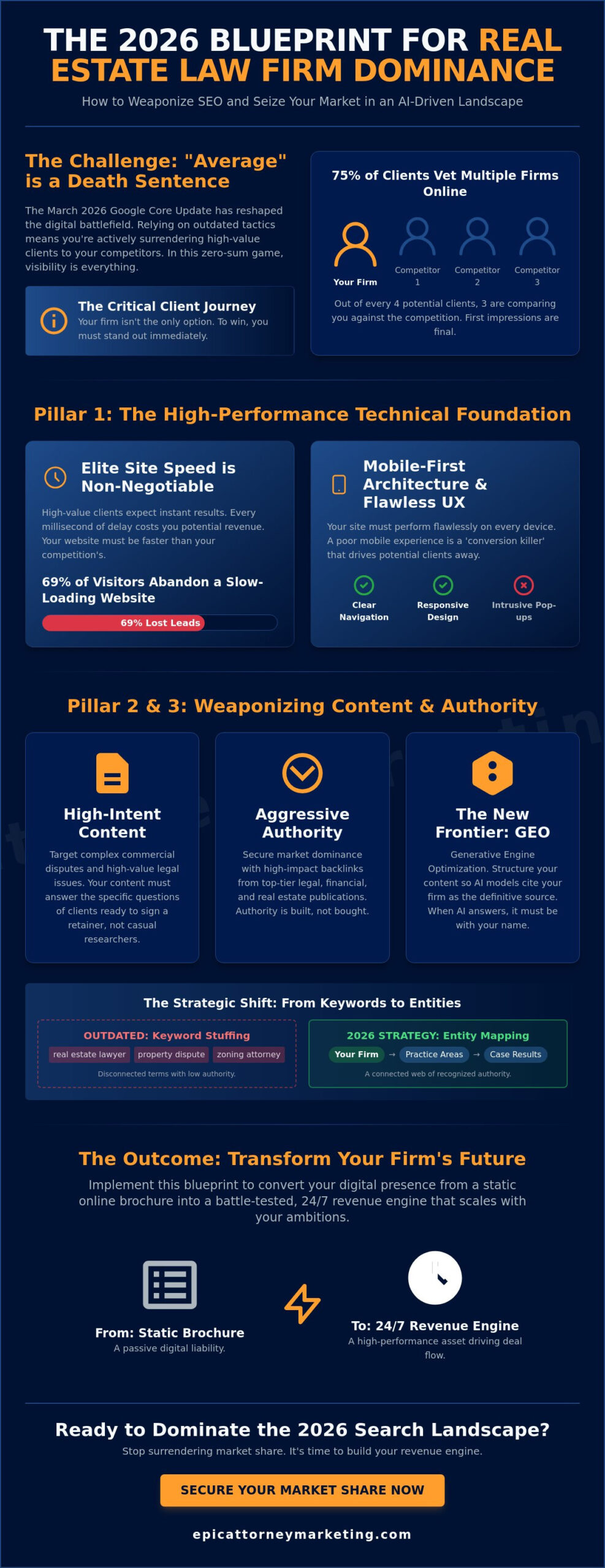
Law Firm Owners: the market has shifted. If you're still treating growth as a passive exercise rather than a high-stakes tactical operation, you've already lost. In 2026, SEO for real estate law firms is a zero-sum game. You either own the digital real estate that controls high-value deal flow, or you're invisible. Average efforts produce average results. In a market where 75% of clients visit multiple sites before making contact, 'average' is just a slow way to go out of business.
To better understand how to position your firm for growth in this competitive environment, watch this helpful video:
The March 2026 Core Update finalized the transition from traditional search to an AI-integrated ecosystem. Firms that failed to evolve their law firm seo strategy are watching their rankings vanish. This isn't just about 'ten blue links' anymore. It's about total authority. To win, you must understand the foundational search engine optimization (SEO) principles that govern how search engines categorize legal expertise.
From Keywords to Entities: The New Rules of Search
Google's Knowledge Graph doesn't just read your text; it maps your firm as an entity. It connects your attorneys, your case results, and your specific practice areas into a web of authority. If Google doesn't recognize your firm as a primary entity in commercial property disputes, you won't rank for high-intent queries. Semantic search now distinguishes between a casual researcher and a high-value closer ready to sign a retainer. You need to dominate the semantic space to capture the latter before your competition does.
Generative Engine Optimization (GEO) for Attorneys
AI Overviews and conversational search are the new gatekeepers of legal leads. GEO is about structuring your data so AI models cite your firm as the definitive source. When a developer asks their AI assistant about zoning litigation, your firm must be the answer. This requires 'Epic' content that survives the AI filter by providing depth that machines cannot replicate. If your content is thin, AI will ignore you. If it's elite, AI will promote you as the undisputed expert.
The Technical Foundation: Building a High-Performance Engine for Property Law
Technical SEO for real estate law firms is the difference between a high-performing asset and a digital liability. If your website's infrastructure is weak, your rankings will fail regardless of how much you spend on content. In the 2026 search landscape, technical precision is the entry price for market dominance. You aren't just building a website; you're engineering a 24/7 revenue engine designed to capture high-stakes deal flow without friction.
Speed is your first line of defense. According to MyCase data from October 2025, 69% of visitors will leave a law firm's website if it loads slowly. High-value clients involved in commercial property disputes don't have the patience for lagging pages. If your site doesn't load instantly on a mobile device, you've lost the lead before they even read your headline. This is why elite law firm website design focuses on performance metrics as much as aesthetics. Every millisecond of delay is a calculated risk to your ROI.
Core Web Vitals and User Experience (UX)
Largest Contentful Paint (LCP) is the metric that defines your authority in Google's eyes. It measures how quickly the main content of your page becomes visible. In a multi-device environment, your site must be flawless on every screen size. We eliminate 'conversion killers' like intrusive pop-ups or confusing navigation that drive bounce rates up. Forbes outlines several actionable SEO tips for lawyers that emphasize the necessity of a clean, fast technical base to support long-term growth.
Advanced Legal Schema and Structured Data
Basic schema is obsolete. To dominate 2026 search results, you must implement comprehensive, layered structured data. This tells search engines exactly who you are and what you do. We utilize specific markers to elevate your visibility:
- 'Attorney' and 'LegalService' Schema: These tags define your practice areas and professional credentials, feeding Google's Knowledge Graph directly.
- FAQ Markup: This allows your firm to occupy more space on the search results page by answering high-intent questions before the user even clicks.
- Review Schema: We pull your battle-tested social proof directly into the SERPs to command immediate trust.
Compliance is also a technical requirement. Since California Senate Bill 37 took effect on January 1, 2026, your site must include specific disclosures like a bona fide office location. Failure to integrate these technical details can lead to penalties that stall your growth. If you're ready to stop guessing and start winning, it's time to audit your technical foundation for maximum impact.
High-Intent Content Strategy: Capturing Commercial and Residential Deal Flow
Traffic is a vanity metric. If your website attracts thousands of visitors who never sign a retainer, your marketing has failed. To achieve total dominance, your content must pivot from answering basic definitions to solving high-stakes legal crises. Most SEO for real estate law firms focuses on 'information seekers' who want free advice. We ignore them. We build strategies for 'High-Value Closers', developers, lenders, and commercial landlords who need elite representation for complex, multi-million dollar deals. If your content doesn't filter for intent, you're just paying for someone else's education.
This intent-focused approach is essential when building topical authority in the luxury residential sector; for example, a firm might reference its expertise in handling the legal complexities for established property enhancement brands like ASunroom4You to attract high-net-worth developers and homeowners.
Developing elite content for law firm website performance requires mapping every word to a specific stakeholder pain point. Commercial real estate stakeholders don't search for 'what is a deed.' They search for 'enforcing specific performance in commercial contracts' or 'mitigating environmental liability in brownfield redevelopment.' Long-form guides on 'Navigating 2026 Zoning Challenges' or 'Advanced Tax-Deferred Exchange Strategies' serve as lead magnets for the highest tier of clients. These aren't just blog posts; they're strategic assets that prove your firm's intellectual dominance in the property sector.
Practice Area Pages That Convert
Generic descriptions are a death sentence for your conversion rate. Your practice area pages must function as closing tools rather than digital brochures. Results-focused copy strips away the fluff and tells the prospect exactly how you win. In a landscape where 75% of clients are comparing you to four other firms, your case results are your strongest weapon. Use concrete proof points like 'Successfully negotiated a $45M retail acquisition' or 'Resolved a 3-year boundary dispute in 6 months.' Pair these with strategic CTAs that drive immediate action. If a prospect isn't convinced of your dominance within 30 seconds, they'll be on your competitor's site.
The 'Epic' Blog: Dominating Long-Tail Real Estate Queries
Topical authority isn't built through sporadic updates. It's earned through a consistent, aggressive publishing cadence. We target high-volume, low-competition long-tail queries that your competitors are too lazy to address. By using data-driven insights to answer 'what if' scenarios, like the impact of the California Senate Bill 37 advertising rules that took effect on January 1, 2026, you position your firm as the undisputed market leader. This builds a moat around your practice that AI answer engines can't breach. When you provide the depth that Google's 2026 updates demand, you don't just rank; you own the conversation.
Aggressive Authority Building: Backlinks and National Visibility
In the 2026 backlink economy, quantity is a liability. Google's March 24, 2026, Spam Update decimated law firms that relied on automated, low-tier link schemes. If your strategy involves buying bulk directory listings, you aren't just wasting money; you're actively flagging your site for a penalty. Dominance in SEO for real estate law firms requires a high-impact, tactical approach to authority. You need "Power Links" from elite publications that search engines recognize as undisputed sources of truth.
National visibility is the secret weapon for local search performance. When your firm earns a mention in a top-tier financial or real estate publication, it sends a massive signal of trust to Google. This authority flows down to your local practice area pages, allowing you to crush competitors who only focus on their immediate zip code. Digital PR is the vehicle for this growth. By positioning your attorneys as the go-to experts for major media outlets, you secure the kind of elite mentions that competitors can't buy. If you want to stop trailing and start leading, it’s time to deploy an aggressive authority campaign that builds a moat around your practice.
The Anatomy of a High-Authority Legal Backlink
Not all links are created equal. We categorize your profile into "Toxic" and "Power" links. A Power link possesses three characteristics: niche relevance, high domain authority, and editorial integrity. For a real estate firm, a link from a construction finance portal or a national legal review is gold. Relevance is the ultimate ranking signal in 2026. Conversely, links from generic, non-legal blogs are worthless at best and dangerous at worst. We don't just build links; we curate a profile of battle-tested authority that forces Google to rank you first.
Strategic Outreach and Digital PR
We don't wait for the market to notice you. We force the issue through aggressive competitive link acquisition. This involves identifying exactly where your rivals are getting their influence and systematically taking it for yourself. Beyond that, we develop original research and data-driven whitepapers that earn natural citations from industry leaders. When you provide the data that others quote, you aren't just participating in the market. You are defining it. This results-first narrative ensures that your firm is seen as an elite strategic partner, not just another vendor in a crowded field.
Scaling Your Firm: Why Epic Attorney Marketing is the Strategic Choice
Law Firm Owners: stop "doing SEO" and start executing a battle-tested strategy. If your current provider treats marketing as a monthly checklist of tasks, they aren't a partner; they're a vendor. In the 2026 search environment, you need a high-impact law firm marketing blueprint that translates technical precision into tangible revenue. We don't care about vanity rankings. We care about ROI, scalability, and your firm's total market dominance.
Your website shouldn't just exist. It must function as an elite, 24/7 revenue engine that captures the high-value deal flow your competitors are currently stealing. Most agencies fail because they don't understand the high-stakes nature of SEO for real estate law firms. They focus on traffic volume while ignoring lead quality. We flip the script. We target the commercial developers, institutional lenders, and high-net-worth stakeholders who drive your practice's growth. Our approach is clinical, aggressive, and designed for firms that refuse to settle for second place.
A Results-First Methodology
We built Epic Attorney Marketing on a foundation of uncompromising standards. Our methodology is transparent and data-driven, utilizing GA4 and real-time Search Console data to track every conversion. We don't offer cookie-cutter packages. Instead, we develop custom strategies tailored to your specific growth targets. If you aren't prepared for total dominance, we aren't the right fit. We only partner with elite firms that have the ambition to scale and the capacity to handle a surge in high-intent inquiries. Our proof of success is treated as an objective, undeniable fact.
The Path to Dominance Starts Here
Inaction has a specific price tag. Every day you remain invisible on the search results pages, your competitors are closing the deals that should be yours. With the March 2026 Core Update favoring authoritative entities, the gap between the market leaders and the laggards is widening. You can't afford to wait for "better timing." The search landscape is a winner-takes-all reality. Your blueprint for capturing the market's most valuable real estate leads is ready. It's time to stop participating and start winning. Dominate Your Market with Epic Attorney Marketing today.
Secure Your Digital Empire in the 2026 Market
Dominating the search landscape requires more than just participation. It demands a high-performance technical foundation and a content strategy that targets high-value closers rather than casual researchers. You've seen how Google's March 2026 Core Update redefined authority. This makes sophisticated entity mapping and AI-integrated optimization non-negotiable for firms that refuse to be ignored. If you aren't visible in the AI Overviews, you're essentially invisible to your most profitable prospects.
Aggressive SEO for real estate law firms is a tactical operation that builds a permanent moat around your practice. By securing elite backlinks and national visibility, you ensure your firm is the only logical choice for complex property deals. At Epic Attorney Marketing, we bring over a decade of legal marketing expertise to your corner. We don't just build sites; we engineer custom high-performance website developments backed by battle-tested SEO strategies for elite firms. The market's most valuable deal flow is waiting for a leader. It's time to stop trailing the competition and start dictating the terms of your growth.
Ready for Total Market Dominance? Get Your Aggressive SEO Blueprint Now.
Frequently Asked Questions
How long does it take to see results from SEO for a real estate law firm?
You should expect to see initial ranking movement within 4 to 6 months; however, total market dominance typically requires a 12-month commitment. SEO is a compounding asset. While technical fixes can yield quick wins within 30 days, building the entity authority required by the March 2026 updates takes sustained effort. If an agency promises page one results in weeks, they're likely using toxic tactics that will trigger a penalty.
What is the difference between local SEO and national SEO for attorneys?
Local SEO targets specific geographic inquiries and Map Pack visibility for cities, while national SEO builds the broad authority that powers those local rankings. In 2026, you can't have one without the other. High-authority national backlinks serve as a massive trust signal. This forces your local pages to outrank competitors who only focus on their immediate zip code, giving you a decisive strategic advantage.
Is SEO or PPC better for generating real estate law leads?
SEO is a long-term revenue engine, while PPC is a short-term lead tap with a high cost-per-acquisition. PPC delivers immediate traffic but stops the moment you stop paying the average $9.21 cost-per-click. Implementing aggressive SEO for real estate law firms builds a permanent, scalable asset that lowers your acquisition costs over time. Elite firms allocate 45% of their marketing budget to SEO to avoid being held hostage by auction prices.
How much should a real estate law firm invest in SEO monthly?
Expect to invest between $5,000 and $15,000 monthly for an aggressive, market-dominating campaign. According to April 2026 industry data, mid-size firms typically invest $5,000 to $10,000, while large or multi-location firms often spend $10,000 or more. If you're paying less than $2,500, you aren't buying a strategy. You're buying a commodity that won't move the needle in high-stakes commercial real estate markets.
Will AI and ChatGPT replace the need for SEO in 2026?
AI won't replace SEO; it has fundamentally changed it into Generative Engine Optimization (GEO). AI assistants rely on authoritative sources to generate answers, and your goal is to be the primary source those engines cite. This shift makes high-intent SEO for real estate law firms more valuable than ever. If your firm isn't structured as a recognized entity in Google's Knowledge Graph, AI tools will simply ignore you.
How do I know if my current SEO agency is actually delivering results?
Audit your lead quality and organic traffic growth against your specific ROI targets. If your agency provides reports filled with vanity metrics like impressions but your high-value deal flow hasn't increased, they're failing. Use GA4 to track conversions, not just clicks. A competent partner provides transparent, data-driven reporting that connects search visibility to signed retainers. If they can't show you the revenue impact, find an elite strategist.
Does my firm need a separate website for commercial real estate law?
You don't need a separate website; you need a technically superior architecture that categorizes practice areas as distinct entities. Splitting your authority across two domains often dilutes your ranking power and doubles your maintenance costs. A single, high-performance website with robust silo structures allows your commercial and residential pages to share authority. Focus on technical precision within one domain to maximize your ROI and build comprehensive LegalService schema.
What are the most important keywords for real estate attorneys in 2026?
Focus on high-intent, long-tail queries that target specific legal crises rather than broad terms. Broad keywords like "real estate lawyer" are expensive and often attract low-quality leads. In 2026, the most valuable queries involve specific disputes, such as "commercial lease enforcement" or "partition action litigation." These terms indicate a prospect is ready to hire. Mapping your content to these specific pain points ensures you capture high-value closers immediately.