
Your marketing agency is likely celebrating a 15% increase in impressions while your firm's bank account remains stagnant. Impressions don't win cases. In a 2026 market where personal injury leads now cost upwards of $600, surface-level reporting is a death sentence for your growth. You need a ruthless focus on the key performance indicators for law firm marketing that transform raw data into total market dominance.
You're right to be skeptical of agencies that hide behind "engagement" while you're left wondering which campaigns actually drove your last high-value settlement. This guide ends the guesswork. We're handing you the Elite 2026 Growth Blueprint to stop the bleed and scale your firm with mathematical certainty. You'll learn how to master the "Dominance Quad" of metrics, navigate the strict new SB 37 advertising regulations, and secure the Epic results that separate the elite firms from the also-rans. We'll show you exactly how to achieve the 526% SEO ROI that the industry's top performers are using to crush their competition.
Key Takeaways
- Learn how to distinguish between useless vanity metrics like "likes" and the high-impact key performance indicators for law firm marketing that actually scale revenue.
- Master the "Dominance Quad" of non-negotiable metrics to ensure your marketing spend delivers a consistent, high-value return on investment.
- Deploy an advanced 2026 tech stack to track complex lead journeys and capture the first-party data needed to outmaneuver local competitors.
- Benchmark your firm's current performance against elite industry standards to identify exactly where you're losing market share.
- Implement a battle-tested 90-day growth framework that holds your entire team accountable for turning leads into signed cases.
Stop Tracking Vanity: The High-Stakes Reality of Law Firm Marketing KPIs
Stop treating your law firm like a hobby. If you want total market dominance, you must distinguish between your internal operational health and your aggressive growth engine. A Key Performance Indicator (KPI) should be a diagnostic tool for expansion, not just a line item on a spreadsheet. Most firm owners are drowning in data but starving for insight. They mistake "keeping the lights on" for "winning the market." Operational KPIs tell you if your staff is working; marketing KPIs tell you if your firm is growing.
Marketing agencies love to hide behind vanity. They'll show you a chart with 50,000 impressions and a 20% increase in social media engagement. It's noise. If those 50,000 eyeballs didn't result in a single retainer, that campaign was a failure. True key performance indicators for law firm marketing focus on the pulse of your growth engine: signed cases and revenue. At Epic Attorney Marketing, we view any metric that doesn't lead to a signed case as an expensive distraction. You don't need more "likes" from people who will never hire you.
To better understand the metrics that actually move the needle, watch this breakdown of the KPIs you can't afford to ignore:
Vanity vs. Value: What Your Agency Isn’t Telling You
Your agency is likely cherry-picking data to justify their monthly retainer. A million impressions mean nothing if your intake team is sitting on their hands. High keyword rankings are equally deceptive. Ranking #1 for a term that doesn't convert is a waste of resources. Value-Based KPIs are the only metrics that justify marketing spend because they track the direct path from a click to a settlement. If you aren't measuring the quality of the lead, you're just subsidizing your agency's ego.
The 2026 Digital Landscape: Why Old Benchmarks Are Obsolete
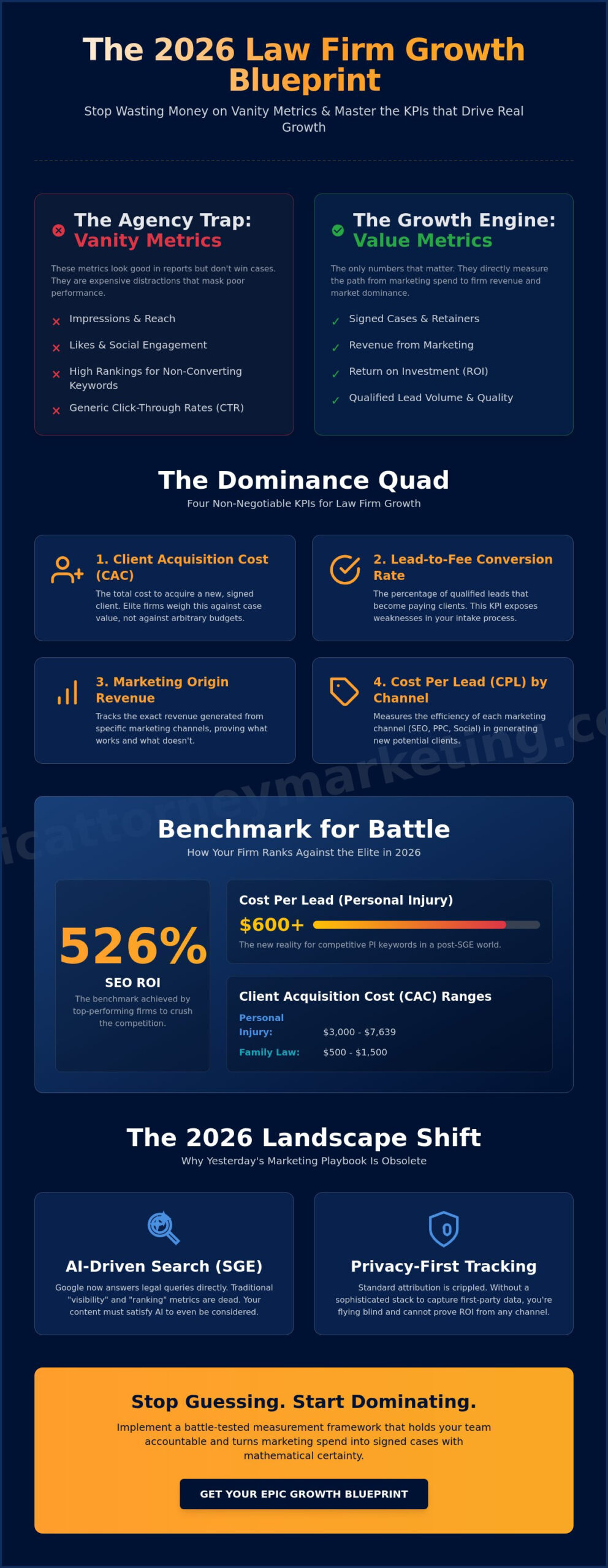
The game changed on January 1, 2026. AI-driven search, or Search Generative Experience (SGE), now answers legal queries directly on the search page. This means traditional "visibility" metrics are dead. You can't rely on simple click-through rates when Google provides the answer before the user ever hits your site. Privacy-first tracking has also crippled standard attribution data, making it harder to see which ad actually triggered the call. Modern law firm marketing requires a sophisticated tracking stack that captures first-party data. Without this, you're flying blind in a high-stakes environment where key performance indicators for law firm marketing are your only roadmap to scalability.
The Dominance Quad: Four Non-Negotiable KPIs for Law Firm Growth
Stop drowning in spreadsheets. Most firms fail because they track too much noise and not enough signal. You only need four numbers to achieve total market dominance. These are the key performance indicators for law firm marketing that separate the elite players from the firms struggling to pay their overhead. We call it the Dominance Quad: Client Acquisition Cost (CAC), Lead-to-Fee Conversion Rate, Marketing Origin Revenue, and Cost Per Lead (CPL) by Channel. If you aren't obsessing over these four, you aren't running a business; you're running a charity for your marketing agency.
Client Acquisition Cost (CAC) vs. Case Value
Elite firms don't fear a high CAC; they fear a low ROI. To calculate your true CAC, you must combine every cent of ad spend with your agency fees and divide it by signed cases. In May 2026, the average CAC for a law firm ranges from $3,000 to $7,639. For personal injury firms in competitive metros, this number is a badge of honor if the case value justifies it. Family law firms typically see a CAC between $500 and $1,500. You must weigh this against the Lifetime Value (LTV) of the client. If your LTV is $50,000, spending $5,000 to acquire that client is a strategic win. This level of analysis is far more critical than baseline social media campaign KPIs that only measure vanity engagement.
Intake Performance: The Silent Killer of Marketing ROI
Your marketing can be world-class, but if your intake team is soft, your ROI will die on the vine. You must track the Lead-to-Appointment and Appointment-to-Retainer ratios with clinical precision. Current data shows that 61% of inbound inquiries still come through phone calls. If your team takes three hours to return a call, you've already lost the case to a faster competitor. Elite firms treat intake as a high-stakes sales operation, not an administrative task. Identifying leakage in your lawyer marketing funnel is the fastest way to double your revenue without spending an extra dollar on ads. If your conversion rate from lead to client isn't hitting the 25% to 35% industry average, your intake is the problem. You should audit your conversion pipeline to ensure you aren't wasting the potential of your key performance indicators for law firm marketing.
Beyond the Click: Advanced Attribution and the 2026 Tech Stack
Last-click attribution is a relic of a simpler time. If you're still using it, you're making strategic decisions based on half-truths. High-value cases don't just appear out of thin air. They often touch five or more channels before a retainer is ever signed. A potential client might find your firm through aggressive law firm SEO, watch one of your AI-generated videos, and then finally click a PPC ad when they're ready to commit. If you only credit the final click, you'll mistakenly cut the very channels that built the trust necessary to win the case. This is why key performance indicators for law firm marketing must account for the entire journey.
The 2026 landscape is defined by privacy-first tracking. Third-party cookies are dead. To maintain total clarity on your ROI, you must implement first-party data tracking. This allows you to bypass browser restrictions and own your data. When you integrate this data with a robust CRM, you close the loop between a digital click and a multi-million dollar settlement. Without this integration, your marketing spend is just a series of expensive guesses. Elite firms don't guess. They use their tech stack to prove which dollars are driving market share and which are just noise.
Multi-Touch Attribution for High-Value Cases
Assisted conversions are the lifeblood of a dominant firm. You need to see how your social media presence and content strategy support your high-intent search ads. We also have to account for "Dark Social." These are the referrals happening in private legal networks and encrypted messaging apps that standard analytics can't see. Relying on single-source attribution is the fastest way to kill a winning strategy and lose your competitive edge. You must measure the collective impact of your digital footprint to understand your true scalability.
AI and Predictive Analytics in Legal Marketing
As of May 2026, 36% of law firms have already integrated AI into their operations. The most successful firms use AI for predictive analytics rather than just reactive reporting. This technology allows you to forecast which leads are most likely to become high-value cases before you spend a dime on intake. Proactive growth forecasting is the new standard. By leveraging digital marketing for attorneys that includes predictive modeling, you can outpace slow-moving competitors who are still looking at last month's traffic. This shift from "what happened" to "what will happen" is the hallmark of an Epic strategy. Mastery of these advanced key performance indicators for law firm marketing ensures you aren't just participating in the market; you're dominating it.
Benchmarking for Battle: How Your Firm Ranks Against the Elite
Average firms settle for survival. Elite firms demand dominance. In the high-stakes legal market of May 2026, simply knowing your numbers isn't enough. You must know how those numbers stack up against the competitors who are currently eating your market share. Mastering the key performance indicators for law firm marketing is the only way to measure that dominance with clinical precision. If your agency is reporting a 3% website conversion rate, they're celebrating mediocrity. High-performing firms are currently achieving 8% to 12% conversion rates by optimizing for the modern, AI-driven search environment.
Practice area benchmarks dictate your tactical reality. A $150 Cost Per Lead (CPL) is a massive victory for a personal injury firm where CPLs in competitive metros now exceed $600. However, that same $150 CPL is a disaster for a family law practice where the target should be $75 to $200. You must also apply a profit margin filter to every marketing dollar. A healthy ROI is at least 3:1, but the elite are hitting 10:1 ratios. If your marketing spend is cannibalizing your net income, your strategy isn't scalable; it's a slow-motion collapse.
The Elite Firm Scorecard: A Comparison Framework
The "5-minute rule" is no longer a suggestion; it's a requirement for survival. Data shows that 61% of inbound inquiries still come via phone calls, and the lead-to-client conversion rate for top performers is 40% to 55%. If you're stuck at the industry average of 25%, you're throwing away half of your potential revenue. Elite firms also prioritize search share of voice over simple rankings. They want to be the answer Google’s AI provides before the user even scrolls. This level of local digital landscape dominance is what builds a "battle-tested" brand.
Audit Your Agency: Are They Hiding Behind Fluff?
Stop accepting "increased traffic" as a win. If your revenue is stagnant, traffic is just a vanity metric used to mask failure. You must demand transparency. Ask your agency how they are attributing cases across multi-touch journeys and what they are doing to lower your cost-per-signed-case. The quality of your leads depends heavily on the strategic content for law firm website you deploy. If your content isn't pre-qualifying leads, you're paying for trash. You should request an aggressive growth audit to see exactly where your current agency is failing you and how to pivot toward total market control.
Scaling to Dominance: Implementing an Epic Measurement Framework
Data is useless if it sits on a shelf. You can track every key performance indicator for law firm marketing ever conceived, but without a framework for execution, you're just admiring your own failure. Elite firms don't just "check the numbers" once a quarter. They use a 90-day growth sprint to ruthlessly calibrate their strategy. This cycle allows you to pivot your budget toward the channels delivering the highest-value cases before your competitors even realize they're losing market share. If the data shows a specific campaign isn't hitting the 5:1 ROI benchmark, you kill it or fix it immediately.
Building a culture of accountability is the bridge between data and revenue. This starts with the managing partner and ends with the intake coordinator. If your intake team knows you're tracking the lead-to-client conversion rate with a target of 40% to 55%, their performance will shift. You aren't just looking for "more leads" anymore. You're building a disciplined machine where every inbound inquiry is treated as a high-stakes opportunity. Execution is what turns a spreadsheet into a scalable framework for client acquisition.
The Epic Growth Engine: Integration and Execution
Your digital presence must be built for conversion, not just aesthetics. Aligning your law firm website design with your KPI goals ensures that every pixel serves the bottom line. Automation is the final piece of the puzzle. Real-time reporting allows for tactical decision-making that happens in hours; you can't wait for a monthly report to see if your PPC spend is being wasted. While 62% of law firms now invest in online marketing, most are still working with generalist agencies that don't understand the aggressive nature of the legal sector. Elite firms partner with specialists who provide a battle-tested methodology for total dominance.
Ready for Market Dominance?
The blueprint is clear. You have the Dominance Quad: CAC, Lead-to-Fee conversion, Marketing Origin Revenue, and CPL by channel. You know that a mature legal SEO campaign can yield an average 3-year ROI of 526%. The only question remaining is whether you'll settle for the industry average or demand the Epic results your firm deserves. Stop guessing and start winning. You should audit your firm’s marketing engine with the experts at Epic Attorney Marketing to secure your strategic advantage in 2026. This is the moment you transition from tracking key performance indicators for law firm marketing to actually dominating your market.
Secure Your Market Dominance in 2026
The era of vanity metrics is dead. If you aren't tracking the "Dominance Quad" or utilizing multi-touch attribution, you're leaving massive revenue on the table for your most aggressive competitors. Elite firms in May 2026 recognize that key performance indicators for law firm marketing are the only objective measure of a firm's scalability and strategic advantage. You now have the blueprint to move beyond simple clicks and start measuring the metrics that actually drive settlements and market share.
Data without execution is just noise. You need a partner who treats your marketing as a high-performance revenue engine, not a creative experiment. Epic Attorney Marketing brings over a decade of battle-tested legal marketing experience to the table. We maintain a specialized focus on high-stakes growth for elite firms, utilizing a results-first methodology that turns data into dominance. Stop settling for "average" reports while your growth plateaus.
Stop wasting ad spend and start dominating—get your Epic Marketing Audit today.
Your firm is built for greatness; it's time your marketing reflected that ambition. Let's build your legacy and crush your competition together.
Frequently Asked Questions
What is the most important marketing KPI for a law firm?
Marketing Origin Revenue is the most critical of all key performance indicators for law firm marketing because it directly links spend to settlements. You must know exactly how many dollars in fees were generated by each specific digital channel. If you can't trace a $50,000 fee back to its source, you're just guessing with your budget. Elite firms prioritize this revenue data over every other metric to ensure their growth is predictable and aggressive.
How much should a law firm spend on client acquisition (CAC)?
Your CAC should be dictated by your practice area's average case value and your desired profit margin. Elite personal injury firms in May 2026 often see a CAC between $3,000 and $7,639 per new client. If you're in family law, expect a range of $500 to $1,500. You must maintain at least a 3:1 ROI to ensure your growth is sustainable and doesn't cannibalize your net income.
What is a good conversion rate for a legal website?
Elite firms achieve website conversion rates between 8% and 12% by optimizing for high-intent traffic. While the industry average languishes at 2% to 4%, settling for those numbers is a recipe for stagnation. Your site must be a high-performance engine that pre-qualifies leads before they even call. If your current conversion rate is below 5%, your design or content is actively costing you money every day.
How do I track where my law firm leads are coming from?
Implement a first-party data tracking stack integrated with your CRM and call tracking software. Relying on "how did you hear about us" is an amateur mistake that leads to bad data. Since 61% of inquiries still come via phone calls, you need dynamic number insertion to see which ad triggered the dial. This level of precision allows you to identify the five digital touchpoints a lead hit before signing.
Why is my Cost Per Lead (CPL) so high compared to industry averages?
High CPL usually stems from targeting high-competition keywords without a diversified strategy. If your "personal injury lawyer" CPC is hitting the $150 range, your CPL will skyrocket unless your conversion engine is perfect. Some specific terms in 2026 even exceed $740 per click. You must balance expensive PPC with aggressive SEO and local visibility to drive your blended CPL down to a manageable level.
How often should I review my law firm marketing KPIs?
Review your high-velocity data weekly and your strategic roadmap every 90 days. Waiting for a monthly report is too slow in a 2026 market where competitors pivot their budgets in hours. Real-time dashboards are the standard for elite firm owners who demand total clarity. This frequency allows you to identify "leakage" in your intake funnel before it becomes a multi-thousand dollar problem.
Can AI help in tracking law firm marketing performance?
AI tools now analyze key performance indicators for law firm marketing to predict lead-to-client conversion with 90% accuracy. As of May 2026, 36% of law firms use these tools to automate reporting and identify high-value cases instantly. This technology removes the lag time between data collection and strategic execution. It allows you to pivot budgets toward winning campaigns before your competitors even finish their morning coffee.
What are the red flags in a law firm marketing report?
The primary red flag is any report that prioritizes vanity metrics like impressions or "likes" over signed cases. If your agency celebrates a 20% increase in traffic while your intake team is idle, they're masking a failure in lead quality. Another red flag is a lack of attribution data. You must know exactly which channel produced your highest-value settlement or you're just throwing money at a wall.