
Your inferior competitors aren't outranking you because they're better lawyers. They're outranking you because they've weaponized Google's 2026 algorithm while you're still playing by 2022 rules. If you're constantly asking, "why is my law firm not showing up on Google," the answer isn't a mystery; it's a tactical failure. You've likely spent thousands on a website that acts like a digital paperweight while your phone stays silent. It's frustrating to receive vague reports from agencies that promise "visibility" but deliver zero leads. We know you're driven by growth and weary of mediocre results.
You know your firm deserves the top spot, and you're done watching mediocre competitors steal your market share. This is your Epic blueprint to stop the bleeding and start the takeover. We'll identify the specific strategic failures burying your firm and show you the aggressive steps required to own the first page in 2026. We're diving into the 32 percent reduction in AI local pack visibility, the impact of the May 2026 core update, and the exact roadmap to achieve total dominance in the Local Pack and organic results.
Key Takeaways
- Learn to distinguish between mere indexation and true competitive ranking so you can stop chasing false metrics of success.
- Uncover the technical flaws and crawl budget drains that lead many law firm owners to ask, "why is my law firm not showing up on Google."
- Crack the Local Pack code by optimizing for the proximity, relevance, and prominence factors that drive high-value leads.
- Audit your firm's authority gap and leverage E-E-A-T principles to systematically outrank established competitors.
- Execute an aggressive 90-day roadmap designed to transform your digital presence into a high-performance lead generation engine.
The Invisible Firm: Diagnosing Why You’re Missing from Search Results
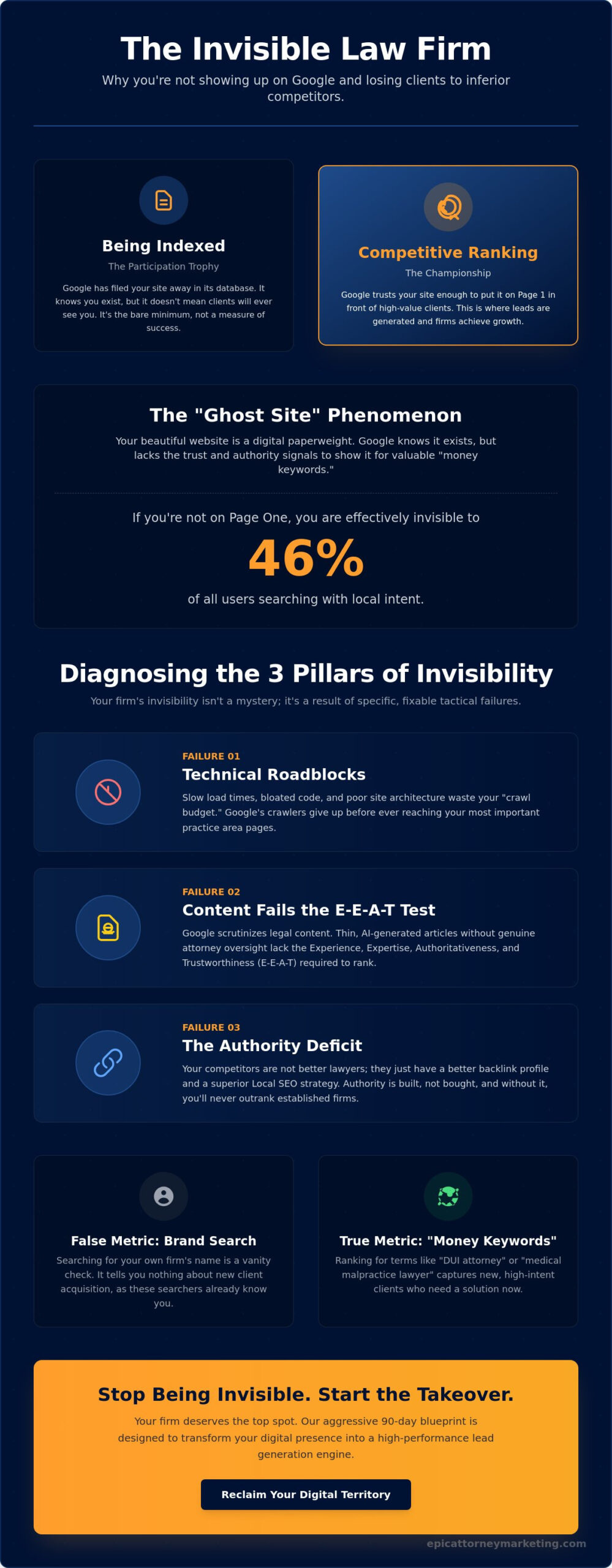
Most Law Firm Owners mistake existence for presence. If you've asked yourself, "why is my law firm not showing up on Google," you're likely conflating technical indexation with competitive ranking. Indexation means Google’s crawlers have found your site and filed it away in their massive database. Ranking means Google actually trusts your site enough to put it in front of a potential client. Being indexed is a participation trophy; ranking is the championship. If you aren't on page one, you're effectively invisible to the 46 percent of users performing searches with local intent.
This leads to the "Ghost Site" phenomenon. Google knows you exist, but it doesn't trust your authority. You might have a beautiful website, but if it lacks the aggressive signals required to outrank the established giants in your market, it will sit in the archives. Search Visibility is the percentage of relevant traffic captured by a firm. If that number is near zero, your digital assets are liabilities rather than growth engines.
To better understand why your firm remains hidden despite your marketing spend, watch this breakdown on the common pitfalls of legal search:
Brand Search vs. Keyword Dominance
Searching for your firm’s name and seeing it at the top of the results is a false metric of success. It's a vanity play. Existing clients and referrals already know who you are. New client growth depends on "Money Keywords" like "DUI attorney" or "medical malpractice lawyer." These are the terms people use when they have a problem but don't have a solution. To see the reality of your situation, use an incognito window or third-party tracking tools. If you aren't appearing for these high-intent queries, your current agency is failing you. They're likely hiding behind reports that highlight brand traffic while ignoring the lack of actual lead generation.
The Three Pillars of Law Firm Invisibility
Invisibility usually stems from three specific failures. First, technical roadblocks like slow load times or broken site architecture stop Google's crawlers in their tracks. Second, your content may fail the "Expertise" test. Google demands high-level E-E-A-T (Experience, Expertise, Authoritativeness, Trustworthiness) for legal queries. If your blogs are thin or AI-generated without attorney oversight, you'll stay buried. Finally, you likely have an authority deficit. Your competitors are winning because they have a battle-tested backlink profile and a superior grasp of local search engine optimization. Dominance isn't an accident. It's a tactical outcome of fixing these pillars.
Technical Roadblocks: Why Google’s Crawlers Are Ignoring Your Website
Existence does not guarantee visibility. Most Law Firm Owners rely on basic, free tools that only scratch the surface of site health. An Epic technical audit goes deeper, exposing the hidden friction that stops Google's spiders from ever reaching your high value content. If you are still wondering why is my law firm not showing up on Google, the culprit is often your crawl budget. Google only allocates a finite amount of time to index your site. Large legal websites frequently waste this precious resource on "junk" pages, outdated archives, or redundant tags, leaving your most profitable practice area pages completely ignored.
By 2026, Core Web Vitals have become the ultimate gatekeeper. Google prioritizes user experience above all else. If your site is burdened by "Technical Debt"—bloated code, unoptimized images, or legacy plugins from a 2018 redesign—you're effectively invisible. While Moz's Beginner's Guide to SEO provides a solid foundation for understanding these mechanics, winning in a cutthroat legal market requires an aggressive removal of every technical bottleneck. Fixing these errors requires more than a simple plugin; it requires an Epic technical audit to reclaim your digital territory.
How to Check if Your Firm is Actually Indexed
Before diagnosing a ranking problem, you must confirm an indexation problem. Open a browser and type "site:yourfirmwebsite.com" into the search bar. This command shows exactly which pages Google has in its registry. If the number is significantly lower than your actual page count, check your Google Search Console "Excluded" reports. A single misconfigured "noindex" tag can silently execute your firm's search visibility by instructing Google to ignore your most valuable pages entirely. It's a common, catastrophic error often left behind by inexperienced developers.
Site Speed and Mobile-First Failures
Speed isn't just a luxury; it's a ranking signal. In 2026, law firm marketing requires sub-2-second load times to maintain dominance. With approximately 76 percent of legal searches happening on mobile devices, Google uses your mobile site as the primary version for ranking. If your desktop site is fast but your mobile experience is a cluttered mess, your rankings will suffer across the board. Security is equally non-negotiable. An expired SSL certificate is a death sentence in the legal niche. Google will flag your site as "Not Secure," driving away 100 percent of your potential leads before they even see your results.
Google Business Profile Failures: Cracking the Local Map Pack Code
The Map Pack is the most valuable real estate on the internet for Law Firm Owners. Statistics show that the top three local results capture 44 percent of all clicks for local searches. If you aren't in that "Top 3" cluster, your firm is effectively invisible to nearly half of your potential clients. This is the brutal reality of local competition. Simply having a verified profile is no longer enough to win. If you're still asking, "why is my law firm not showing up on Google," you're likely losing the battle of proximity, relevance, and prominence.
Dominance in the Local Pack requires a tactical alignment with Law Firm SEO in 2026. Many firms sabotage themselves through amateur mistakes like keyword stuffing their business name or selecting generic categories. Google’s 2026 algorithm is aggressive in identifying manipulation. Using a primary category like "Lawyer" instead of a specific niche like "Personal Injury Attorney" is a strategic blunder that hands leads directly to your competitors. You need to own your niche, not just participate in it. Proximity remains a dominant factor, but relevance and prominence are the levers you can actually pull to outrank firms that are physically closer to the searcher.
The Verification and Suspension Trap
Legal firms face intense scrutiny compared to other industries. Google frequently triggers manual reviews for attorneys, especially in high-competition markets. By 2026, video verification has become the default standard for new and updated listings. This requires proving your physical office is legitimate with continuous footage of signage and management actions. If you find your profile suspended, don't panic and create a duplicate listing. This only worsens the problem. Consistency is your armor. Your Name, Address, and Phone number (NAP) must be identical across every directory, from Avvo to Yelp, to maintain the trust required for high rankings.
Review Velocity and Sentiment Analysis
Resting on your laurels is a recipe for decline. A law firm with 100 five-star reviews from two years ago will lose to a competitor with 10 fresh reviews from the last month. Google prioritizes review velocity, which is the steady stream of new feedback that proves you're still active and effective. A significant ranking boost is observed once a business reaches the 10-review threshold, but the quality of the text matters just as much as the quantity. Google’s AI now performs sentiment analysis on the text of your reviews. It "reads" the specific keywords and emotional register of client feedback to determine your relevance. An Epic strategy ensures you're generating high-impact testimonials that mention your practice areas naturally, providing the ranking signals Google craves.
The Authority Deficit: Why Your Competitors Own the First Page
If you've optimized your Google Business Profile and fixed your technical errors but still find yourself asking, "why is my law firm not showing up on Google," you likely have an authority deficit. Google doesn't just rank websites; it ranks entities it trusts. In the legal sector, this trust is measured through E-E-A-T: Experience, Expertise, Authoritativeness, and Trustworthiness. Your competitors aren't just lucky. They've spent months or years building a digital moat that tells Google they are the definitive source for legal help in your jurisdiction. High-quality content for law firm website serves as a foundation for all other SEO efforts.
The "Backlink Gap" is often the most significant hurdle. This is the difference between the number and quality of sites linking to you versus your competitors. If a rival firm has been featured in major legal journals or local news outlets while you have zero external mentions, Google will naturally favor them. Thin content is the primary reason law firms drop out of the top 10. Google’s 2026 updates aggressively devalue sites with generic, surface level information that fails to provide real value to a potential client. You can't win a high stakes battle with low stakes content.
Strategic Backlink Building vs. Spam
There is a massive difference between elite legal niche links and junk SEO backlinks. Many agencies take the easy route by buying cheap links from overseas farms. This is a liability. Google's AI is now sophisticated enough to identify these "Link Schemes" and may issue permanent bans. True dominance comes from earning links from high authority legal news, local bar association sites, and prestigious directories. These are the battle-tested signals that move the needle. Bridge your authority gap and dominate your market with an Epic authority audit.
Content Hubs and Semantic Search
The era of the 500-word blog post is dead. To rank in 2026, you must build comprehensive content hubs that act as definitive practice area guides. Semantic search has evolved. Google now understands that a user searching for a "Car Accident Lawyer" is also looking for a "Personal Injury Attorney." It connects these concepts automatically. If your site doesn't demonstrate a deep, interconnected web of expertise, you'll lose to firms that do. By utilizing Digital Marketing for Attorneys, you can create a multi-channel authority loop where your content, social signals, and backlinks all reinforce your position as the market leader.
Executing the Blueprint: How to Reclaim Your Digital Territory
Diagnosis is useless without decisive action. You've identified the technical debt, the authority gaps, and the Local Map Pack failures burying your practice. Now, you must transition from passive marketing to aggressive market dominance. If you're still asking why is my law firm not showing up on Google, it's time to stop looking for excuses and start executing a battle-tested strategy. Dominance isn't a gift from an algorithm; it's a tactical outcome of superior positioning and relentless optimization.
The 90-day turnaround is your first objective. While SEO is a long-term play, fixing a broken strategy yields visible momentum within three months. You should expect immediate technical remediation, indexation recovery for suppressed pages, and a measurable climb in Local Pack visibility. This isn't about "waiting and seeing." It's about forcing Google to recognize your firm as the undisputed authority in your jurisdiction. High-stakes ranking is impossible on a weak foundation. This is why custom law firm website design is the non-negotiable prerequisite for 2026. Your site must be a high-performance marketing engine, not just a digital business card.
Transparency is the hallmark of an elite strategic partner. Stop accepting vague reports that highlight "impressions" or "clicks" without context. You need real-time reporting and tangible lead data. If your marketing isn't driving signed cases, it's failing. Demand a clear view of your ROI and the mechanics behind every ranking shift. We don't hide behind jargon; we lead with results.
Audit, Optimize, Dominate
The path to the top begins with a deep-dive forensic audit of your current digital footprint. We strip away the technical debt and legacy errors sabotaging your growth. Once the foundation is secure, we move to aggressive onsite optimization. This ensures every page aligns with 2026 search intent and satisfies Google's E-E-A-T requirements. Finally, we scale your firm's authority through battle-tested outreach and elite content development. We don't just participate in the market. We own it.
Choosing an Elite Strategic Partner
Generalist marketing firms don't understand the high-stakes environment of a law practice. They use cookie-cutter templates that fail to resonate with high-value clients or Google's sophisticated filters. Boutique legal agencies outperform "jack-of-all-trades" firms because we live and breathe legal SEO. The Epic Web Results advantage is our results-first methodology. We are as ambitious as the attorneys we represent, and we have the track record to prove it. Stop being invisible. Get your Epic SEO Audit today.
Secure Your Strategic Advantage
You've seen the mechanics of the first page. You understand that invisible technical debt, authority deficits, and Local Map Pack neglect are the real reasons you're losing. Dominance isn't granted to the best lawyers; it's seized by the most strategic ones. If you're tired of wondering why is my law firm not showing up on Google, it's time to stop accepting mediocrity from your current agency. Passive marketing will never yield the elite results your practice requires.
Epic Web Results brings over a decade of legal marketing experience and a specialized focus on high-stakes law firm growth to every partnership. Our battle-tested 90-day ranking blueprint is designed to strip away technical failures and install a high-performance lead engine. Don't let inferior competitors continue to steal your market share while your practice sits in the shadows. You've built a firm that deserves to lead; now it's time to claim that position.
Claim Your Market Dominance – Get a Free SEO Audit
Your firm has the expertise; we have the blueprint to make sure the world sees it. Let's start winning today.
Frequently Asked Questions
Why can I find my firm by name but not for my practice areas?
Ranking for your firm name only proves you're indexed; it doesn't mean you're competitive. Brand searches come from people who already know you. If you're wondering why is my law firm not showing up on Google for terms like "car accident lawyer," it's because you lack the authority and relevance signals required to beat established rivals. You're winning the vanity race but losing the lead generation war.
How long does it take for a new law firm website to show up on Google?
Indexation typically happens within days, but ranking for competitive keywords takes between three to six months of aggressive optimization. Google puts new sites in a "sandbox" to test their credibility and E-E-A-T signals. Our battle-tested 90-day blueprint is designed to accelerate this timeline, moving your firm from total invisibility to a dominant position by focusing on high-impact technical and authority fixes immediately.
Can a Google penalty be reversed if my previous agency used 'black hat' tactics?
Yes, but it requires a high-stakes forensic audit and a complete removal of toxic assets. If your previous vendor bought "junk" backlinks or used keyword stuffing, Google may have issued a manual or algorithmic penalty. Reclaiming your territory involves disavowing bad links and replacing thin, AI-generated fluff with elite content. It's an aggressive recovery process, but it's the only way to restore your firm's digital reputation.
Is it possible to rank in the Local Pack if my office is outside the city center?
You can absolutely rank outside the city center by maximizing your prominence and relevance to overcome the proximity factor. While physical distance is a major ranking signal, Google favors firms that demonstrate superior authority and a consistent stream of fresh reviews. With the Local Pack capturing 44 percent of clicks, you must use localized content and hyper-specific GBP categories to force your way into the top three results.
What is the most important ranking factor for law firms in 2026?
Experience, Expertise, Authoritativeness, and Trustworthiness (E-E-A-T) remain the dominant factors for legal search in 2026. Google prioritizes content written or reviewed by actual attorneys and verified through rigorous GBP processes, including video verification. Your digital presence must prove you're a legitimate, high-performing entity. Firms that rely on generic templates or stock imagery will continue to lose ground to those projecting elite, battle-tested authority.
Why did my law firm's rankings suddenly drop after a Google update?
Rankings typically crash because your site failed to meet the quality thresholds of the latest algorithm shift, such as the May 2026 core update. If you're asking why is my law firm not showing up on Google after a steady period of visibility, your technical foundation or content depth likely became obsolete. Google constantly raises the bar for "helpful content." If your site hasn't evolved with these aggressive standards, you'll be replaced by more agile competitors.
Do I need a separate SEO strategy for every practice area I handle?
You need a distinct content hub and specific authority signals for every practice area to achieve total market dominance. A "general practitioner" approach fails in search because Google seeks specialists. If you handle both family law and criminal defense, each requires its own set of high-intent keywords, localized backlinks, and E-E-A-T proof points. Treating them as a single strategy dilutes your relevance and hands the advantage to niche-focused competitors.
How much should a law firm realistically spend on SEO to see results?
Realistically, a mid-sized firm should expect a monthly retainer between $3,000 and $9,500 to compete in most markets. In highly competitive metropolitan areas, costs often exceed $10,000 monthly to maintain dominance. By 2026, Answer Engine Optimization (AEO) for AI platforms adds an additional premium of $2,000 to $8,000. If you're paying less than these industry standards, you're likely paying for a passive service that won't deliver a meaningful ROI.