
Is saving five thousand dollars on a website template worth losing five million dollars in lifetime case value? For law firm owners chasing elite growth, the choice between a DIY law firm website builder vs professional design isn't about aesthetics. It's about whether you want a digital business card or a high-performance revenue engine. You've likely noticed your firm looks "small" compared to the market leaders, and you're right to be concerned. With 96% of potential clients starting their search online in 2026, an invisible search presence isn't just a nuisance; it's a financial catastrophe.
We agree that the "DIY illusion" is tempting when you're looking at a five hundred dollar price tag, but that shortcut creates technical debt that kills your visibility. This article proves why professional web architecture is the only path to total market dominance and how mediocre builders cost you millions in lost leads. We will analyze the 3.4x lead generation advantage of custom sites, the non-negotiable mobile-first requirements of 2026, and the exact blueprint to transform your site into an elite brand powerhouse that functions as a 24/7 lead-generation engine.
Key Takeaways
- Stop treating your digital presence as a monthly expense; learn why DIY models are "rented" space that fails to build real brand equity for your firm.
- Discover the mechanics of the "conversion gap" and how custom UI/UX turns high-stress leads into high-value clients.
- Expose the hidden technical debt and code bloat that keeps DIY sites invisible to modern AI-driven search engines.
- Master the math of the DIY law firm website builder vs professional design debate to see how a small conversion increase results in millions in annual ROI.
- Identify the exact moment your firm must pivot to an elite "Epic" methodology to secure total market dominance.
The DIY Illusion: Why "Easy" is the Most Expensive Word in Legal Marketing
Law firm owners often mistake a lower price tag for a better deal. They view the choice between a DIY law firm website builder vs professional design as a simple cost-saving exercise. It isn't. It's a strategic decision between owning an elite revenue-generating asset or renting a generic digital storefront. When you use a DIY builder, you're locked into a "rental" model. You don't own the underlying code; you can't easily migrate your data; and you're restricted by the platform's rigid ecosystem. This lack of flexibility is a death sentence for any firm aiming for total market dominance.
The allure of a five hundred dollar setup fee is a trap that ignores the reality of zero brand equity. If your website lives on a drag-and-drop platform, it's a digital business card, not a marketing engine. Elite growth requires a site that evolves with the market. Builders limit your ability to implement custom integrations or advanced tracking, effectively capping your firm's scalability before you even sign your first client of the month. To better understand the technical landscape of these platforms in 2026, watch this helpful video:
The "Template Trap" and Brand Dilution
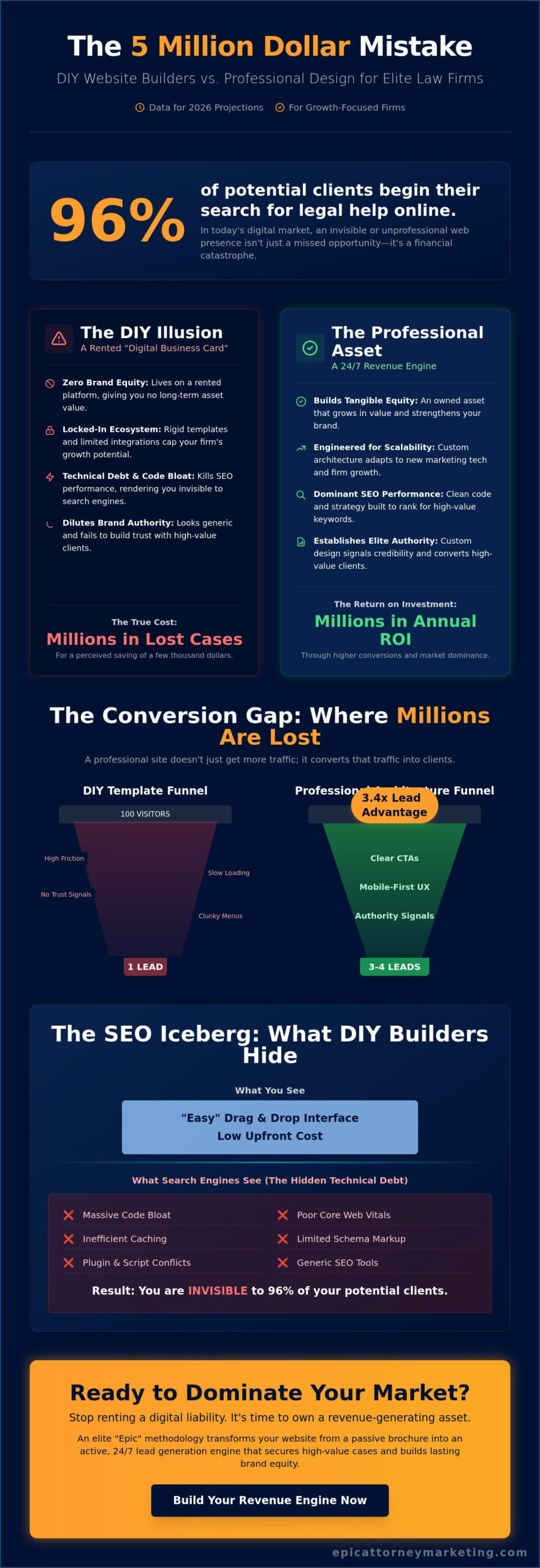
Verified data shows that 96% of potential clients begin their legal search online. These prospects typically visit 3-4 law firm websites before making contact. If your site uses the same template as five hundred other firms, you have zero competitive advantage. High-value personal injury or corporate clients possess a refined "cheapness" radar. They won't trust a multi-million dollar case to an attorney whose website looks like it was assembled in a weekend. Professional design creates an immediate aura of elite authority that converts skeptics into leads.
Time vs. Strategy: The Attorney’s Real Hourly Rate
Calculate your real hourly rate. If you're billing three hundred dollars per hour or more, spending twenty hours wrestling with font sizes and mobile responsiveness is a six thousand dollar mistake. That doesn't even include the opportunity cost of lost cases. While a DIY site might cost under two thousand dollars to launch, the technical debt it creates is staggering. You need a site that executes, not just a site that exists. Epic growth happens when you delegate the architecture to strategists and focus your time on winning in the courtroom. Stop playing web designer and start playing to win.
Professional Architecture vs. Template Mediocrity: The Conversion Gap
A website that merely "looks professional" is the bare minimum. In the high-stakes battle for market share, the real difference between a DIY law firm website builder vs professional design lies in the conversion gap. Most DIY templates are built for photographers or coffee shops; they aren't designed to handle a lead in a state of legal crisis. A potential client facing a catastrophic injury or a corporate lawsuit doesn't have the patience for friction. If your site requires them to hunt for a phone number or navigate a clunky menu, they'll bounce. You've lost them to a competitor who understands that web design is a strategic hunt for leads, not a creative hobby.
Professional architecture focuses on reducing cognitive load. It guides the user from pain to solution in seconds. While templates offer basic contact forms, an elite marketing engine integrates sophisticated intake systems. This includes 24/7 chatbots, which 19% of law firms have already adopted as of 2026, and streamlined "free case review" forms that capture data without overwhelming the prospect. If you want to stop losing high-value cases to the firm down the street, you need to optimize your conversion architecture before your next campaign launches. Every click that doesn't lead to a call is wasted capital.
Legal Authority Signals That Templates Lack
Generic builders rely on plugin widgets that look identical across thousands of sites. This kills your credibility. High-intent leads need to see social proof that feels authentic and authoritative. Since 84% of potential clients read online reviews before choosing an attorney, your site must weave these testimonials into the user journey, not hide them on a separate page. Custom-coded trust signals, such as dynamic case result tickers and verifiable attorney bios, create a psychological "halo effect." This positions your firm as the dominant authority before the lead even picks up the phone. Templates can't replicate that level of specific, battle-tested credibility.
Mobile-First Dominance in the Legal Sector
In 2026, "mobile-responsive" is an outdated term. Your site must be mobile-first. The majority of legal searches happen on smartphones, often in urgent situations where every millisecond counts. When evaluating a DIY law firm website builder vs professional design, remember that generic templates often suffer from "code bloat" that slows load times. If your site takes longer than two seconds to load, your bounce rate will skyrocket. Elite professional design ensures that click-to-call buttons and mobile navigation are battle-tested for performance. You aren't just building a site for a desktop; you're building a tool for the device that stays in your client's pocket 24 hours a day.
The Technical Debt of DIY Builders: SEO and Scalability Killers
You don't win a race with a parachute deployed. In the aggressive world of legal search, the code powering your site is either a propulsion system or a dead weight. When comparing a DIY law firm website builder vs professional design, the most dangerous differences are invisible to the naked eye. Drag-and-drop builders are notorious for "code bloat." They rely on massive, generic script libraries to make their "easy" interfaces function. This results in a messy backend that forces search engine crawlers to sift through mountains of junk code to find your content. Professional architecture, by contrast, is lean and purpose-built for speed and discoverability.
Technical debt in legal marketing is the hidden accumulation of sub-optimal code and architectural shortcuts that eventually makes elite search visibility impossible. Every time you use a plugin to fix a basic design flaw, you add another layer of weight. Over time, this debt compounds. By the time you realize your firm is invisible in search results, the cost to "fix" the DIY site often exceeds the price of a custom build. You can't scale a firm on a foundation of broken code. If you intend to achieve total market dominance, you must start with a clean, high-performance asset that search engines actually want to rank.
Core Web Vitals and Search Rankings
Google’s 2026 algorithms have moved beyond simple keyword matching. They now prioritize the user experience through aggressive Core Web Vitals metrics. DIY platforms consistently struggle with LCP (Largest Contentful Paint), which measures how fast your main content loads. If your LCP exceeds 2.5 seconds, your rankings will suffer. Since "near me" searches for lawyers have increased by 42% since 2024, a slow-loading mobile site isn't just a technical glitch; it's a direct leak in your revenue stream. Custom builds allow for server-side optimizations that DIY builders simply cannot match.
Advanced Schema and Entity Optimization
Modern SEO is a game of entities, not just keywords. To rank for high-value terms, your site needs precise "LegalService" schema markup that tells search engines exactly who you are, what you do, and which jurisdictions you dominate. Most DIY platforms offer generic SEO plugins that provide only surface-level data. This leaves your firm at a disadvantage against competitors who use Law Firm SEO in 2026 strategies to map their firm’s authority directly into Google’s Knowledge Graph. Elite legal websites require custom-coded schema that builders aren't designed to handle. Without this technical precision, you're fighting for scraps while the market leaders take the lion's share of the leads.
Calculating the True ROI: Opportunity Cost vs. Design Fees
Amateur firms focus on what a website costs. Elite firms focus on what it generates. When you weigh a DIY law firm website builder vs professional design, the math is often brutal and unforgiving. If your current DIY site converts at 1% and a professional build raises that to 3%, you haven't just improved your site; you've tripled your business. For a firm seeing 1,000 monthly visitors, that 2% gap represents 20 additional leads every month. If your average case value is $15,000, that "cheap" website is costing you $300,000 in monthly revenue. That isn't a saving; it's a financial hemorrhage.
We call this the "Invisible Loss." You can't track the clients who never called because your site looked like a template from 2018. Since the average client visits 3-4 law firm websites before making contact, your digital presence is constantly being compared to your most aggressive competitors. If your site feels "small" or "cheap," the high-value lead simply clicks the back button and calls the firm with the elite architecture. Professional design is a capital investment that pays dividends through higher conversion rates and superior brand positioning. It's the difference between being a market participant and a market leader.
Lead Value vs. Acquisition Cost
The Lifetime Value (LTV) of a single high-value legal client can reach into the hundreds of thousands. Despite this, many attorneys hesitate to spend more than a few hundred dollars on their primary lead-generation engine. A custom site lowers your long-term cost per acquisition (CPA) by ensuring that every dollar spent on traffic actually converts. This technical precision is vital for supporting Law Firm Marketing campaigns that demand high-performance landing pages. When your site executes at a higher level, your marketing spend becomes more efficient, allowing you to outspend and outrank everyone in your jurisdiction.
Scalability: From Solo Practitioner to Elite Firm
Growth requires infrastructure. A DIY site is a temporary fix that eventually hits a ceiling. As you scale, you'll find that drag-and-drop builders cannot handle advanced integrations, custom CRM workflows, or the aggressive SEO requirements of 2026. You'll eventually have to scrap the DIY site and start over. The cost of "doing it twice" is always higher than doing it right the first time. Custom architecture supports aggressive growth by providing a battle-tested foundation that won't break when you double your traffic. If you're ready to stop playing small, get an Epic audit of your current digital assets and see exactly where you're leaving money on the table.
Dominating the Market: When to Pivot to an Elite Legal Website
If your lead volume has plateaued while your competitors are aggressively scaling, your infrastructure is the bottleneck. You've reached the ceiling of what a template can provide. The choice between a DIY law firm website builder vs professional design is no longer a matter of preference; it's a matter of survival in a consolidating market. In 2026, 62% of law firms are heavily investing in online marketing. This isn't just competition. It's a digital land grab. If your site feels "good enough," you're already losing ground to elite firms that treat their digital presence as a high-performance weapon.
Signs of failure are easy to spot. High bounce rates, an invisible presence in AI-driven search results, and a brand that looks "small" are the symptoms of technical debt. Transitioning from a builder to a custom-designed asset is the first step toward total market dominance. You must move from a site that merely exists to one that executes with clinical precision. The 42% increase in "near me" searches since 2024 proves that prospects are looking for local authority. If your site doesn't immediately project that authority, you're handing cases to your rivals. Our methodology transforms average digital footprints into battle-tested marketing engines that function as 24/7 lead-generation tools.
The Epic Attorney Marketing Advantage
We don't build "pretty" websites. We build revenue engines. Our approach integrates Law Firm Website Design with aggressive SEO and conversion strategies that have been battle-tested in the most competitive jurisdictions. We focus on results-first architecture. This means every pixel and every line of code is calibrated to command market dominance. While 36% of firms are now using AI tools, we ensure your site is optimized for "Generative Engine Optimization" (GEO), making your firm the authoritative source that AI search engines cite first. We move you beyond the template mediocrity that keeps firms small.
Taking Action: Your Roadmap to Total Dominance
Stop settling for mediocre results and "good enough" templates. The transition to an elite digital presence begins with a cold, hard look at your current data. If your site isn't your top-performing associate, it's a liability. Growth requires infrastructure that won't break under the pressure of aggressive PPC or SEO campaigns. Schedule a strategic consultation to audit your current digital presence and identify the leaks in your conversion funnel. It's time to stop playing defense and start dominating your market. Ready to dominate? Get your Epic Law Firm Website Design today.
Secure Your Market Dominance Today
You can't lead the market while tethered to a generic template. The debate over a DIY law firm website builder vs professional design ends when you realize that your digital infrastructure determines your firm's revenue ceiling. We've proven that custom architecture eliminates the technical debt that slows down 2026 search crawlers and fixes the conversion gaps that lose you high-value cases. Your website is either a liability or your most aggressive closer.
Epic Attorney Marketing doesn't build digital brochures; we build high-performance assets. With over a decade of experience and battle-tested SEO strategies, we focus exclusively on high-growth law firms ready to scale. Every day you wait is another day your competitors capture the 96% of prospects searching for legal help online. It's time to stop settling for mediocre templates and start commanding the authority your firm deserves. Success in 2026 belongs to the firms that execute with clinical precision.
Stop losing leads to inferior competitors. Build your Epic marketing engine today.
Frequently Asked Questions
Is a DIY website builder ever okay for a new law firm?
A DIY builder is only acceptable for hobbyists with zero growth ambition. While the initial cost stays under $2,000, the long-term damage to your brand is often irreparable. You're effectively starting your firm with a technical handicap. If you intend to compete for high-value cases, skipping the DIY law firm website builder vs professional design shortcut is the only logical move for serious owners.
How much does a professional law firm website design actually cost in 2026?
In 2026, professional design costs vary based on firm size and complexity. Template-based agency sites range from $1,000 to $5,000. Basic custom sites for small firms typically cost between $3,000 and $7,000. Large firms requiring extensive customization and advanced features should expect to invest $40,000 to over $100,000 to secure a dominant market position and high-performance lead generation.
Will a professional design automatically improve my law firm SEO?
Professional design provides the technical foundation that makes elite SEO possible. By eliminating the code bloat found in drag-and-drop builders, custom sites achieve the sub-2.5 second LCP required by Google’s 2026 algorithms. You aren't just buying a look; you're buying a clean backend that search engines can actually crawl and index without getting stuck in the technical debt of a template.
Can I migrate my content from a DIY builder to a custom professional site?
Migration is rarely a simple process because DIY platforms are closed, proprietary ecosystems. You can't easily export the underlying code to a custom server. Most transitions require a manual rebuild of your content to ensure it meets elite performance standards. This is why the "start cheap and upgrade later" strategy is a trap that forces you to pay for your digital presence twice.
How long does it take to build a custom law firm website vs. a DIY site?
A DIY site takes days to launch, while a custom professional build typically requires 8 to 16 weeks. This timeline reflects the depth of strategic planning, custom coding, and conversion testing involved. A site built in a weekend is a digital brochure. A site built over three months is a battle-tested marketing engine designed for total market dominance and scalability.
What are the specific legal ethics requirements for website design?
Modern legal websites must meet WCAG 2.1 Level AA accessibility standards to mitigate litigation risks. The Department of Justice has set compliance deadlines for public entities starting April 26, 2027. Following these standards is essential for brand protection. Professional designers integrate these requirements into the base code, whereas DIY templates often fail these critical audits and leave your firm vulnerable.
Do I own my website if I use a professional design agency?
You own the asset when you partner with an elite agency. Unlike DIY platforms where you "rent" your presence on their proprietary servers, a custom build gives you full ownership of the code and database. This ensures you aren't held hostage by a platform's monthly fees or limited functionality. Real ownership is a prerequisite for building long-term brand equity and enterprise value in the legal sector.
How does custom design impact my Google Ads (PPC) performance?
Custom design aggressively lowers your cost per acquisition in Google Ads. High-performance landing pages improve your Quality Score, which directly reduces what you pay per click. If your professional site converts just 2% better than a generic template, your PPC ROI skyrockets. You stop wasting budget on clicks that bounce and start capturing the high-intent leads your competitors are losing.