
If you cannot trace a signed retainer back to the exact dollar that generated it, you aren't marketing; you're subsidizing your agency's lifestyle. In 2026, the average cost per click for legal services sits at $8.58, yet 82% of law firms report that their PPC ROI remains underwhelming. You're likely tired of opaque reports that prioritize "impressions" over actual bank deposits. Mastering the art of measuring ROI on law firm marketing isn't a luxury for the elite anymore. It's the baseline requirement for survival in a market where your competitors use clinical data to outmaneuver you.
You know that throwing money at a problem doesn't solve it, and "trusting the process" is usually code for a lack of accountability. You want a system that turns marketing into a predictable revenue engine instead of a black hole for your firm's capital. This guide provides the exact mathematical framework to calculate your returns and identify which channels actually drive growth. We'll strip away the creative fluff to focus on the mechanics of winning and scaling your firm through aggressive, results-driven optimization.
Key Takeaways
- Stop chasing clicks and start measuring ROI on law firm marketing through the lens of Cost Per Acquisition (CPA) to ensure every dollar fuels firm expansion.
- Identify the "Vanity Metric Trap" and learn why impressions are often just a expensive distraction from real market dominance.
- Compare the long-term compounding power of SEO against the immediate lead generation of PPC to build a balanced, high-yield investment portfolio.
- Discover how the 5-minute intake rule can instantly multiply your marketing yield without increasing your current advertising spend by a single cent.
- Implement a clinical framework that holds your marketing team accountable and turns raw data into an undeniable competitive advantage.
The Fatal Flaw in Law Firm Marketing: Why Most Attorneys Fail at ROI
Most law firms treat their marketing budget like a donation to Google. They hope for the best while their agencies send reports filled with "engagement" and "impressions." In 2026, survival requires a clinical approach to Return on Investment (ROI). It's no longer about being present; it's about being dominant. Measuring ROI on law firm marketing is the only way to distinguish between a strategic investment and a total loss of capital.
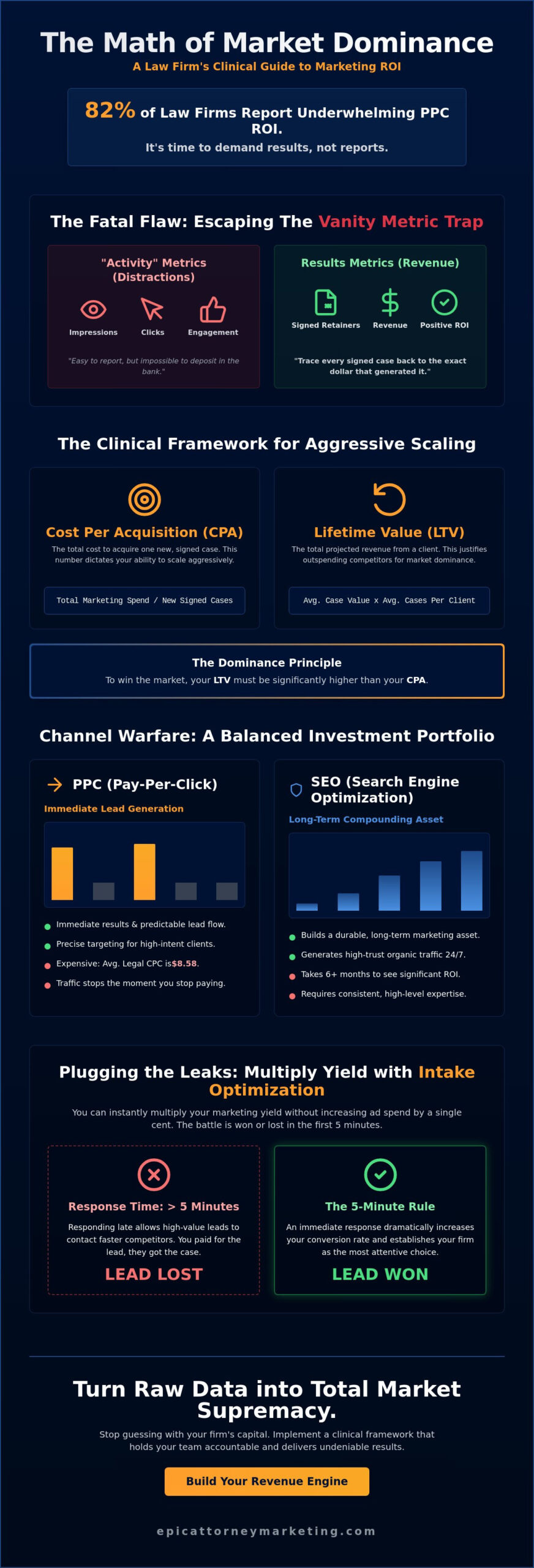
The "Vanity Metric Trap" is where most firms bleed out. Clicks, impressions, and likes are easy to generate but impossible to deposit. If your agency is bragging about a 20% increase in traffic while your signed retainer count remains stagnant, you're being misled. These are leading indicators at best and distractions at worst. You aren't paying for traffic; you're paying for market share and revenue.
To better understand how to move beyond these surface-level metrics, watch this helpful video:
Guesswork is a luxury you can't afford in a landscape where PPC keywords for personal injury can exceed $300 per click. True legal ROI stands on three pillars: Acquisition, Conversion, and Retention. If you fail at any one of these, your entire marketing engine collapses. Acquisition brings them to the door. Conversion gets them to sign. Retention turns a single case into a lifetime of brand equity. Measuring ROI on law firm marketing across these pillars is what separates the market leaders from the firms struggling to keep the lights on.
Activity vs. Results: The Metric Delusion
Agencies love "activity" because it's easy to report. Traffic is a leading indicator; it suggests potential. Revenue is the only lagging indicator that matters. Your monthly report likely hides a lack of growth behind a wall of technical jargon. ROI is the net profit generated from a specific marketing campaign divided by the total cost of that campaign. If that number isn't driving your strategy, you're just guessing.
The Long-Game Reality of Legal Decision Cycles
Legal marketing isn't e-commerce. A personal injury or corporate law lead might take six months to mature. Short-term ROI calculations often lead firms to cut budgets on high-performing assets like SEO prematurely. You need a system that attributes a signed retainer today back to the initial search or content touchpoint from half a year ago. Without this clinical tracking, you'll kill your best growth engines because they didn't produce an instant result.
The Math of Market Dominance: Calculating True Legal Marketing ROI
Standard accounting math is for firms that are content to merely participate in the market. If your goal is total dominance, you need a clinical framework that accounts for the reality of legal cycles. Most agencies give you a basic formula: revenue minus cost, divided by cost. It's a weak metric that ignores the long game. When calculating marketing ROI, you must move beyond simple subtraction and embrace strategic projection. Measuring ROI on law firm marketing requires factoring in overhead, billable hours lost to intake, and the specific Lifetime Value (LTV) of your practice area.
Cost Per Acquisition (CPA) is the only number that dictates your ability to scale. It's the ceiling of your aggression. If you don't know your maximum allowable CPA, you're just gambling with your firm's capital. High-growth firms calculate LTV to justify spending that would terrify a less sophisticated competitor. A personal injury firm with a $30,000 average case value can afford to outspend a criminal defense firm with a $5,000 average turn. If you aren't using these numbers to calibrate your spend, you're leaving the door open for a rival to outbid you for every high-value lead in your jurisdiction.
Customer Acquisition Cost (CAC) vs. Revenue Per Case
You must determine your maximum allowable CAC to remain profitable while scaling. This isn't just about lead costs; it's about the total investment required to sign a retainer. Firms with the highest LTV can afford to outrank everyone else because they understand the back-end math. You can lower your CAC without sacrificing quality by tightening your brand authority and optimizing your intake funnel. If your conversion rate from lead to signed case improves by even 5%, your ROI shifts dramatically. If you're ready to stop guessing and start scaling, it's time to analyze your current acquisition costs with clinical precision.
The Compounding Return of Organic Assets
PPC is a linear engine; when you stop paying, the leads stop flowing. It's a vital tool for immediate cash flow, but it doesn't build equity. In contrast, law firm seo acts as a compounding asset that drives down your average CPA over time. You should view your website as a 24/7 sales engine rather than a digital brochure. Every month you aren't dominating the search results, you're paying a "Cost of Inaction." This is the revenue your competitors are siphoning away while you hesitate. Measuring ROI on law firm marketing means comparing the immediate cost of a click against the long-term value of owning the top spot on the SERP. The math is clear: organic dominance creates a moat that a simple ad budget can't bridge.
Channel War: Evaluating ROI Across SEO, PPC, and Social Media
Marketing isn't a monolithic spend. It's a strategic deployment of capital across different battlefronts. Measuring ROI on law firm marketing requires understanding that each channel serves a distinct tactical purpose. You don't judge a scout by the same metrics as a heavy artillery unit. Some channels build long-term dominance; others capture immediate, high-intent traffic. If you treat them all the same in your reports, you're misallocating resources and leaving market share on the table for more sophisticated rivals. High-stakes professionalism demands that every channel justifies its existence through measurable financial returns.
Content marketing isn't just about filling pages. It's about building the psychological authority required to convert high-value clients who are vetting multiple firms. Social media often serves as a brand validator rather than a direct lead generator. You must be clinical about this distinction. If you're spending thousands on social posts but your signed retainers aren't moving, you're funding a vanity project. Every piece of content must be a tactical asset designed to move a prospect closer to a signed retainer.
PPC: The Scalpel for Immediate Growth
Google Ads in 2026 is a bloodbath for the unprepared. With average legal CPCs reaching $8.58 and competitive personal injury terms often exceeding $300, guesswork is financial suicide. You must measure ROI here by the hour, not the month. A/B testing landing pages isn't optional. It's the only way to protect your ad spend from being incinerated by low conversion rates. Effective lawyer marketing requires a surgical approach to bid management, targeting high-intent clusters rather than broad, expensive terms that exhaust your budget without results.
SEO: The Ultimate ROI Engine
While PPC provides the spark, SEO builds the furnace. Organic search remains the highest ROI channel for attorneys because it creates a high-moat strategy. The long-tail value of content for law firm website assets is that they continue to produce leads years after the initial investment. This compounding effect drives your average CPA down to levels that PPC simply cannot match. Beyond the math, there's a "Brand Equity" return. Dominating the SERP positions you as the objective leader in your field. This perception undeniably influences the 75% of potential clients who visit between two and five websites before making contact. Measuring ROI on law firm marketing means recognizing that organic dominance is the only way to achieve total market supremacy.
Plugging the Leaks: Optimizing Intake to Multiply Your Marketing Yield
You can deploy the most aggressive SEO and PPC strategies in the country, but if your intake process is soft, you're merely funding your competitors' growth. Many firms claim their marketing is "failing" when the reality is a catastrophic failure at the point of contact. Measuring ROI on law firm marketing is a futile exercise if you don't account for the leads that die on your front desk. If a prospect calls and encounters a passive receptionist instead of a high-performance closer, that lead's value drops to zero instantly. You aren't running a library; you're running a high-stakes professional practice that requires clinical precision at every touchpoint.
The 5-minute rule is the absolute baseline for survival. Research indicates that 75% of potential clients visit between two and five law firm websites before making a final decision. If you don't respond within five minutes of an inquiry, your chances of conversion plummet. Your intake team must be trained to treat every call as a closing opportunity. Technology should handle the heavy lifting of automated follow-ups to ensure no lead is left behind. If you aren't using A.I. and automated sequences to nurture prospects who don't sign immediately, you're leaving millions on the table for more disciplined firms to collect.
The Psychology of the Legal Lead
In practice areas like personal injury or criminal defense, the "Urgency Factor" is everything. A lead is often in a state of crisis and seeks the path of least resistance to a solution. You build immediate trust by demonstrating speed and authority during that first phone call. Don't just take a message; provide a clear roadmap for the next steps to secure the retainer. A 10% increase in intake efficiency can result in a 50% increase in net ROI. If you want to see these results in your own practice, it's time to audit your intake performance with an elite partner.
Tracking the Lead Journey
Dominance requires closing the loop between the "click" and the "check." You must implement CRM systems that track the entire lead journey with clinical accuracy. Call tracking and form attribution are not optional features; they are the bedrock of data-driven decision making. This level of granularity allows you to identify and eliminate "junk leads" that inflate your CPA and waste your staff's time. Measuring ROI on law firm marketing means knowing exactly which keywords produced your highest-value cases and which ones only produced noise. Stop guessing which channels work and start engineering your firm's growth through total data transparency.
The Epic Advantage: Turning Data Into Total Market Supremacy
Data is not a static record of what happened in the past. It is the intelligence you need to dictate what happens next. Measuring ROI on law firm marketing transforms your firm from a passive participant into a market-dominating force. While your competitors are busy debating the creative direction of their latest social media posts, you must focus on the clinical mechanics of scale. We don't view marketing as an expense. We view it as a high-level strategic operation designed to achieve total superiority in your jurisdiction. If you can't measure it, you can't manage it; and if you can't manage it, you certainly can't dominate with it.
Epic Web Results uses a results-obsessed framework to scale firms aggressively. We move you away from the cycle of "spending on ads" and toward the objective of owning the market. This transition requires a partner who operates with the same level of competitive aggression as you do. When you have total transparency into your metrics, you stop guessing where your next big case is coming from. You start engineering your growth with mathematical certainty. A partnership with an elite, strategic agency is the final step in turning raw data into a monumental competitive advantage.
Beyond the Spreadsheet: The Vision for Growth
True market leaders use ROI data to reinvest in higher-value practice areas with surgical precision. If the data shows that a specific lead source produces a 10x return on personal injury cases, you don't just maintain that spend; you accelerate it. Building a law firm marketing engine that competitors cannot replicate requires a mindset shift. You must move from the cautious perspective of a boutique firm to the ambitious outlook of a national powerhouse. Measuring ROI on law firm marketing provides the roadmap for this expansion, ensuring every dollar spent is a tactical move toward total supremacy.
Your Next Move: The Audit of Truth
It's time to confront the limitations of your current efforts. Audit your agency's performance today. If they provide reports filled with vanity metrics but cannot show you a direct line to signed retainers, they're a liability to your growth. Look for a partner who prioritizes your bottom line over their own comfort. You deserve a strategist who is just as ambitious as you are and who treats your capital with the respect it deserves. Stop settling for mediocre results and start demanding dominance. Schedule your aggressive growth strategy session with Epic Web Results today.
Secure Your Absolute Market Dominance
The era of guesswork in legal advertising is dead. Success in 2026 belongs to the firms that treat their marketing budget as a high-yield investment vehicle rather than a necessary evil. You've seen the math. You now understand that measuring ROI on law firm marketing is the only path to sustainable, aggressive growth. By optimizing your intake funnel and leveraging the compounding power of organic search, you build a moat that no competitor can cross.
Epic Attorney Marketing brings over a decade of legal marketing expertise to every partnership. Our proprietary high-performance marketing engines are engineered specifically for high-stakes litigation growth. We don't just provide services; we deliver market supremacy through clinical data analysis and relentless optimization. The window for seizing total market share is open. It's time to stop funding your agency's lifestyle and start funding your firm's dominance.
Dominate your market with a results-driven strategy from Epic Attorney Marketing.
Your firm is ready to scale. Take the first step toward total market supremacy today.
Frequently Asked Questions
What is a good ROI for law firm marketing in 2026?
A healthy ROI target for law firms is typically 5:1. Elite firms aiming for total market dominance often push toward 10:1 by optimizing every touchpoint. Your target must be high enough to cover overhead and billable hours while leaving significant profit for reinvestment. If your current return is below 3:1, your marketing engine is likely misfiring or your intake process is leaking revenue.
How long does it take to see a positive ROI from legal SEO?
You should expect 6 to 12 months before legal SEO delivers a substantial positive return. It's an equity-building strategy that compounds over time. While PPC provides an immediate spark, SEO is the engine that eventually drives your cost per acquisition to its lowest possible point. The firms that dominate the market are the ones with the discipline to fund this long-term asset.
Why is my Cost Per Lead (CPL) increasing every year?
CPL rises because legal keywords are some of the most expensive on the market. With average CPCs hitting $8.58 and top-tier terms costing much more, you're fighting in a hyper-competitive space. If your intake and conversion processes aren't evolving, you're simply paying the "inefficiency tax" of a crowded market. You can't control the market price, but you can control your conversion efficiency.
Should I focus on SEO or PPC for the best ROI?
The most effective strategy integrates both. PPC captures immediate intent and provides the data you need for testing. SEO builds the long-term authority required for measuring ROI on law firm marketing at a scale that makes your firm untouchable. Use PPC for the quick win and SEO for the permanent moat. Relying on just one channel leaves your firm vulnerable to algorithm shifts or price spikes.
How do I track referrals in my ROI calculations?
You must treat referrals as a distinct channel within your CRM. Assign a projected case value to every referral and track the source with clinical precision. This allows you to see how your brand development and reputation management efforts are indirectly fueling your firm's growth through word of mouth. Referrals aren't "free" leads; they're the result of your firm's market positioning and authority.
Can a small firm compete with national "Big Law" marketing budgets?
Smaller firms win by being tactical rather than broad. You don't need a national budget to dominate a specific local jurisdiction or a high-value niche practice area. By focusing on local visibility and custom website design that converts, you can outmaneuver "Big Law" firms that often rely on bloated, inefficient ad spends. Precision always beats raw volume in a high-stakes environment.
What tools are essential for tracking law firm marketing ROI?
You need a closed-loop system that includes a legal-specific CRM, call tracking, and advanced attribution software. These tools are non-negotiable for measuring ROI on law firm marketing accurately. Without them, you're just guessing which channels are making you money and which are merely funding your vendor's lifestyle. Data transparency is the only way to hold your marketing team accountable.
How does practice area affect typical ROI benchmarks?
Practice areas dictate your mathematical ceiling. Personal injury firms can tolerate a high CPA because a single case has massive lifetime value. Conversely, volume-driven practices like bankruptcy or DUI require a much leaner acquisition model. Your ROI benchmarks must align with the specific revenue potential of your cases. If your marketing strategy doesn't account for your practice's unique math, you're destined for mediocre results.