
In the high-stakes world of legal services, being a "good" lawyer isn't a competitive advantage; it's the bare minimum. If you're tired of watching high-value leads bounce from your practice area pages while tire-kickers clog your intake line, you're facing a digital credibility crisis. You know that building trust with potential clients online is the only way to scale, yet your current site likely feels more like a static brochure than a strategic weapon. Since 79% of clients research attorneys online before making contact, your digital presence is either your greatest closer or your most expensive liability.
The path to market superiority begins with a clinical analysis of your current digital footprint. We perform a comprehensive digital audit to identify every leak in your conversion funnel. From there, we handle the heavy lifting. Our team executes high-level SEO, precision PPC advertising, and authoritative content development—often utilizing specialized regulatory insights from platforms like CorpLawUpdates.in—that establishes you as the undisputed leader in your practice area. Building trust with potential clients online becomes an automated result of our tactical execution. The choice is yours: will your firm remain just another listing, or will you claim your position as the ultimate authority? Contact Epic Attorney Marketing today and start dominating.
It's time to stop being viewed as a commodity and start commanding the authority your expertise deserves. You'll learn how to master the psychological triggers and tactical signals required to bridge the digital trust gap and turn skeptical visitors into high-value clients. We'll break down how to transform your website into a 24/7 conversion engine that justifies premium fees through undeniable market superiority. From leveraging AI-driven search standards to deploying high-impact video content, this is your blueprint for total market dominance.
Key Takeaways
- Identify the "Digital Trust Gap" that causes elite law firms to lose high-value cases to less competent competitors with better websites.
- Leverage the "Halo Effect" to ensure every digital touchpoint reinforces your status as an elite strategic partner rather than a mere vendor.
- Learn the specific tactical signals required for building trust with potential clients online, moving beyond passive reviews to active authority.
- Engineer a high-performance trust engine that combines technical precision with content that addresses the high-stakes concerns of your ideal clients.
- Discover how to transform a standard practice page into a relentless conversion tool that justifies premium fees and secures total market saturation.
The Invisible Trust Gap: Why Your Law Firm is Leaking High-Value Cases
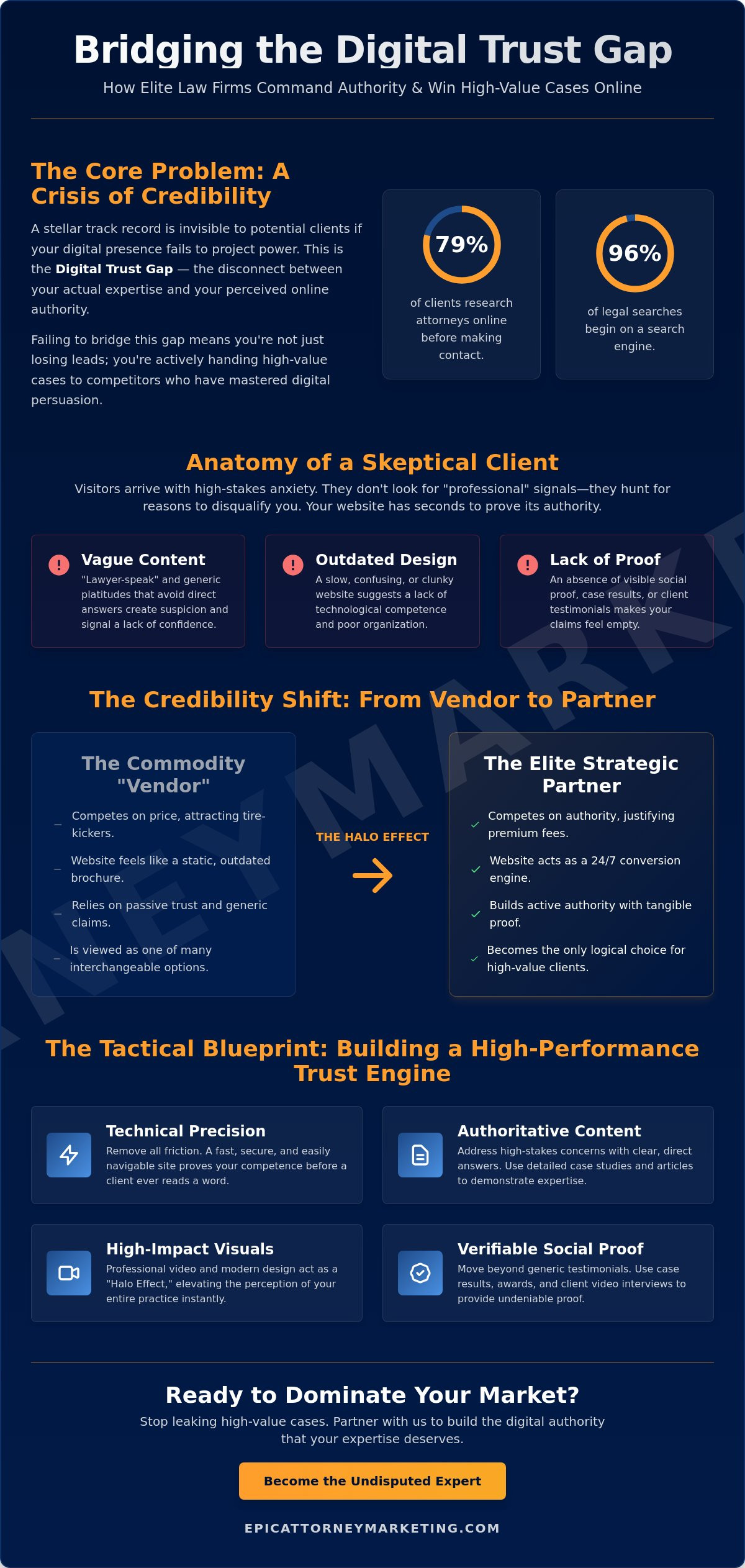
Your trial record is flawless. Your legal mind is sharp. But to the 96% of people who start their legal search online, none of that exists if your digital presence fails to project power. This is the Digital Trust Gap. It's the disconnect between your actual expertise and your perceived authority. If your website looks like a generic template, you aren't just losing visitors; you're handing high-value cases to aggressive competitors who have mastered the art of digital persuasion. You're effectively paying a "mediocrity tax" every time a qualified lead chooses a louder, more authoritative firm over yours.
In 2026, building trust with potential clients online requires more than a "Contact Us" form and a stock photo of a gavel. Skepticism is at an all-time high. Consumers are weary of over-promised results and under-delivered service. They aren't looking for a "service provider" anymore. They're looking for a strategic partner who commands the room before they even enter it. Trust isn't a soft sentiment; it's a measurable marketing metric that determines your cost per acquisition and your ultimate market share. If you can't prove your worth in the first three seconds, you've already lost.
To better understand how this dynamic shifts the power balance, watch this breakdown:
The Anatomy of a Skeptical Legal Client
Most visitors arrive at your site in a state of high-stakes anxiety. They're facing vulnerability, financial risk, or a legal crisis. In this headspace, they don't just look for "professional" signals; they look for reasons to disqualify you. "Professional" is the baseline expectation. "Authoritative" is what stops the scroll. If your site is slow, lacks clear answers, or feels impersonal, they'll bounce within seconds. Understanding the psychological principles of trust is vital here. You must address their fear with undeniable certainty. Red flags that trigger an immediate exit include:
- Vague, "lawyer-speak" content that avoids direct answers.
- Outdated design that suggests a lack of technological competence.
- A lack of visible social proof or verifiable results.
Trust as a Competitive Advantage
Market leaders don't compete on price. They compete on authority. When you successfully bridge the trust gap, you gain the leverage to justify premium fee structures. Clients pay more for the peace of mind that comes from hiring the undisputed expert. This isn't about participating in the market. It's about dominating the conversation. Perceived authority acts as a force multiplier for your marketing spend. It shortens the sales cycle because the "selling" happened before the first phone call. You aren't auditioning for the role; you're the only logical choice.
- Trust accelerates the lead-to-client conversion speed.
- High-authority branding filters out "tire-kickers" and attracts high-value cases.
- Building trust with potential clients online turns your website into a 24/7 revenue engine.
The Psychology of Credibility: Moving from "Vendor" to "Elite Strategic Partner"
Trust isn't built through warmth; it's built through competence. If your website forces a visitor to think too hard, you've already failed the test of "Cognitive Ease." When a potential client struggles to find a phone number or decipher a complex navigation menu, their brain subconsciously flags your firm as disorganized. Building trust with potential clients online relies on removing friction. If your digital interface is a mess, the assumption is that your litigation strategy is a mess, too. You don't win high-stakes cases by being confusing; you win by being clear.
The "Halo Effect" dictates that one high-quality signal can elevate the perception of your entire practice. A single, authoritative case study or a flawlessly executed video can make a visitor assume you're the elite choice in every other category. Research on the dynamics of trust shows that these initial digital impressions are often more durable than subsequent interactions. You don't get a second chance to be the authority. If your brand doesn't radiate intellectual dominance immediately, you're just another name in a crowded field.
Desperation is the loudest sound on the internet. Many firms attempt to build credibility by over-explaining every minor detail of the law. This backfires. It makes you look like a student, not a master strategist. Real authority is concise. It provides the solution, not the homework. When you stop trying to prove you're smart and start proving you're the answer, the power dynamic shifts in your favor.
Establishing Instant Authority via Design
The "3-Second Rule" is the only metric that matters for your homepage. Visual hierarchy should immediately telegraph your professional competence. Templates are for hobbyists. In high-value litigation, a generic site suggests a generic lawyer. Investing in law firm website design is a tactical necessity for building trust with potential clients online. It's the difference between looking like a vendor and being recognized as a powerhouse. Your design must be an objective, undeniable fact of your superiority.
The Language of Certainty
Stop saying "we can help." It's passive and weak. Start saying "we win." Replace vague marketing fluff with data-backed claims that leave no room for negotiation. If you've recovered millions, say it. If you've dominated a specific niche for decades, lead with it. Legal Authority is the intersection of proven results and strategic communication. Elite firms understand that Epic Attorney Marketing builds systems designed for total market dominance, ensuring your firm is the only logical choice for high-value clients.
Passive Trust vs. Active Authority: Why Generic Testimonials Fail
"John was a nice guy" is the phrase that kills high-value conversions. It’s a generic platitude that tells a skeptic nothing about your tactical prowess or your ability to secure a multi-million dollar settlement. High-stakes clients aren't looking for a friend; they're looking for a mercenary who can navigate complex legal terrain. Passive trust relies on a high star-rating average. Active Authority weaponizes every win. Building trust with potential clients online requires shifting from collecting "nice" comments to curating strategic evidence that proves you are the only logical choice for the job.
The "Case Study Engine" is the ultimate trust builder. Instead of a single quote, you must present a narrative of the conflict, the strategy, and the objective victory. This approach turns your website into a ledger of success that competitors cannot replicate. In the 2026 legal landscape, proactive reputation management is a requirement. Statistics from the Martindale-Avvo Consumer Survey show that 84% of potential clients read online reviews before choosing an attorney. Even more striking, 56% trust Google Reviews more than personal recommendations. If you aren't actively managing this narrative, you're leaving your brand's reputation to chance.
Beyond the 5-Star Rating
Generic reviews are easy to ignore. To convert a skeptical visitor, you must curate testimonials that specifically address client objections and fears. If your typical client is worried about the duration of a case, highlight a review that praises your speed. Video testimonials are even more effective. Websites featuring video content see 2.6 times more user engagement. Leveraging aggressive digital marketing for attorneys allows you to amplify these success stories across multiple channels, ensuring your authority is felt everywhere your clients look.
Strategic Transparency and Ethics
Authority is not just about shouting your wins; it's about adding real value to client relationships through strategic transparency. Clear explanations of your process and fee structures eliminate the "fear of the unknown" that causes high bounce rates. However, you must remain compliant. ABA Model Rule 7.1 prohibits any false or misleading statements. In California, Senate Bill 37 now requires you to disclose if an award or recognition was conditioned on payment. True authority doesn't need to cheat. You display results by letting the facts speak for themselves, using expertise signals like certifications and high-profile media mentions to solidify your standing without violating state bar advertising rules.
The Tactical Blueprint: Building a High-Performance Trust Engine
Trust is an engineering problem. You can't command authority if your digital infrastructure is crumbling. SSL certificates, lightning-fast load speeds, and flawless mobile responsiveness are the minimum requirements for building trust with potential clients online. If your site takes more than three seconds to load, you've effectively told a high-value lead that your firm is inefficient. Professionalism is measured in milliseconds. You need a platform that reflects the high-stakes nature of your practice; anything less is an admission of weakness.
There's a direct correlation between technical performance and law firm SEO. Google's 2026 algorithms prioritize "Trust Signals" because they mirror user experience. If users bounce due to a clunky interface, your rankings will crater. Total market saturation requires a website that functions as a high-precision instrument. This includes an omnipresence strategy. By combining social media visibility with aggressive PPC retargeting, you remain top-of-mind. You don't just want to be found; you want to be unavoidable in your market.
Content as a Conversion Tool
Content isn't filler. It's a conversion tool. Generic blog posts are dead. You need "Power Pages" that dismantle complex legal hurdles. Your content for law firm website must answer the high-stakes questions your competitors are too afraid to touch. With Google's AI Overviews now appearing in approximately 47% of legal searches, your content must be optimized for generative engines to stay relevant. Use an FAQ strategy to pre-empt objections before they ever reach a consultation. This is how you win the battle for intellectual dominance.
Technical Integrity as a Professional Signal
Every broken link is a strike against your credibility. It suggests a lack of attention to detail that clients fear will translate to their case. Secure, frictionless lead capture forms are essential. If a prospect has to hunt for a way to contact you, they'll find someone else. In 2026, implementing A.I. video has become a primary channel for demonstrating expertise. Research shows that websites with video see 2.6 times more engagement. It humanizes the firm while maintaining a standard of elite professionalism. If you're ready to scale, Epic Attorney Marketing is the partner you need to build this high-performance engine.
Total Market Dominance: Partnering with Epic Attorney Marketing
Participation is for the mediocre. You didn't build a prestigious law firm to be just another "option" in a sea of generic competitors. In a market where 96% of legal help begins with an online search, being visible isn't enough. You must be dominant. Epic Attorney Marketing doesn't function as a mere vendor; we operate as elite strategic partners for firms that refuse to settle for average growth. We've spent over a decade perfecting the Trust Architecture required to turn skeptical visitors into high-value clients. We understand that building trust with potential clients online isn't about being liked. It's about projecting an undeniable aura of authority that makes hiring any other firm feel like a reckless gamble.
Our methodology strips away the fluff of traditional agency models. We focus entirely on the mechanics of winning. By transforming your website from a static brochure into a high-performance conversion engine, we ensure you command the attention your expertise deserves. This isn't a creative exercise; it's a strategic overhaul designed for firms that want to scale aggressively and secure total market saturation. If you're weary of mediocre results and "tire-kicker" leads, it's time to deploy a system built for the high-stakes reality of 2026.
The Epic Advantage
Generalist agencies don't understand the nuances of the legal industry. They don't grasp the state bar rules or the specific psychological triggers of a person facing a legal crisis. We do. Our proprietary approach, known as the "Aggressive Blueprint," is the definitive standard for law firm marketing. We don't just generate leads; we manufacture authority. This legal-only focus allows us to navigate complex compliance requirements while simultaneously crushing your competition in the search results.
Next Steps for Total Dominance
The path to market superiority begins with a clinical analysis of your current digital footprint. We perform a comprehensive digital audit to identify every leak in your conversion funnel. From there, we handle the heavy lifting. Our team executes high-level SEO, precision PPC advertising, and authoritative content development that establishes you as the undisputed leader in your practice area. Building trust with potential clients online becomes an automated result of our tactical execution. The choice is yours: will your firm remain just another listing, or will you claim your position as the ultimate authority? Contact Epic Attorney Marketing today and start dominating.
Claim Your Position as the Undisputed Authority
The digital trust gap is the single greatest threat to your firm’s growth. You've seen how psychological triggers and technical precision dictate whether a high-value lead calls you or clicks away. Building trust with potential clients online isn't a passive byproduct of tenure; it's a strategic operation that requires a high-performance marketing engine. If your current presence doesn't project undeniable power within three seconds, you're effectively subsidizing your competitors' expansion. Market leaders don't leave their reputation to chance. They engineer it.
Epic Attorney Marketing brings over a decade of legal marketing exclusivity to your practice. We don't offer generic solutions. We deploy our proprietary Aggressive Blueprint methodology to transform stagnant websites into monumental conversion tools. You deserve an elite strategic partner that matches your ambition and understands the high-stakes nature of the legal sector. It's time to stop participating in the market and start commanding it. Ready to dominate your market? Schedule your strategic growth session with Epic Attorney Marketing today. Your firm’s total market saturation is the only objective that matters.
Frequently Asked Questions
How long does it take to build trust with potential clients online?
First impressions are forged in less than three seconds. While long term credibility is sustained through consistent content, the initial decision to trust or bounce happens almost instantly. Your website's visual hierarchy and load speed dictate this immediate reaction. If your digital interface isn't high performance from the first click, you've lost the lead before they even read your bio.
What are the most important trust signals for a law firm website?
The most critical signals are technical integrity, verifiable social proof, and intellectual dominance. This includes an SSL certificate, lightning fast page speeds, and custom design that avoids generic templates. Building trust with potential clients online also requires "Active Authority" through detailed case studies. These elements work together to prove your firm is a high level strategic partner rather than a commoditized vendor.
Can SEO actually help build trust with my clients?
Search engine visibility is a proxy for authority in the mind of the consumer. When your firm appears at the top of Google for high stakes keywords, it carries an implicit endorsement from the world's most trusted algorithm. High rankings suggest that your firm is the market leader. If you aren't visible, you don't exist; if you aren't at the top, you aren't the authority.
Does social media marketing really work for serious law firms?
Social media is a tool for omnipresence and humanizing your expertise. It isn't about "likes"; it's about staying top of mind while a prospect moves through their decision making journey. By sharing authoritative insights and A.I. videos, you reinforce your status as a master strategist. Serious firms use these platforms to dominate the conversation and ensure they are the only logical choice when a crisis hits.
How do I handle negative reviews without hurting my firm’s reputation?
Respond with clinical professionalism and zero defensiveness. Address the process rather than the person, and never disclose confidential client information. A single negative review won't sink a firm that has a robust reputation management strategy in place. In fact, a professional response to criticism can actually increase trust by demonstrating your firm's commitment to high level communication and accountability.
What is the best way to showcase legal results without being "braggy"?
Let the data speak for itself through objective case studies. Instead of using hyperbolic language, focus on the conflict, the strategic hurdles you overcame, and the final financial or legal outcome. This approach provides the "Language of Certainty" that high value clients crave. Always ensure your results are presented in compliance with ABA Model Rule 7.1 to maintain ethical standing while projecting power.
How does website design impact attorney-client trust?
Design is the silent ambassador of your brand's competence. A disorganized or outdated site suggests a disorganized or outdated legal practice. High performance design utilizes "Cognitive Ease" to guide visitors toward a conversion without friction. When your site is easy to navigate and visually commanding, building trust with potential clients online becomes a natural byproduct of the user experience. Mediocre design is an expensive liability.
Is content marketing necessary if I already have a strong referral base?
Referrals are no longer enough to close the deal. Statistics show that 79% of clients research attorneys online before making contact, even if they were referred by a friend. If your digital presence doesn't match the high praise of the referral, you create a "Trust Gap" that leads to lost cases. Content marketing ensures that your online authority validates and amplifies your real world reputation.