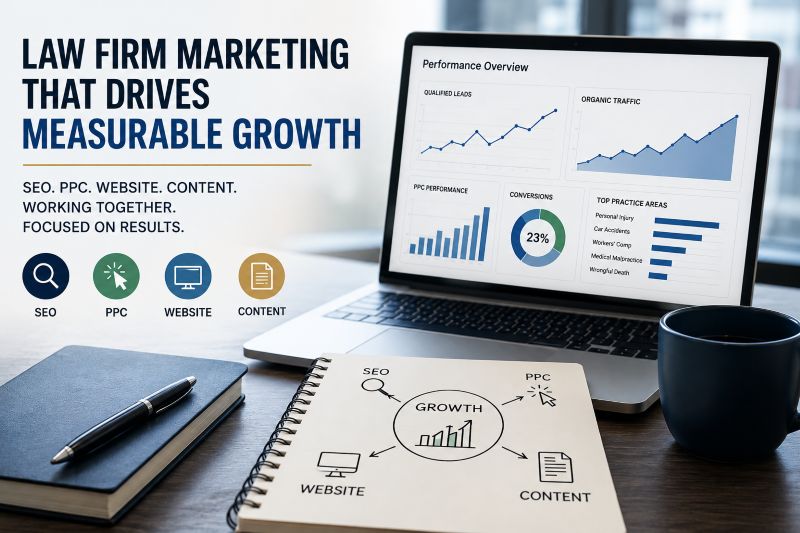

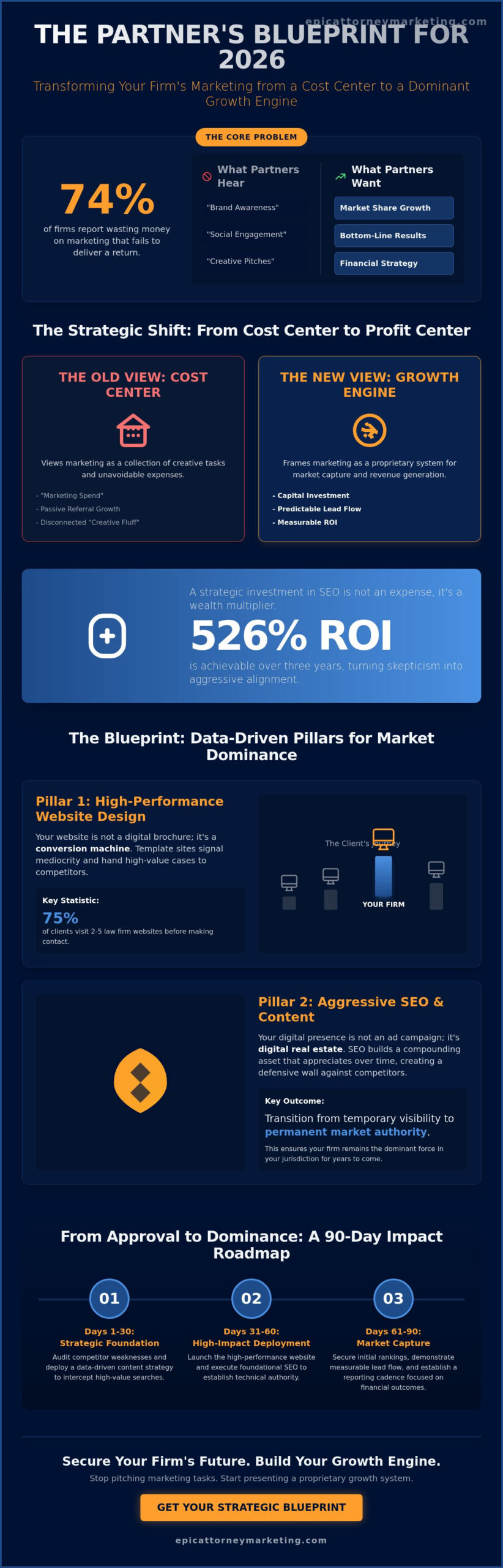
Your partners don't care about "brand awareness" or "social engagement" metrics. They care about market share and the bottom line. If you're treating your law firm marketing plan presentation to partners as a creative pitch rather than a financial strategy, you've already lost the room. Over 74% of firms report wasting money on marketing that fails to deliver a return; your partners are tired of being part of that statistic. They aren't looking for another cost center. They're looking for a high-performance growth engine that scales.
You need to frame your 2026 marketing strategy as a high-stakes operation designed for total market dominance. This article provides the blueprint to secure full budget approval by translating technical jargon into partner-level financial outcomes. We'll show you how to frame your plan as a predictable revenue system, demonstrating that a strategic investment in SEO can yield a 526% ROI over three years. This shift turns partner skepticism into aggressive alignment. By the end of this guide, you'll have a roadmap to command the boardroom and transform your marketing plan into a non-negotiable asset for firm expansion.
Key Takeaways
- Stop pitching creative tasks and start presenting a proprietary growth system that scales firm equity.
- Identify the high-impact levers like SEO and custom website design that transform your digital presence into a central revenue engine.
- Master the law firm marketing plan presentation to partners by leading with aggressive market data and competitor weaknesses rather than creative fluff.
- Neutralize partner skepticism by reframing marketing costs as the high price of lost opportunities and finite referral loops.
- Transition from boardroom approval to total market dominance with a tactical 90-day roadmap designed for immediate impact.
The Strategic Imperative: Why Your Marketing Plan is a Revenue Engine
Partners often view marketing as a necessary evil or a drain on the firm’s quarterly distributions. This perspective is a liability. A successful law firm marketing plan presentation to partners must dismantle the idea that marketing is a collection of creative tasks. It is a proprietary growth system. In 2026, relying on the status quo is not a conservative strategy; it is a high-risk gamble with your firm's equity. While you wait for referrals, aggressive competitors are building digital infrastructure designed to intercept your best cases before they ever reach your office.
To win the boardroom, you must apply the foundational principles of services marketing to the firm's specific financial goals. This means moving beyond the "intangible" and focusing on the mechanics of market capture. You aren't just buying ads. You're building a scalable engine that transforms market demand into signed retainers. If your presentation doesn't connect digital visibility to the firm's long-term valuation, you're just asking for permission to spend money rather than offering a path to wealth.
To better understand how this strategic shift looks in practice, watch this helpful video:
Shifting from Cost-Center to Profit-Center
Stop talking about "spend" and start talking about acquisition costs. Every dollar funneled into the law firm marketing plan presentation to partners should have a projected multiplier. Partners understand ROI; they don't understand "engagement." Passive growth is a relic of the past. In a hyper-competitive legal market, firms that fail to dominate search results effectively outsource their growth to their rivals. If you don't control the lead flow, you don't control your firm's future. It's that simple.
Market Share as a Non-Negotiable Asset
Your digital presence is not a brochure. It is digital real estate. Unlike traditional advertising that disappears when the invoice is paid, law firm SEO builds compounding authority that appreciates over time. This creates a formidable defensive wall against encroaching national firms. By positioning your marketing plan as an asset rather than an expense, you frame the budget as a capital investment. You're securing the firm's territory and ensuring that your practice remains the dominant force in your jurisdiction for years to come.
Building the Blueprint: Data-Driven Pillars of a Dominant Plan
Elite firms don’t dabble in marketing tactics. They deploy calibrated systems. Your law firm marketing plan presentation to partners must showcase the specific levers that force growth. While competitors waste budgets on billboards and generic networking, you must focus on the data-driven pillars that command the market. This starts with a high-performance website and ends with total search dominance. Every pillar of your plan must be a calculated strike against your competition's market share.
High-Performance Website Design
A template website is a liability. It signals mediocrity to high-value clients and limits your technical visibility. In 2026, law firm website design is about more than aesthetics; it is about engineering a conversion machine. Statistics show that 75% of potential clients visit between two and five websites before making contact. If your site doesn't immediately project authority and capture lead data, you are handing cases to your competitors. You need a custom architecture designed for tactical lead capture, not just a digital brochure.
Aggressive SEO and Content Strategy
Ranking is only half the battle. Closing high-value clients requires authority-driven content for law firm websites that answers the questions your competitors ignore. Technical SEO provides the foundation, but content is the closer. By leveraging data to identify high-intent keywords, you can intercept prospects at the exact moment they need representation. This approach transforms your website into an asset that compounds in value, creating a defensive wall that national firms cannot easily breach.
Integrating Pay-Per-Click (PPC) advertising alongside these long-term efforts ensures immediate market entry. While SEO builds your firm's legacy, PPC captures the "ready-to-sign" leads that your partners demand today. This dual-track approach demonstrates a sophisticated understanding of how to balance immediate cash flow with sustainable equity growth.
When finalizing your law firm marketing plan presentation to partners, you must drive change through strategic communication by aligning these technical assets with the partners' desire for predictable revenue. They aren't buying tools; they're buying market share. Reviewing your current digital footprint with an elite strategic partner is the first step toward building this blueprint and exposing the gaps in your current strategy.
The Partner-Level Presentation: Selling Growth, Not Tactics
Stop treating the boardroom like a classroom. Your partners don't need an education in digital trends; they need a demonstration of financial dominance. When delivering a law firm marketing plan presentation to partners, your first slide shouldn't be about your goals. It should be about the firm's lost revenue. Highlight the 74% of law firms that waste money on underperforming campaigns. Then, show them exactly which competitors are currently harvesting the leads that should belong to your firm. This isn't just a plan. It is a tactical intervention.
Partners are driven by net profit and ROI. If you lead with "impressions" or "likes," you've lost the room before you've even started. You must perform a brutal gap analysis. Show them the reality: while 87% of firms have a website, only 35% actually acquire clients through them. This represents a massive leakage in firm equity. Your presentation must frame the proposed budget not as a cost to be managed, but as a capital allocation toward a high-yield asset. This focus on maximizing a firm's worth mirrors the strategic approach taken by Significant Business Results when advising owners in the architecture and engineering sectors on leadership and long-term succession planning.
Framing ROI and Predictable Lead Flow
To justify the budget, you must speak the language of Lifetime Value (LTV). If the cost to acquire a signed case through paid channels sits between $2,500 and $3,000, you must contrast that immediately with the average settlement or fee value. This turns the conversation from "what does this cost" to "how many cases do we want to buy." Use a Success Scorecard to track these financial KPIs, moving beyond vanity metrics. By deploying aggressive lawyer marketing strategies, you can project a 12-month growth trajectory that feels like an objective reality rather than a hopeful guess.
Competitive Benchmarking
Nothing motivates a partner faster than seeing a rival win. Visualizing the search landscape is essential. Show them the specific digital weaknesses of your top three competitors. Are they slow to respond? Is their content thin? Use these vulnerabilities to position your plan as the ultimate tactical response. Your law firm marketing plan presentation to partners should prove that the market is currently up for grabs. If your firm doesn't claim that space, a more aggressive rival certainly will. You aren't just presenting a marketing strategy; you're presenting a plan for market capture that leaves your competitors fighting for scraps.
Overcoming Resistance: Navigating Partner Objections and Skepticism
Expect resistance. Skepticism is a partner's primary defense mechanism. They've seen marketing trends come and go, often leaving nothing but a hole in the firm's distributions. Your law firm marketing plan presentation to partners must be bulletproof to survive this scrutiny. It needs to dismantle the "referral-only" mindset and reframe the budget as a tool for risk mitigation. If you don't address these objections head-on, your plan will die in the boardroom.
The Referral Ceiling
The most dangerous words in a law firm are "we've always grown through referrals." Relying on referrals is a linear, passive strategy. It leaves the firm's growth to chance. In 2026, even the strongest referral will still vet your firm online. If your digital presence is weak, you are actively killing the trust that the referral built. Digital marketing doesn't replace your network. It scales it. It ensures that when a referral searches for you, they find a dominant authority rather than a digital ghost. You are using technology to amplify the firm's existing reputation to an audience you haven't met yet.
Risk Mitigation and Scalability
Partners often view marketing spend as a sunk cost. You must reframe it as an investment in firm stability. A diversified law firm marketing plan reduces your dependence on a single source of cases. It gives the firm the power to "turn the tap" on lead flow based on current capacity. This scalability is what separates a lifestyle practice from a dominant market leader. By building a predictable engine, you remove the "feast or famine" cycles that plague traditional firms.
Elite marketing doesn't dilute firm prestige. It enhances it. The "burned before" objection usually stems from hiring generalist vendors who sold tasks rather than strategy. You are proposing a strategic partnership. This means moving away from order-takers and toward an outsourced elite marketing department that is as invested in the firm's growth as the partners themselves. Stop viewing marketing as an overhead expense. Start viewing it as the primary driver of the firm's future valuation. Schedule a strategic market audit today to show your partners the exact cost of their current inaction.
Executing for Dominance: From Presentation to Market Leadership
Boardroom approval is a victory, but it's a hollow one without immediate, aggressive execution. The momentum from a successful law firm marketing plan presentation to partners must be channeled into a tactical strike. You don't have months to find your footing. You need a results-only partner who understands that every day without market dominance is a day your rivals profit from your hesitation. Execution must be clinical, swift, and unapologetically focused on the bottom line.
Why Specialized Legal Marketing Matters
Generalist agencies are a liability. They don't understand the ethical boundaries or the high-stakes nature of legal acquisition. Effective digital marketing for attorneys requires more than just generic traffic; it requires a niche approach that targets high-intent cases. You need an elite strategist who is as ambitious as you are, not a vendor who hides behind "brand awareness" reports. A partner who understands the legal landscape will protect your firm's prestige while aggressively capturing market share.
The 90-Day Dominance Roadmap
Your transition from approval to market leadership follows a strict, high-impact timeline. This roadmap ensures that partners see the "Success Scorecard" moving in the right direction immediately.
- Days 1-30: Immediate Revenue Capture. We focus on technical website optimization and aggressive PPC adjustments. This intercepts existing market demand and generates immediate lead flow to prove the system's viability.
- Days 31-60: Building Momentum. We deploy authority-driven content and initiate strategic backlink building. This phase solidifies your search rankings and begins the compounding growth of your digital assets.
- Days 61-90: Market Leadership. We use data from the first 60 days to refine lead generation tactics. This is where we move from participation to dominance, expanding your reach into high-value practice areas.
This isn't just about surviving 2026. It's about building a legacy of market superiority. The "Epic" approach is designed for firms that refuse to settle for mediocre results. Don't let your strategic blueprint gather dust. Take the momentum from your law firm marketing plan presentation to partners and turn it into an undeniable market reality. Secure your firm’s future by partnering with a strategist who plays to win. The market is waiting; make sure it belongs to you.
Claim Your Firm’s Future as a Market Leader
You've seen the blueprint for total market capture. Securing buy-in requires a fundamental shift from pitching creative tactics to presenting a proprietary revenue system. By focusing on high-impact pillars like aggressive SEO and custom website design, you frame the budget as a capital investment that builds firm equity. A successful law firm marketing plan presentation to partners is your opportunity to lead the firm away from the limitations of passive growth and toward a future of predictable, scalable dominance.
Mediocrity is the enemy of expansion. With over a decade of elite legal sector experience, we don't just provide services; we forge unapologetically results-oriented strategic partnerships. Our proprietary high-performance growth methodologies are designed for firms that refuse to play for second place. It's time to stop reacting to the market and start controlling it. Don't let another quarter pass with your rivals harvesting your leads.
Secure Your Firm's Dominance: Get a Strategic Marketing Audit Today
Your firm's path to the top is clear. Take command of your jurisdiction and build the legacy your partners demand.
Frequently Asked Questions
How do I justify a large marketing budget to conservative partners?
You justify a large budget by reframing it as a capital investment in a high-yield asset rather than an overhead cost. Present the cost to acquire a signed case against the average fee generated to show a clear profit multiplier. Conservative partners respond to data that proves a predictable return on their capital. If you don't invest in growth, you're effectively paying a "stagnation tax" to your competitors.
What are the most important KPIs to show in a partner presentation?
The most important KPIs are Cost Per Acquisition (CPA), Lead-to-Signed-Case ratio, and Net Profit Margin per lead source. Avoid vanity metrics like traffic or social media impressions. Partners need to see a Success Scorecard that tracks the direct line from marketing spend to firm revenue. This financial clarity turns a tactical pitch into a high-level business strategy.
How long does it take to see a real ROI from a new law firm marketing plan?
Real ROI from a law firm marketing plan presentation to partners begins within 30 days via PPC but takes 6 to 12 months to compound through SEO. While paid ads generate immediate cash flow, the true equity growth happens when organic search dominance begins to lower your average acquisition costs. You are building a revenue engine that accelerates over time.
Should we focus on SEO or PPC in our initial presentation?
You should present both as a unified strategy for total market capture. Use PPC for immediate market entry and lead generation to satisfy short-term revenue goals. Simultaneously, position SEO as the foundation for long-term dominance and firm valuation. Relying on one without the other leaves the firm vulnerable to more aggressive rivals who are playing both the short and long games.
How do I handle a partner who insists that word of mouth is all we need?
Remind the partner that word of mouth is a finite, passive strategy that leaves the firm's growth to chance. In 2026, 75% of prospects will vet a referral online before making contact. Even if a referral is initiated during a casual round of golf—perhaps while discussing the best value for practice gear from Golf Ball Monkey—the prospect's next step is almost always a digital verification. If your digital presence doesn't match your physical reputation, you are actively losing the referrals that the partner values. Digital dominance amplifies word of mouth; it doesn't replace it.
What is the biggest mistake lawyers make when presenting a marketing plan?
The biggest mistake is leading with creative ideas or technical jargon instead of financial outcomes. Partners don't care how the engine works; they care how fast the car goes. Your law firm marketing plan presentation to partners must focus entirely on market share, competitive superiority, and bottom-line growth. If you talk about "likes" instead of "leads," you've already lost the room.
How do I choose between an in-house marketer and an elite agency?
Choose an elite agency when you require a multi-disciplinary team of master strategists who focus exclusively on aggressive legal growth. An in-house marketer is often a generalist who lacks the technical depth and specialized tools needed for total market dominance. Strategic partnerships offer a level of scalability and specialized expertise that a single employee cannot match.
Can we protect our firm's prestige while using aggressive marketing tactics?
Elite marketing enhances prestige by positioning the firm as the undisputed authority in its jurisdiction. High-performance custom website design and authority-driven content elevate your brand by proving you are the clear leader in your field. Mediocrity and "quiet" marketing are what truly dilute a firm's prestige. Dominance is the ultimate form of prestige in a competitive landscape.