

Your marketing budget isn’t an expense to be minimized; it’s a war chest for total market displacement. Most partners treat their spend like a utility bill, paying for “visibility” while their competitors eat their market share. If you’re tired of opaque reporting and high costs per lead that never convert, it’s time to shift your perspective. Managing a law firm’s marketing budget effectively requires a transition from passive spending to aggressive capital allocation. You aren’t just buying ads. You’re buying the future of your firm’s revenue.
We understand the frustration of watching $250 clicks for “medical malpractice” keywords vanish into thin air without a signed case to show for it. You suspect you’re being outmaneuvered by firms with better data and more aggressive strategies. This guide ends that cycle of uncertainty. We’ll show you how to transform your marketing spend into a predictable revenue engine that scales as you grow. You’re about to get a clear roadmap for budget allocation that ensures you don’t just participate in the market; you dominate it. We’re stripping away the creative fluff to focus entirely on the mechanics of winning.
Key Takeaways
- Stop viewing marketing as a cost; learn why the “incremental trap” of minor annual increases won’t let your firm grow.
- Discover the Epic Allocation Matrix for managing a law firm’s marketing budget effectively, shifting from maintenance to total market dominance.
- Master the 70/30 rule to balance long-term digital equity with immediate lead generation so your revenue engine doesn’t stall.
- Identify and eliminate vanity metrics that drain capital while dismantling the bottleneck of a referral-only model.
- Learn how to reinvest profits into high-performance website design to maximize ROI and accelerate your firm’s revenue flywheel.
The Psychology of Dominance: Why Your Current Budgeting Strategy is Failing
Most law firm partners treat their marketing budget like a utility bill. They see it as a necessary evil, a line item to be trimmed during lean months and ignored when the phones are ringing. This mindset is the primary reason firms stagnate. Managing a law firm’s marketing budget effectively requires a radical psychological shift. You aren’t just paying for “brand awareness” or “visibility.” You’re engaged in market displacement. Every dollar you spend is a tactical strike designed to seize a lead that would have otherwise gone to your competitor. Since the history of legal marketing shifted from static directories to aggressive digital competition, the stakes have never been higher.
The 2026 digital environment is saturated. Passive marketing is now effectively invisible. If your strategy is simply to “exist” online, you’re donating your budget to the platforms rather than building an asset. To dominate, you must stop viewing marketing as an expense and start treating it as a strategic capital allocation. You don’t buy ads; you buy your competitor’s market share.
To better understand the shift from spending to strategic allocation, watch this framework for budget planning:
The Expense vs. Investment Mindset
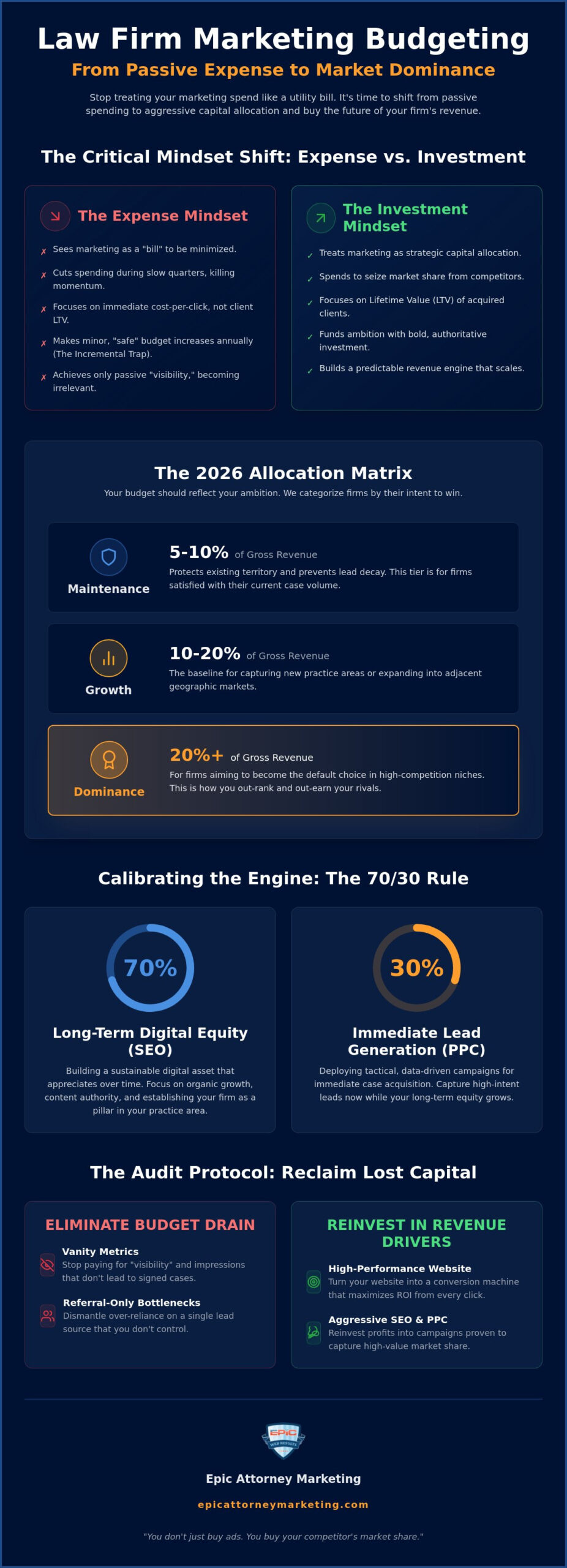
When you view marketing as a “bill,” your first instinct is to cut the activities that drive growth the moment a case settles or a quarter feels slow. This is a fatal error. Elite firms focus on the lifetime value of the clients they acquire rather than the immediate cost of the click. They understand that a $250 click for a high-value personal injury lead is a bargain if the settlement value is six figures. A Strategic Marketing Budget is a performance-indexed capital allocation designed to capture market share and maximize client lifetime value.
The High Cost of Mediocrity
Many firms fall into the “Incremental Trap.” They add 5% to last year’s budget and wonder why they aren’t growing. In a market where competitors are using AI-driven PPC and aggressive SEO, a “safe” budget is a recipe for irrelevance. Mediocrity is expensive. It results in missed opportunities in high-value practice areas where the cost of entry is high but the rewards are transformative. Breaking through the noise in 2026 requires a bold, authoritative stance. If you aren’t out-investing your rivals, you’re giving them permission to out-rank and out-earn you. Managing a law firm’s marketing budget effectively means funding your ambition, not just your overhead.
The 2026 Allocation Matrix: Benchmarking for Aggressive Growth
Conservative marketing advice is the fastest way to ensure your firm remains invisible. Most industry “experts” suggest spending a meager 2% to 5% of your gross revenue on marketing. In 2026, that isn’t a growth strategy; it’s a slow-motion liquidation of your market share. With US legal advertising spend projected to exceed $3 billion this year, managing a law firm’s marketing budget effectively requires a commitment to aggressive capital deployment. If you aren’t willing to out-invest your rivals, you’ve already conceded the territory.
We utilize the Epic Allocation Matrix to categorize firms by their level of ambition. This isn’t about what you can afford; it’s about what you intend to win. Your budget should reflect your current growth stage and your target market’s density. If your competitors are paying $250 per click for high-value personal injury keywords while you’re trying to grow on a maintenance-level budget, you aren’t even in the game. You’re just a spectator.
- Maintenance Tier (5-10% of Gross Revenue): Designed to protect existing territory and prevent lead decay. This is for firms that are satisfied with their current volume.
- Growth Tier (10-20% of Gross Revenue): The baseline for firms looking to capture new practice areas or expand into adjacent geographic markets.
- Dominance Tier (20%+ of Gross Revenue): Reserved for firms aiming to become the default choice in high-competition niches like personal injury or mass torts.
Defining Your Firm’s Growth Stage
Maintenance mode focuses on protecting your flank. It relies heavily on optimized law firm SEO to maintain organic rankings and referral flow. However, if your goal is expansion, you must fund an aggressive digital marketing for attorneys blueprint. Total dominance requires you to outspend the market, effectively pricing smaller competitors out of the most lucrative lead channels. It’s about achieving a state where your firm is the only logical choice for a high-value claimant.
Practice Area Weighting
A flat percentage across all departments is a strategic failure. Personal injury leads frequently command CPCs between $70 and $250, whereas family law or estate planning may range from $25 to $75. You must weight your spend based on case value and competitor density. High-intent, high-competition areas require a frontline investment that dwarfs volume-based leads. Before you commit your capital, ensure your intake capacity can handle the surge. There’s no point in generating a 400% increase in leads if your team can’t sign them within minutes. If you’re ready to move beyond basic budgeting toward aggressive market positioning, you must calibrate your spend to match the velocity of your intake engine.
SEO vs. PPC: Calibrating the Engine for Maximum Velocity
Managing a law firm’s marketing budget effectively demands that you stop treating SEO and PPC as competing silos. Instead, view them as a two-speed engine designed for maximum velocity. Elite lawyer marketing utilizes Pay-Per-Click (PPC) for immediate tactical strikes while Search Engine Optimization (SEO) builds permanent market equity. If you only fund PPC, you’re a tenant paying rent to Google. If you only fund SEO, you’re building a mansion but starving while the paint dries. You need both to achieve total market displacement.
We advocate for the 70/30 Rule. In this framework, 70% of your capital builds permanent digital assets through high-performance SEO and strategic content for law firm website development. The remaining 30% drives immediate lead flow through PPC. This ratio ensures you’re capturing today’s cases without becoming a hostage to rising ad costs tomorrow. It’s about balancing short-term cash flow with long-term wealth creation.
SEO: Building Your Firm’s Digital Real Estate
SEO is the only marketing channel that appreciates in value over time. Unlike PPC, where the leads stop the second you stop paying, organic rankings compound. In the 2026 landscape, Google’s Search Generative Experience (SGE) prioritizes deep authority and verified expertise. Cheap SEO is a liability; it produces thin content that fails to rank and invites manual penalties. High-quality organic authority acts as a strategic moat, protecting your firm from the $250-per-click wars that bleed your competitors dry. When you own the search results, you own the market.
PPC: Tactical Air Support for Immediate Lead Flow
PPC provides the tactical air support your firm needs while your organic authority matures. It’s the bridge to immediate revenue. However, with personal injury CPCs frequently exceeding $250 in 2026, you can’t afford a leaky bucket. Every dollar spent on ads must be protected by aggressive landing page optimization. Managing a law firm’s marketing budget effectively requires a feedback loop where PPC data identifies high-converting keywords to inform your long-term content strategy. This ensures your website isn’t just generating generic traffic, but capturing high-value intent that signs cases. Don’t just buy clicks; buy signed contracts.
The Audit Protocol: Eliminating Waste and Reclaiming Lost Capital
Managing a law firm’s marketing budget effectively requires a clinical, unsentimental audit of every dollar leaving your firm. Most partners are horrified to discover that up to 40% of their spend is leaked into “black hole” channels that provide zero ROI. If you can’t trace a specific dollar to a signed retainer, that dollar is being wasted. The 2026 market is too competitive for “gut feelings” or agency reports filled with jargon. You need a clean-slate methodology that prioritizes capital efficiency over historical spending habits.
The first step in reclaiming your capital is dismantling the Referral Myth. Referrals are excellent for profit margins, but they are an unpredictable bottleneck to scaling. If your growth depends on the whims of past clients, you don’t have a business; you have a hobby. True market dominance is built on predictable, paid lead flows that you control. This protocol identifies and eliminates the high-cost, low-return activities that bloat your bottom line.
- Identify Vanity Metrics: Likes, follows, and reach are distractions. If an activity doesn’t contribute to a signed case, it’s a liability.
- Technology Audit: Eliminate redundant SaaS tools. Many firms pay for three different CRMs or automation tools that perform the same function.
- Lead Attribution: Implement a system that tracks the exact path a lead took from the first click to the final signature.
- Cutting the Fluff: Reallocate budgets from generic “brand awareness” into high-intent search channels where claimants are actively looking for help.
Attribution: The Only Metric That Matters
In a high-stakes environment, “I think it’s working” is the most expensive phrase a partner can say. You must distinguish between raw leads and qualified intakes. A lead that doesn’t fit your practice area or has a low case value is just noise. Clinical tracking systems allow you to see the true cost per signed case (CPSC) across all channels. If your PPC campaigns are generating high volume but low-quality intakes, the budget must be cut and redirected immediately. Data doesn’t lie; your agency might.
The Social Media Trap
Most firms waste thousands on social media engagement that never converts into a client. Unless you are in a specific niche where social proof is the primary driver, these budgets are often better spent on core law firm marketing pillars like SEO and high-intent PPC. Social media should be a strategic asset for brand authority, not a tactical distraction that drains your war chest. Stop paying for digital applause and start paying for market share. If you’re ready to stop the bleeding and optimize your spend, schedule a strategic audit of your current marketing performance today.
Scaling for Dominance: Turning Your Budget into a Revenue Machine
Scaling is the point where mid-tier firms plateau and market leaders accelerate. True dominance relies on a geometric progression known as the “Flywheel Effect.” As your strategic investments in SEO and PPC begin to yield high-value settlements, you must resist the urge to pocket the surplus. Managing a law firm’s marketing budget effectively means reinvesting those early wins back into the engine to increase your bid velocity and content depth. This cycle creates a barrier to entry that competitors simply cannot fund.
Your goal is to reach a state of total market displacement. In this phase, your firm becomes the default choice for the most lucrative cases in your jurisdiction. You aren’t just participating in the market; you’re dictating its terms. Moving from a mid-tier practice to a dominant force requires a blueprint that prioritizes capital efficiency and aggressive expansion. If you don’t fund your own growth, you’re effectively funding your competitor’s victory.
The Conversion Multiplier
A $10,000 ad spend on a mediocre website is $10,000 burned. Your digital infrastructure is the foundation of your entire marketing ROI. High-performance law firm website design acts as a conversion multiplier, turning expensive traffic into signed retainers. In 2026, user experience and trust signals are the primary drivers of intake. If your site is slow, confusing, or looks like a template from 2018, your effective cost-per-acquisition will skyrocket. Dominant firms invest in bespoke designs that lower their CPSC by maximizing every single click.
Choosing Your Strategic Partner
Managing a law firm’s marketing budget effectively is too complex for an in-house generalist or a passive vendor. You need an elite strategic partner that speaks the language of dominance, not just “deliverables.” A vendor sends you a PDF of impressions and clicks once a month. A strategic partner analyzes your intake data, identifies high-value opportunities, and adjusts your tactical strikes in real time. Hiring in-house often creates a bottleneck of limited expertise. Outsourcing to a specialized team gives you access to a master strategist who is as ambitious as you are.
Stop guessing with your capital and start winning. If you’re ready to transform your budget into a high-velocity revenue machine, the choice is clear. Stop settling for mediocre results and start commanding your market with Epic Web Results.
Secure Your Market Displacement
Managing a law firm’s marketing budget effectively isn’t about finding the lowest price; it’s about deploying capital where it yields the highest return. You’ve learned to dismantle the “incremental trap” and replace it with an aggressive allocation matrix that funds your growth. By calibrating the 70/30 balance between long-term SEO equity and immediate PPC strikes, you create a moat your rivals cannot cross. Elite firms don’t just participate in the market. They own it.
We’ve spent over a decade refining results-oriented strategies specifically for the legal sector. Our proprietary high-performance marketing engine methodology is designed for total market displacement. Stop watching your competitors capture the high-value cases you deserve. Ready to dominate your market? Get your aggressive growth blueprint from Epic Web Results today.
The market is waiting for a leader. It’s time to take your place at the top.
Frequently Asked Questions
What is a realistic marketing budget for a small law firm in 2026?
A realistic budget for a small firm aiming for aggressive growth in 2026 is 10% to 15% of gross revenue. With US legal advertising spend projected to exceed $3 billion this year, a lower allocation ensures your firm remains invisible to high-value claimants. Managing a law firm’s marketing budget effectively requires you to treat this as capital for expansion, not a cost to be minimized. If you spend like a small firm, you’ll stay one.
How much should a law firm spend on SEO versus Google Ads?
Most high-performing firms allocate 30% to 40% of their digital budget to SEO and 20% to 30% to PPC. This balance provides a mix of immediate lead flow and long-term organic equity. We recommend a split that favors equity-building activities to prevent you from becoming a permanent hostage to Google’s rising cost-per-click rates. You must fund the engine that builds permanent market share.
How do I calculate the Return on Investment (ROI) for my legal marketing?
ROI is calculated by dividing the net profit from signed cases by your total marketing investment. Stop tracking vanity metrics like impressions or clicks. Focus on Cost Per Signed Case (CPSC) as your primary metric. If your marketing doesn’t result in a signed retainer, the ROI is zero. A clinical tracking system is mandatory to ensure every dollar is performing at peak capacity.
Is social media marketing worth the budget for a law firm?
Social media is rarely a primary lead generator and often functions as a vanity trap that drains capital away from high-intent search channels. Unless you’re in a specific niche requiring heavy social proof, you should redirect that spend into SEO or PPC. Your budget should follow the claimant’s intent. In 2026, that intent lives on the search results page, not in a social feed.
How often should I review and adjust my law firm’s marketing budget?
You should review tactical performance monthly and strategic allocation quarterly. PPC campaigns require weekly monitoring to manage cost-per-click inflation, which can reach $250 for specific personal injury keywords. Quarterly reviews allow you to pivot capital toward your most profitable practice areas. Static budgets are a recipe for stagnation in a fast-moving digital landscape where competitors pivot in real time.
Can I handle my law firm’s marketing in-house to save on budget?
Handling marketing in-house is a false economy that usually leads to mediocre results and missed opportunities. Managing a law firm’s marketing budget effectively requires specialized mastery that a generalist staff member cannot provide. The opportunity cost of missing a single high-value case far outweighs the agency fee. You need a strategic partner that lives and breathes market dominance, not an employee learning on your dime.
What is the average cost per lead for personal injury lawyers in 2026?
The cost per lead for personal injury lawyers in 2026 varies wildly based on keyword density and geographic competition. Average CPCs for “car accident lawyer” range from $75 to $180 per click, while “medical malpractice” can exceed $250. Depending on your landing page conversion rate, a single qualified lead can cost anywhere from $300 to $1,000. You must fund your budget to compete at these elite levels.
Why is my law firm’s marketing budget not producing signed cases?
Your budget isn’t producing cases because of intake friction or poor landing page optimization. Research shows a five-hour delay in responding to inquiries results in significant lost revenue. If you’re buying expensive clicks but your team isn’t signing them in minutes, you’re lighting money on fire. Marketing brings them to the door; your intake engine must close them before your competitor does.