
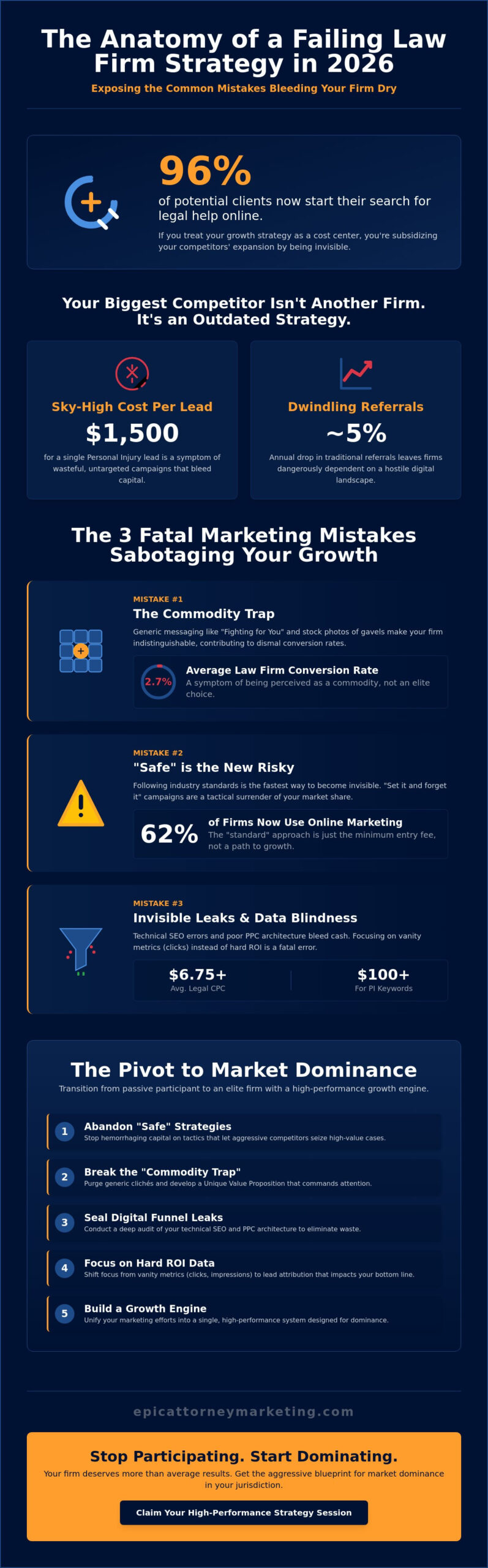
In 2026, your biggest competitor isn't the firm across the street; it's an outdated strategy bleeding your firm dry. While 96% of people with a legal issue now start their search online, most partners are still flushing capital down the drain on generic, low-impact campaigns. If you're struggling with a $1,500 cost per lead for personal injury cases or stagnant rankings, you're likely falling victim to common law firm marketing mistakes to avoid that keep you trapped as a commodity. Total market dominance isn't about spending more. It's about surgical precision.
You've likely noticed that traditional referrals are dropping by up to 5% annually, leaving you dependent on a digital landscape that feels increasingly hostile. It's exhausting to watch your ad spend vanish while aggressive competitors capture the high-value cases you deserve. This guide identifies the exact technical and strategic errors sabotaging your growth and provides the blueprint to pivot toward a dominant online presence. We'll break down the shift from wasteful targeting to hyper-local authority and AI-driven lead generation that ensures your firm doesn't just participate; it wins.
Key Takeaways
- Stop hemorrhaging capital on "safe" strategies that allow aggressive competitors to seize your market share and high-value cases.
- Break the "Commodity Trap" by purging the generic cliches that make your firm indistinguishable from every other practice in your jurisdiction.
- Seal the "invisible leaks" in your digital funnel by identifying common law firm marketing mistakes to avoid within your technical SEO and PPC architectures.
- Shift your focus from vanity metrics like clicks to the hard lead attribution data that actually dictates your firm's bottom-line ROI.
- Learn the five-step pivot required to transition from a passive market participant to an elite firm with a unified, high-performance growth engine.
Stop Bleeding Cash: The Strategic Cost of Common Law Firm Marketing Mistakes
Most managing partners view their marketing budget as a necessary evil. It's a line item on a P&L statement, grouped with rent and office supplies. This mindset is the foundation of the most common law firm marketing mistakes to avoid in a landscape where 96% of potential clients start their journey in a search bar. If you treat your growth strategy as a cost center rather than a high-yield revenue engine, you're essentially subsidizing your competitors' expansion. Passive marketing isn't just ineffective; it's a tactical surrender of your market share.
To better understand why traditional approaches are failing, watch this helpful video:
The history of legal advertising reveals a shift from simple directories to a hyper-aggressive digital arms race. In 2026, a "set it and forget it" campaign is a death sentence for your ROI. If you aren't actively optimizing for the shifts in search behavior and AI adoption, you're bleeding cash through invisible leaks in your digital funnel.
The High Price of Mediocrity
Average marketing efforts don't just yield average results; they often yield zero results. When you settle for "participation marketing," you're paying for the privilege of being ignored. Consider the opportunity cost. Every high-value lead that doesn't click your link because your presence is lackluster is a lead that funds your competitor’s next office. With average legal CPCs at $6.75 and personal injury keywords regularly exceeding $100 as of March 2026, there's no room for "good enough." You need an aggressive blueprint for law firm marketing that prioritizes market dominance over mere visibility.
Why "Safe" is the New Risky
Following industry standards is the fastest way to become invisible. In 2026, 62% of law firms are investing in online marketing. This means the "standard" approach is now the minimum requirement for entry, not a path to growth. If your firm relies on a basic website with generic copy, you're effectively hidden from high-stakes clients who demand authority. The market has moved toward hyper-local targeting and AI-integrated search experiences. Relying on "safe," outdated tactics isn't conservative; it's a high-stakes gamble with your firm's future. You don't need a vendor to manage your ads. You need a master strategist to dominate your jurisdiction.
The Commodity Trap: Why Generic Messaging Is Killing Your Conversion Rate
The Commodity Trap is a silent profit killer. It occurs when your firm’s messaging is indistinguishable from every other practice in your jurisdiction. In 2026, the average conversion rate for a law firm website is a dismal 2.7%. If your site relies on overused legal clichés like "Justice for All" or "Fighting for You," you're actively contributing to that low number. These phrases have become white noise. They don't build trust. Instead, they signal a lack of original strategy and creative lethargy. This is one of the most pervasive common law firm marketing mistakes to avoid if you want to attract high-value cases rather than price-shoppers.
Visual presentation is just as critical as your copy. Generic stock photos of gavels, scales, and marble columns scream "average." Premium clients don't hire average. They want elite representation. When your digital presence looks like a template, it suggests your legal strategy is a template too. To achieve total market dominance, you must establish a Unique Value Proposition (UVP) that commands attention immediately. If you can't explain why a client should choose you over the firm next door in ten seconds, you've already lost the lead.
Escaping the Sea of Sameness
Audit your current messaging with clinical objectivity. Does your content sound like a passive service provider or a master strategist? Most firms fail because their practice area pages are merely lists of services. They explain the law instead of selling a solution. High-performance law firm website design is about more than aesthetics; it’s about building an authority engine. Your site must communicate that you don't just participate in your field. You dominate it. If your brand feels stagnant, it's time to reconstruct your brand identity for maximum market impact.
Psychological Triggers of Elite Branding
Elite branding uses bold, declarative language to build instant psychological trust. It doesn't ask for permission to lead. In 2026, high-end UI/UX and custom photography are non-negotiable requirements for growth. Since 84% of potential clients read online reviews before choosing a lawyer, they are already looking for proof of superiority. Your branding must confirm that proof. Move away from weak phrases like "We can help" and pivot toward aggressive, results-oriented statements. This shift in tone resonates with high-achieving clients who are weary of mediocre results and looking for a partner as ambitious as they are. Stop being a vendor. Start being the obvious choice.
Technical Failure: How Invisible SEO and PPC Errors Sabotage Your Growth
You’re likely hemorrhaging revenue through cracks you can't even see. While most partners obsess over the color of their logo, the backend of their digital presence is often a graveyard of broken redirect chains and unoptimized schema. These invisible technical errors are the common law firm marketing mistakes to avoid if you intend to scale past your current plateau. A visually stunning website that fails to load under two seconds or lacks mobile responsiveness is nothing more than a digital paperweight. In 2026, search engines and users alike have zero patience for technical incompetence.
Technical failure extends beyond your website's code into your lead generation funnel. If your site isn't optimized for "near me" searches, which have surged 42% in the last two years, you are effectively invisible to local prospects. This isn't just about "doing SEO." It's about ensuring your infrastructure can support the weight of a dominant market position. For firms looking to strengthen their technical foundation beyond marketing, Telx Computers offers valuable guidance on maintaining high-performance IT systems. If your site speed is lagging, your bounce rate will skyrocket, and your ROI will vanish before you even get a chance to pitch a client.
The SEO Ceiling: Why You Are Stuck on Page Two
Page two of Google is where potential cases go to die. Many firms fall into the trap of churning out generic "content for the sake of content." They produce thousands of words that no one reads and search engines ignore because the underlying technical foundation is weak. High-performance growth requires a law firm SEO strategy that prioritizes site architecture and high-authority backlink building over vanity blog posts. If your technical SEO is flawed, your content will never break through the ceiling to reach high-intent prospects who are ready to hire.
PPC Pitfalls: Burning Your Ad Budget
Stop treating Google Ads like a high-stakes slot machine. One of the most expensive errors in legal marketing is sending paid traffic to a generic homepage. When you pay upwards of $100 per click for personal injury keywords, forcing a lead to search for a contact form is tactical suicide. Every PPC campaign must be surgically aligned with a dedicated landing page designed for one thing: conversion.
- Broad-Match Keywords: These attract "pro se" tire-kickers who drain your budget without ever signing a retainer.
- Negative Keyword Neglect: Failing to filter out irrelevant searches is a guaranteed way to waste ad spend on low-quality traffic.
- Intent Mismatch: Bidding on informational keywords when you need transactional leads results in high traffic but zero revenue.
Scaling requires precision. If your campaigns aren't built on a foundation of data-driven technical excellence, you aren't investing; you're gambling. It's time to stop the bleed and start building an engine that actually performs.
Data Blindness: The Fatal Error of Ignoring Lead Attribution and ROI
Guesswork is a luxury your firm cannot afford. If you can't point to the specific marketing dollar that generated your last signed retainer, your strategy is built on sand. This level of data blindness is among the most common law firm marketing mistakes to avoid. Most firms operate in a fog. They throw capital at multiple channels and hope for the best. Hope is not a strategy. In 2026, the firms that dominate are the ones that treat their data with clinical precision. Failing to track ROI is a fatal oversight that compounds other common law firm marketing mistakes to avoid.
Operating without granular lead attribution means you're likely over-investing in dead ends and starving your winners. You must calculate the Lifetime Value (LTV) of every client to understand what you can actually afford to pay for acquisition. If you don't know that a specific lead source yields a massive return over several years, you'll never have the confidence to outbid the competition for premium cases. You're essentially flying blind in a storm.
Vanity Metrics vs. Revenue Reality
A million impressions mean nothing if your bank account is stagnant. Many agencies hide behind "vanity metrics" like clicks, likes, and page views to mask a lack of actual revenue. These are distractions. You need a "Command Center" view of your firm's performance that tracks every lead from the first touchpoint to the final signature. If your marketing partner isn't talking about ROI and conversion metrics, they aren't a partner. They're a vendor selling you smoke. You need to audit your lead attribution model to ensure every cent is working toward a signed contract.
Closing the Loop: Marketing Meets Intake
Marketing doesn't stop at the lead. It stops at the signature. One of the most catastrophic errors is driving high-intent traffic to a firm that doesn't answer the phone or follow up within minutes. In 2026, 84% of potential clients read reviews before choosing a lawyer. If your intake team is slow, cold, or disorganized, you're burning your marketing budget at the finish line. You must identify where the leak is: is the marketing failing to generate quality, or is the intake process failing to close? Data-driven firms don't rely on gut feelings to answer this question. They use hard numbers to fix the leak and scale their dominance.
Transitioning from Participation to Dominance: Building a High-Performance Marketing Engine
Identifying the common law firm marketing mistakes to avoid is merely the diagnostic phase of your firm's evolution. To actually win, you must transition into the surgical phase. In 2026, the firms that achieve 10x growth aren't those with the biggest budgets; they are the ones with the most integrated engines. A fragmented approach where one vendor handles your SEO and another manages your PPC is a tactical error that leads to data silos and wasted capital. Dominance requires a unified strategy where every digital asset works in concert to crush the competition.
To stop the bleed and start the scaling process, your firm must execute a precise five-step pivot:
- Technical Decontamination: Seal the invisible leaks in your SEO and PPC architectures immediately.
- Brand Reconstruction: Purge the generic cliches and establish an elite, authoritative Unique Value Proposition.
- Unified Integration: Synchronize your design, content, and paid traffic into a single, high-conversion loop.
- Attribution Mastery: Deploy granular tracking to identify exactly which channels drive signed cases.
- Aggressive Scaling: Reinvest your savings from eliminated waste into high-performing, high-intent keywords.
The Unified Marketing Strategy
An aggressive growth strategy doesn't treat SEO, PPC, and website design as separate tasks. They are components of a single, relentless machine. Your PPC data should inform your SEO content strategy. Your website design must be surgically optimized to convert the high-cost traffic your ads generate. Continuous optimization and clinical A/B testing are the only ways to stay ahead as search behavior evolves. If you aren't constantly refining your digital presence, you are falling behind. Positioning your firm as the undeniable leader in your practice area requires a level of tactical sophistication that most vendors simply cannot provide.
Your Next Move: The Market Dominance Audit
Stop settling for mediocre results from agencies that treat your growth as a side project. Achieving total market dominance requires a fundamental mindset shift. You must view your marketing as a high-stakes strategic operation rather than a creative exercise. The firms that will own the market in the late 2020s are making data-driven decisions today. They are identifying their vulnerabilities and pivoting before the competition realizes what happened. Don't wait for your lead volume to drop further before you take action. Your next move is to Contact Epic Attorney Marketing to build your high-performance engine. Audit your firm's current strategy before your competitors do it for you.
Claim Your Market Dominance Starting Today
The margin for error in legal marketing has vanished. As we've detailed, technical leaks, generic messaging, and data blindness are the most expensive common law firm marketing mistakes to avoid if you intend to scale. Your firm's growth depends on a fundamental shift from a passive participant to an aggressive market leader. You don't need another vendor; you need an elite strategic partner who prioritizes signed cases over vanity metrics. Success in 2026 requires a unified engine that converts high-intent traffic into high-value clients with clinical precision.
At Epic Attorney Marketing, we bring over a decade of elite legal marketing experience to high-growth firms. Our specialized focus ensures that every strategy is backed by hard data and a relentless focus on ROI. It's time to stop the bleed and start the scaling process. You've seen the blueprint for market dominance; now it's time to execute. Your competitors are already moving. Make sure you're the one leading the charge.
Stop settling for average and dominate your market, get your Epic Audit today.
Frequently Asked Questions
What is the most common marketing mistake law firms make in 2026?
The most prevalent error is viewing marketing as an administrative expense rather than a high-yield investment. Many firms fall into common law firm marketing mistakes to avoid by settling for participation marketing that merely checks boxes. In 2026, if you aren't aggressively optimizing for market dominance, you're effectively subsidizing your competitors' growth. Stop treating your budget like a bill and start treating it like a tactical weapon.
How do I know if my law firm website is leaking leads?
Low conversion rates and high bounce rates are the primary indicators of a leaking funnel. With the average law firm website conversion rate sitting at just 2.7% as of March 2026, any technical friction or slow load times will drive prospects to your competitors. If your phone isn't ringing despite high traffic, your site architecture or messaging is failing to close the deal. You need a clinical audit of your digital infrastructure.
Why is my law firm SEO not producing high-value cases?
Most law firm SEO fails because it targets traffic volume instead of transactional intent. Ranking for broad informational terms might increase your vanity metrics, but it won't sign high-value cases. To dominate, you must focus on high-intent keywords and hyper-local targeting. If your content doesn't position you as a master strategist who solves specific, high-stakes problems, you'll remain trapped on page two while aggressive competitors seize the leads.
Can I handle my law firm marketing in-house to avoid mistakes?
You can try, but an in-house team rarely matches the specialized expertise of an elite strategic partner. High-performance marketing requires deep mastery of technical SEO, PPC architecture, and UI/UX design. Most in-house staff become overwhelmed by the sheer volume of tactical shifts in 2026. This often leads to common law firm marketing mistakes to avoid, such as data blindness and fragmented strategies that fail to scale or produce measurable ROI.
How much should a law firm spend on marketing to avoid being outspent by competitors?
Industry data shows larger firms with 20 or more attorneys invest 4-8% of revenue in marketing, while smaller firms typically spend 2-4%. However, the total dollar amount matters less than the precision of the spend. You shouldn't aim to match your competitor's budget; you should aim to outperform their ROI. Precision targeting and superior conversion rates allow you to seize market share without needing to outspend every firm in your jurisdiction.
What is the difference between a marketing vendor and a strategic partner?
Vendors perform chores while strategic partners drive growth. A vendor will sell you a blog post or a PPC campaign as a standalone product. A strategic partner integrates every channel into a unified, high-performance engine designed for total market dominance. You don't need a vendor to manage your tasks. You need a master strategist who is just as ambitious about your firm's expansion and financial returns as you are.
How do I fix a generic UVP that makes me look like every other lawyer?
Start by purging every legal cliché from your website and collateral. Words like "Justice" or "Compassionate" are white noise to premium clients who want results. Replace them with bold, declarative statements that highlight your specific competitive advantages and measurable success. Your Unique Value Proposition must sell a solution to a high-stakes problem in under ten seconds. If your messaging doesn't command immediate attention, you're just another commodity.
What metrics should I actually care about in my law firm marketing reports?
ROI and lead attribution are the only metrics that truly matter for your firm's growth. Clicks, impressions, and page views are vanity metrics that often mask a lack of actual revenue. You should focus on cost per lead and, more importantly, cost per signed case. If your marketing reports don't show a direct line from ad spend to a signed contract, you're flying blind. Demand hard data that proves your marketing is a revenue engine.